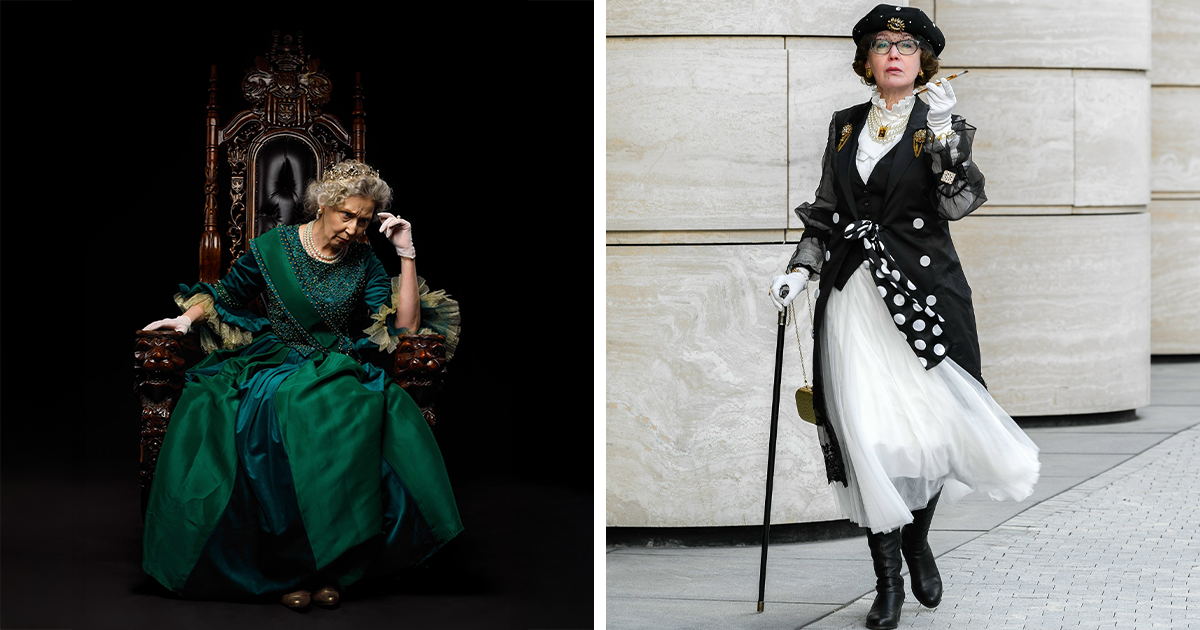
Some people retire and take up gardening. Some learn watercolor. Some become absolute legends with a needle, thread, a closet full of fabric, and enough imagination to make a museum curator whisper, “Wait, did she just step out of a fairy tale?” That is the magic behind Marina Badianova, a self-taught cosplayer whose incredible cosplays have charmed people across the internet.
Her work is not the usual quick costume you grab five minutes before a party, then spend the evening explaining because nobody recognizes it. Badianova creates rich, theatrical looks inspired by history, folklore, books, films, fairy tales, vintage fashion, and steampunk fantasy. Each outfit feels like a tiny story: a noblewoman pausing in a forest, a mysterious traveler with a cane, a queen in green velvet, a wise grandmother from an old legend, or a character who looks ready to offer you tea and possibly a prophecy.
The viral appeal is obvious. These are not just costumes. They are handmade worlds. In a culture where cosplay often celebrates anime heroes, comic book icons, video game warriors, and blockbuster characters, Badianova’s work stands out because it feels timeless. Her cosplays are not shouting for attention. They invite you closer, adjust their lace collar, and say, “There is a story here. Sit down.”
Who Is Marina Badianova?
Marina Badianova is known online as a creative older cosplayer from St. Petersburg who makes her own costumes and works with photographers to bring each character to life. Earlier features described her as a 58-year-old grandmother who had already created dozens of looks inspired by steampunk, history, folklore, and fairy tales. Later collections continued to show her growing portfolio, proving that creativity does not come with an expiration date stamped somewhere near the elbow.
What makes her especially compelling is the handmade nature of the work. Badianova is a self-taught seamstress, and her costumes are often described as hand-stitched with simple tools. That detail matters. In cosplay culture, craftsmanship is part of the performance. A costume is not only judged by how glamorous it looks in a photo, but also by how carefully the creator transforms raw materials into something believable, wearable, and expressive.
Her inspiration reportedly comes from memories, books, films, children’s stories, and imagined scenes. That explains why her cosplay photos feel less like product shots and more like illustrations from an old storybook. She does not merely wear an outfit. She becomes the person who might have worn it.
Why These Incredible Cosplays Surprise People
The surprise is not only that Badianova makes elaborate costumes. Plenty of cosplayers do that, and some of them could probably build a dragon out of foam, glue, and caffeine by sunrise. The surprise is how much personality each of her looks contains.
Many of the 39 pictures associated with her newer cosplay collection show a remarkable range: royal gowns, bonnets, parasols, floral headpieces, vintage hats, walking sticks, dramatic capes, layered shawls, medieval-inspired dresses, steampunk outfits, fairy-tale silhouettes, and historical clothing details. Some images place her in forests or snow. Others use interiors, old streets, garden settings, or dramatic studio backdrops. The result is a gallery that feels like a costume drama wandered into a fantasy convention and decided to stay for snacks.
The best cosplay is not about looking expensive. It is about looking intentional. Badianova’s looks work because every element appears to support the character: the pose, facial expression, jewelry, textile texture, color palette, hat shape, prop choice, and location. A cane is not just a cane. A basket is not just a basket. A bonnet is not just something your great-aunt would insist is “practical in spring.” In her photos, accessories become clues.
Cosplay Is Costume, Performance, and Storytelling
Merriam-Webster defines cosplay as dressing up as a character from fiction, such as a comic book, video game, television show, or related imaginary world. But in practice, cosplay has grown far beyond a dictionary entry. It is costume design, character acting, fandom, photography, crafting, performance, and sometimes mild panic when the hot glue gun runs out at 2 a.m.
Cosplay has deep roots in fan culture. Long before the word became common, science fiction fans were dressing up at conventions in the 1930s. The term “cosplay” itself is linked to the Japanese shortening of “costume play,” and today it describes a global creative movement. At major U.S. events such as San Diego Comic-Con, Anime Expo, Dragon Con, WonderCon, and New York Comic Con, cosplay is not a side activity. It is often one of the main attractions.
That context helps explain why Badianova’s work resonates. She is participating in a tradition that celebrates transformation. But instead of copying only popular modern characters, she leans into atmosphere. Her work blends historical costuming, folklore, fantasy, and original character energy. She may not always be portraying a single instantly recognizable franchise figure, yet each look feels like it belongs to a character you want to know.
The Craftsmanship Behind the Magic
One reason cosplay fans appreciate handmade work is that costume construction is hard. It involves design, measuring, sewing, fitting, fabric selection, prop styling, makeup, wig work, weather planning, movement testing, and the ancient ritual of discovering that something looks perfect while standing still but turns into a fabric octopus when you try to walk.
Badianova’s costumes show an eye for silhouette. Many of her looks use historical shapes: full skirts, fitted bodices, lace collars, layered sleeves, dramatic hats, long shawls, and textured outerwear. These choices give the viewer an immediate sense of time and mood. A narrow waist, a high collar, or a carefully placed brooch can signal an era or personality before the caption says a word.
Texture is another secret weapon. Velvet, lace, faux fur, embroidery, patterned fabric, beads, ribbons, and weathered materials make the costumes feel tactile. You can almost hear the fabric rustle. That is important because cosplay photography often depends on visual richness. The viewer cannot touch the costume, so the image must make the material feel alive.
Details That Make Her Cosplays Memorable
Her strongest images often include three ingredients: a clear character type, an expressive pose, and a setting that supports the story. A forest setting can turn a dress into folklore. A throne can turn a gown into royalty. A snowy landscape can turn a shawl and cup into a scene from a winter legend. A city street can make a vintage outfit feel like a character escaped from a novel and is late for a mysterious appointment.
Props also help. Parasols, baskets, books, staffs, cups, canes, flowers, puppets, and even animals add personality. They give the character something to do, which helps the cosplayer avoid the dreaded “standing like a mannequin who just remembered taxes” pose. Badianova’s photos often feel active even when she is still because the pose suggests thought, movement, or emotion.
Why Age Makes the Story Even Better
It would be easy to frame Badianova’s success as surprising only because she is older, but that would miss the point. The real story is not “older woman does cosplay.” The real story is “artist keeps creating, learning, dressing up, imagining, performing, and refusing to let age boss her around like a rude stage manager.”
Cosplay communities often celebrate the idea that anyone can become a character, regardless of age, body type, background, gender, or skill level. Badianova embodies that spirit beautifully. She challenges the lazy assumption that play belongs only to young people. In her work, play is serious business. It is also joyful business, dramatic business, and occasionally “where did she find that hat?” business.
Her popularity also reflects a broader cultural hunger for creative role models who do not fit the usual influencer template. She is not relying on trends alone. She is building a body of work through patience, craft, imagination, and collaboration with photographers. That feels refreshing in an internet environment where many things are optimized to disappear after twelve seconds.
The Role of Photography in Her Cosplay Success
A cosplay costume can be stunning in person, but photography decides how it travels online. Badianova’s images are successful because they frame her costumes as scenes. Lighting, background, composition, color, and posture all work together. The camera does not simply document the outfit. It completes the illusion.
That is especially important for historical and fairy-tale cosplay. A superhero costume may only need a bold pose and a recognizable logo. A folklore-inspired character needs mood. It needs atmosphere. It needs the feeling that something happened just before the photo was taken and something stranger may happen right after.
Many cosplay photographers understand this deeply. They look for locations that match the character’s world, whether that means a convention hallway, a wooded path, an old building, a dramatic staircase, or a simple wall with the right light. Badianova’s photos often benefit from this kind of visual storytelling. The image becomes a collaboration between maker, performer, photographer, and setting.
Why Handmade Cosplay Still Matters in a Buy-It-Now World
Today, anyone can buy a ready-made costume online. That is convenient, and there is nothing wrong with it. Not every fan has the time, budget, sewing machine, storage space, or emotional stamina to make an outfit from scratch. However, handmade cosplay carries a different kind of charm.
When someone makes a costume by hand, the final look contains choices. Why this shade of green? Why this trim? Why this sleeve length? Why this weathered edge? Handmade work shows the creator’s interpretation. It is not just imitation. It is translation.
Badianova’s work feels powerful because it has that handmade signature. Her costumes do not look like they came sealed in plastic with a size chart that hurt everyone’s feelings. They look lived-in, personalized, and designed for the character she wants to portray. That gives the photos emotional weight.
Cosplay, Respect, and the “Cosplay Is Not Consent” Rule
Any discussion of cosplay culture should also mention etiquette. Cosplayers may dress as fictional characters, but they are real people. Convention communities increasingly emphasize the rule “cosplay is not consent,” which means people should not touch cosplayers, grab props, take close-up photos, or make rude comments without permission.
This matters online, too. When a cosplay photo goes viral, viewers should remember that there is a person behind the image. Praise the craftsmanship. Appreciate the artistry. Share with respect. Do not reduce the creator to age, body type, gender, or assumptions. The best fandom spaces are built on enthusiasm and consent, not entitlement.
Badianova’s work deserves that kind of respectful attention. Her photos are fun, but they are also evidence of labor. Every fold, stitch, prop, and pose took time. Complimenting that effort is far more meaningful than simply reacting with surprise.
What Creators Can Learn From Marina Badianova
For beginners, Badianova’s cosplay journey offers several useful lessons. First, start with inspiration that actually moves you. If a character, era, or story makes your imagination itch, follow it. Good cosplay begins with curiosity.
Second, details matter, but perfection is not required. A costume does not need to be museum accurate to feel magical. It needs coherence. Choose a color story, a silhouette, a prop, and a mood. Then build around them.
Third, performance matters as much as fabric. A simple outfit can become memorable with the right expression and pose. Ask: Who is this character? Are they shy, proud, mysterious, wicked, kind, tired, royal, mischievous, or about to sell you a suspicious potion? Let the answer guide your body language.
Fourth, collaboration can elevate the work. A photographer, makeup helper, prop maker, or supportive friend can turn a costume into a finished visual story. Cosplay may start at the sewing table, but it often blossoms in community.
Why the Internet Loves These 39 Pics
The internet loves transformation. It loves before-and-after reveals, hidden talents, unexpected hobbies, and people who casually prove that creativity has no deadline. Badianova’s cosplay gallery checks all those boxes, but it also offers something warmer: sincerity.
There is no cynical gimmick in her work. The costumes feel joyful. They feel like the result of someone asking, “What if I became this character for a moment?” and then actually doing it. That sincerity is contagious. Viewers are not only impressed by the photos. They are encouraged by them.
In a world that often tells adults to be practical, efficient, serious, and allergic to whimsy, Badianova’s work is a friendly rebellion. It says imagination is not childish. It is human. Sometimes it wears a bonnet. Sometimes it wears a crown. Sometimes it carries a cane and looks ready to defeat boredom in single combat.
Personal Experiences and Reflections on Incredible Cosplays
There is something uniquely memorable about seeing an incredible cosplay in person. A great costume can stop a crowd without anyone raising their voice. You might be walking through a convention center, half-lost, holding an overpriced pretzel, and suddenly a person dressed as a warrior queen or forest witch passes by. For a second, the concrete hallway disappears. The fluorescent lights become stage lights. Everyone turns their head. That is the power of cosplay done well.
What makes a cosplay unforgettable is rarely only accuracy. Accuracy is impressive, of course. When someone recreates armor, embroidery, jewelry, or a complex hairstyle down to the tiniest detail, it deserves applause and maybe a hydration break. But emotional accuracy matters just as much. The best cosplayers capture the feeling of a character. They know how the character stands, looks, gestures, and occupies space. That is why Marina Badianova’s work feels so compelling. Her costumes are beautiful, but her expressions and poses are what make them breathe.
Anyone who has tried costume-making understands how quickly a “simple idea” becomes a full diplomatic negotiation with fabric. You begin with confidence. You buy material. You sketch a design. Then the sleeves start acting like independent governments. The hat refuses physics. The trim costs more than expected. The glue betrays you. And yet, when the outfit finally comes together, the frustration becomes part of the story. Wearing a handmade costume feels different because you know every hidden seam and every small victory.
That is why viewers respond so strongly to handmade cosplays. They can sense effort even if they do not know the technical details. A carefully chosen button, a weathered prop, a hand-sewn hem, or a perfectly matched shawl tells the audience that someone cared. Badianova’s cosplays have that caring quality. They look built from affection, not from a desire to chase a trend.
Her work also reminds people that creativity can be wonderfully practical and wonderfully impractical at the same time. On one hand, sewing teaches patience, problem-solving, measurement, material knowledge, and repair skills. On the other hand, the final goal may be to look like a fairy-tale aristocrat holding a basket in the snow. That combination is delightful. It proves that useful skills do not always need boring outcomes.
For people who want to begin cosplaying, her example is encouraging. You do not need to start with a giant armored suit, a mechanical wing system, or a wig taller than your refrigerator. You can begin with one character idea, one thrifted garment, one handmade accessory, or one dramatic photo concept. Cosplay grows through practice. The first attempt may be uneven, but every creator learns by making things that are almost right.
The deeper experience of cosplay is not just being seen. It is seeing yourself differently. A shy person may discover confidence in a cape. A quiet maker may find community through a shared fandom. An older creator may remind younger fans that imagination is lifelong. A beginner may learn that the best way to start is not to wait until everything is perfect, but to make something anyway.
That is the real charm behind “This Woman Surprises People With Her Incredible Cosplays.” The photos are lovely, but the message is better: you are allowed to keep becoming. You are allowed to play, craft, invent, and transform at any age. And if anyone tells you otherwise, simply put on an enormous hat, pick up a cane, stare into the middle distance like the heroine of a forgotten legend, and continue being fabulous.
Conclusion
Marina Badianova’s incredible cosplays are more than pretty outfits in a photo gallery. They are proof that imagination ages beautifully when it is used often. Through hand-stitched costumes, expressive poses, rich accessories, and storybook settings, she turns cosplay into wearable storytelling. Her work celebrates history, folklore, fantasy, and personal creativity while reminding viewers that art does not belong to one generation.
Whether she appears as a queen, wanderer, wise woman, steampunk character, fairy-tale figure, or elegant vintage heroine, Badianova brings warmth and personality to each look. The 39 pics are not just surprising because the costumes are detailed. They are surprising because they feel alive. That is the mark of great cosplay: it makes the viewer believe, even for a moment, that the character has stepped out of another world and into ours.
For fans, makers, and curious readers, her work offers a simple invitation: keep creating. Keep experimenting. Keep playing. The thread may tangle, the hat may wobble, and the first photo may catch you blinking like a confused owl, but the magic is worth it.