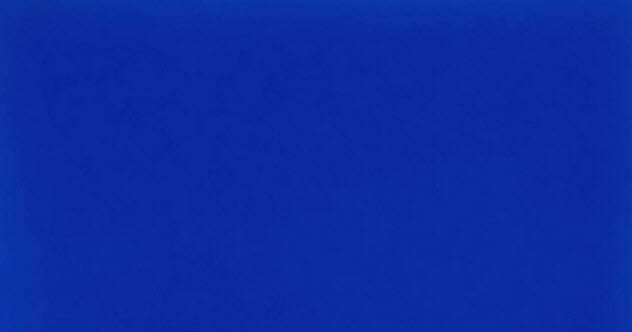
Welcome to the wonderfully irrational corner of the art world, where a canvas that looks “simple” can sell for more than a mansion, a beach house, and probably the neighbor’s boat too. Monochrome art has a funny reputation: some people see a deep philosophical statement, others see a wall that forgot to put on pants. Either way, the market has spoken, and the market has yelled in all caps.
The truth is that one-color paintings are not about doing less because the artist ran out of ideas. They are about reduction, intensity, scale, surface, and the nerve to ask whether color alone can carry emotion, meaning, and presence. In the hands of the right artist, one color is not “just one color.” It becomes atmosphere, theology, architecture, silence, pressure, and occasionally a reason someone at an auction house starts sweating into a very expensive suit.
What Counts as a One-Color Painting Here?
For sanity, this list uses a practical definition: monochrome and near-monochrome paintings whose identity is built around one dominant color. That means a razor-thin stripe, a subtle tonal shift, or even a slash in the canvas does not disqualify the work. If anything, those tiny interruptions are often the entire point. This article also focuses on publicly reported auction results rather than private sales, and it uses the auction totals as reported at the time of sale, with no inflation adjustment and no exchange-rate gymnastics.
So yes, this is a real list about real art, real prices, and very real sums that could buy a house in most American cities with enough money left over for furniture, snacks, and perhaps a small existential crisis.
Top 10 One-Color Paintings Worth More Than Your House
1. Barnett Newman, Black Fire I $84,165,000
If you want the poster child for “How is that worth so much?” this is it. Barnett Newman’s Black Fire I is a towering black painting interrupted by one of his signature vertical “zips.” It looks severe, solemn, and absolutely uninterested in explaining itself. That seriousness is part of the appeal. Newman’s work helped define postwar American abstraction, and collectors treat major examples like cultural monuments, not decoration. At this price, it is not competing with your house. It is competing with a neighborhood.
2. Barnett Newman, Onement VI $43,800,000
A huge blue field split by a lighter stripe should not, on paper, cause bidding wars. And yet Onement VI did exactly that. The painting has become one of the best-known examples of how monochrome and near-monochrome abstraction can dominate a room through scale and confidence alone. Newman’s genius was turning apparent emptiness into an event. Stand in front of a work like this, and it stops feeling like a blue rectangle and starts feeling like weather.
3. Barnett Newman, Onement V $30,920,000
Yes, Newman appears again. No, that is not a clerical error caused by someone staring too long into a color field. Onement V sold for the same price as Brice Marden’s Complements, which tells you something important: the market sees the monochrome tradition as a serious lane, not a quirky side road. Newman’s Onement paintings are foundational works in Abstract Expressionism and Color Field painting. In plain English, they helped rewrite the rules for what a painting could be.
4. Brice Marden, Complements $30,920,000
Brice Marden is often described as restrained, which is a polite art-world way of saying he knew how to make quiet feel expensive. Complements is a two-panel work whose pared-down surfaces still carry a remarkable amount of visual pressure. Marden’s monochrome and near-monochrome paintings are beloved because they are both intellectual and sensuous. They are rigorous without being cold, and spare without being empty. Think less “blank wall” and more “meditation with a trust fund.”
5. Lucio Fontana, Concetto spaziale, La Fine di Dio $29,173,000
Fontana’s famous punctured and slashed surfaces are a reminder that monochrome art is not always smooth and silent. Sometimes it gets stabbed, elegantly. La Fine di Dio is a single-color work that turns the surface into something cosmic and unstable. Fontana was obsessed with space, literally and conceptually, and his monochrome paintings use cuts and perforations to break the old boundary between painting and actual space. The result is both minimalist and dramatic, which is a very profitable combination.
6. Frank Stella, Point of Pines $28,082,500
Frank Stella’s early Black Paintings changed the conversation around modern painting by pushing repetition, flatness, and structure to the front of the stage. Point of Pines is a black painting that looks machine-sharp, cool, and oddly musical. Stella once became famous for the line “what you see is what you see,” but that should not fool you into thinking the work is shallow. The painting’s power comes from its discipline. It is one color doing push-ups.
7. Robert Ryman, Bridge $20,605,000
Robert Ryman made white paintings so persistently and so brilliantly that he essentially bullied the art world into admitting white can be endless. Bridge sold for more than $20 million because Ryman was never really “just painting white.” He was painting surface, support, edges, light, hardware, and the whole physical condition of painting itself. In his hands, white becomes a laboratory. It also, apparently, becomes a luxury asset.
8. Yves Klein, California (IKB 71) €18,375,000
No list about one-color paintings would feel complete without Yves Klein, the high priest of blue. His patented International Klein Blue turned monochrome painting into an immersive experience. California (IKB 71), a massive blue work, proved that Klein’s market still has serious muscle. Part of his enduring appeal is that his monochromes are never merely flat blue objects; they are declarations. Klein wanted viewers to feel color as something boundless, not decorative. He basically took “blue mood” and supersized it into an art-historical event.
9. Robert Ryman, Untitled $11,680,000
Another Ryman, because once collectors fall for a major white painting, they really fall. This Untitled work from the early 1960s sits close to the heart of Ryman’s mature language. The surface appears modest at first glance, but that modesty is deceptive. The brushwork, material decisions, and edge behavior are exactly what make these paintings matter. Ryman invites slow looking, which is a useful skill in an age when most people give art about two seconds before scrolling away.
10. Frank Stella, Sharpeville $11,625,000
Another Stella, another reminder that black paintings are not some niche side quest in art history. Sharpeville belongs to the body of early work that helped bridge Abstract Expressionism and Minimalism. Its restrained palette does not make it emotionally empty. Instead, it makes every structural decision louder. Stella’s monochromes feel like design, architecture, and painting all got locked in a room together and came out with expensive opinions.
Why Do Collectors Pay So Much for Monochrome Art?
Scarcity Matters
There are not many museum-level monochrome paintings by artists like Newman, Ryman, Klein, Fontana, and Stella floating around the market. Once a major example lands in a top collection or museum, it often stays there for decades. When one does come up for sale, bidders know they may not get another shot any time soon.
Art History Matters Even More
These paintings are not expensive because they are simple. They are expensive because they changed painting. Monochrome art pushed modernism toward questions of pure color, pure surface, and pure presence. It stripped away storytelling and forced viewers to confront painting itself. That may sound nerdy, but in the art market, being historically important is like having beachfront property with perfect zoning.
Presence Beats Reproduction
One-color paintings often look underwhelming on a phone screen. In person, they can be thunderous. Scale, texture, edge quality, light absorption, and the artist’s exact handling of paint all matter. A reproduction turns a Ryman into a JPEG. The real thing turns a wall into a philosophical encounter.
Provenance, Condition, and Myth
Collectors are not only buying pigment on canvas. They are buying the artist’s place in history, the work’s exhibition trail, its former owners, and its role in a movement. In other words, the painting is not just an object. It is a story with paperwork, and the paperwork is wildly persuasive.
What These Paintings Really Prove
The biggest lesson from these sales is not that rich people have strange hobbies, though that remains a strong possibility. It is that visual restraint can carry enormous cultural weight. A one-color painting asks a very bold question: what happens when you remove almost everything and still expect the viewer to feel everything? The best monochromes answer that question with scale, conviction, and a surface so charged that it makes silence feel loud.
That is why these paintings keep commanding serious money. They are not decorative leftovers from modernism. They are some of the clearest examples of art betting everything on one idea and somehow winning.
Extended Experience: What It Feels Like to Stand in Front of a One-Color Painting
Reading about monochrome paintings is one thing. Standing in front of one is another species of experience entirely. On a laptop, a black painting can look like a printer problem. In a gallery, it can feel like a wall-sized pause button for your brain. That gap between reproduction and reality explains a lot of the price gap too. People are not paying millions for a thumbnail. They are paying for presence.
The first surprise is usually scale. A painting you imagined as a tidy little rectangle turns out to be enormous, the kind of object that does not merely hang on the wall but occupies the room like a second architecture. A Barnett Newman can feel less like a painting and more like a vertical force field. A Robert Ryman can seem to glow and recede at the same time, which is frankly rude behavior for white paint.
The second surprise is texture. Monochrome paintings are often sold as pure ideas, but they are also deeply physical things. Yves Klein’s blue can look powdery, velvety, and almost airborne. Fontana’s slashes turn a flat surface into a wound, a doorway, and a joke about how two-dimensional painting maybe was never enough to begin with. Stella’s black paintings reveal precision so crisp that they start to feel engineered. What seemed emotionally cold from a distance starts to look fiercely intentional up close.
Then there is the weird time effect. Narrative paintings tell you where to look: here is the hero, here is the battle, here is the horse doing horse-related drama. Monochromes do not give you that map. You have to slow down, look longer, and let tiny differences start doing heavy lifting. A slightly warmer band of black. A brushstroke that catches light differently. A soft edge where your eye expected a hard one. It is not flashy. It is cumulative. The painting wins by making your attention more precise.
That is also why these works can feel oddly personal. Not personal in a confessional sense, but personal in the way silence is personal. The painting does not offer much chatter, so your mind fills the room with its own weather. One person sees calm. Another sees pressure. Another sees transcendence. Another sees an expensive rectangle and mutters something about interior paint. Fair enough. But even that reaction proves the point: monochrome art is never as neutral as it pretends to be.
There is a final irony here that makes the whole subject more fun. The more a painting removes, the more viewers argue about what is left. That argument is part of the experience. A one-color painting becomes a test of patience, perception, ego, taste, and sometimes your willingness to admit that the thing you laughed at five minutes ago is now weirdly haunting you. That is a good trick. It is also a rare one.
So when a monochrome painting sells for the price of multiple homes, the headline may sound absurd, and honestly, it is a little absurd. But in person, the absurdity starts to make emotional sense. These paintings are not trying to impress you with complexity. They are trying to overwhelm you with concentration. One color. One field. One idea taken all the way to the wall. Sometimes that is enough to change art history. And apparently, it is enough to vaporize a mortgage too.
Conclusion
Monochrome painting is the ultimate high-risk move in modern art. Strip away the imagery, ditch the storytelling, reduce the palette, and you are left with nowhere to hide. That is exactly why the best one-color paintings remain so powerful. They are uncompromising, memorable, and impossible to ignore once you actually stand in front of them. Whether the dominant hue is black, blue, white, yellow, or something in between, these works prove that less can do far more than most people expect. Sometimes less can even sell for more than your house, your block, and your entire annual budget for common sense.