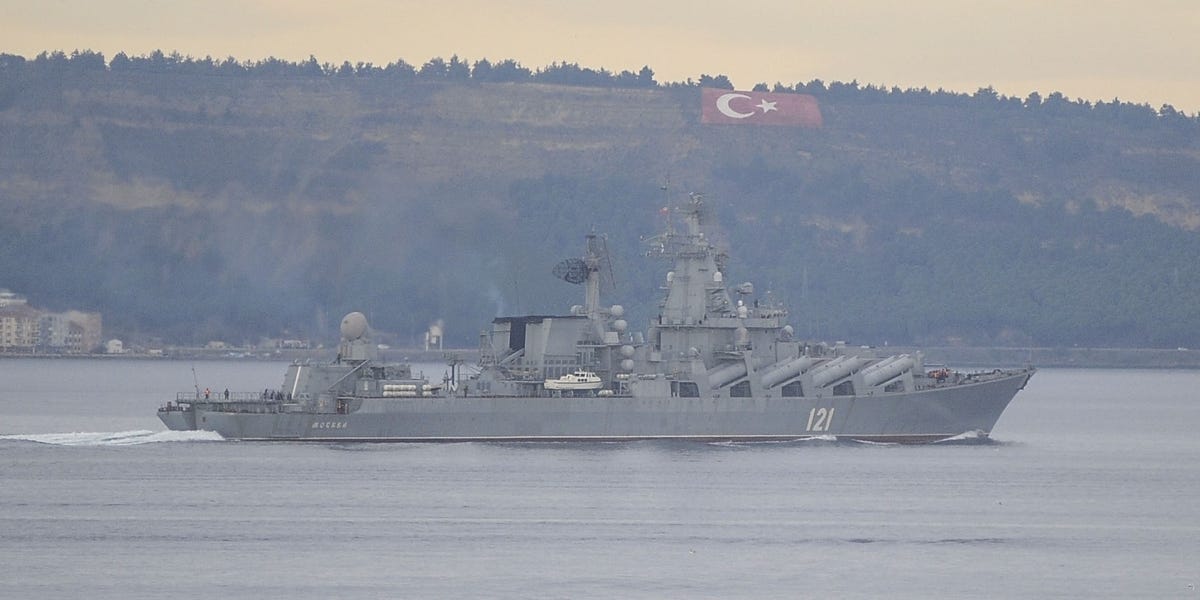
When the Russian cruiser Moskva sank in the Black Sea in April 2022, it was not just another headline in a war already packed with shock, confusion, and late-night push alerts. It was a naval earthquake. The flagship of Russia’s Black Sea Fleet, a huge Soviet-era guided-missile cruiser named after Moscow itself, went from symbol of power to symbol of vulnerability in a matter of hours.
Ukraine said it struck the ship with domestically produced Neptune anti-ship missiles. Russia first said a fire had caused ammunition to explode, then said the damaged vessel sank while being towed in stormy seas. U.S. officials later supported Ukraine’s account, saying the cruiser had been hit by Ukrainian missiles. Whatever Moscow’s preferred version, the result was impossible to spin away: one of Russia’s most important warships was gone.
The sinking of the Moskva became one of the most dramatic moments of the Russia-Ukraine war. It carried military weight, psychological force, and historical symbolism. It also delivered a hard lesson to every navy watching from afar: in modern warfare, even a heavily armed cruiser can become a very expensive lesson in humility.
What Was the Moskva?
The Moskva was a Slava-class guided-missile cruiser built during the Soviet era. Originally named Slava, it entered service in the early 1980s and was later renamed Moskva, meaning “Moscow.” The ship was large, heavily armed, and designed for Cold War naval confrontation. It carried anti-ship missiles, surface-to-air missiles, guns, radar systems, and command capabilities.
In plain English, the Moskva was not a small patrol boat having a bad Tuesday. It was a major naval platform, a floating command symbol, and the flagship of Russia’s Black Sea Fleet. Its presence was meant to project authority across the Black Sea, protect other vessels, and support Russia’s military campaign against Ukraine.
The ship also had symbolic baggage. Early in Russia’s full-scale invasion of Ukraine, the Moskva was linked to the Snake Island incident, when Ukrainian defenders famously rejected a Russian demand to surrender. That phrase became a rallying cry for Ukrainian resistance. So when the same warship later sank, the symbolism was so obvious it practically wrote its own headline.
How Did Ukraine Sink the Russian Cruiser Moskva?
According to Ukraine, its forces struck the Moskva on April 13, 2022, using Neptune anti-ship missiles. The Neptune is a Ukrainian-made coastal defense missile system designed to target naval vessels. For Ukraine, a country without a traditional blue-water navy able to match Russia ship-for-ship, this was a textbook example of asymmetric warfare: do not fight the giant by copying the giant; find the giant’s weak ankle.
Russia’s first explanation was different. Moscow said a fire had broken out aboard the cruiser, causing ammunition to detonate. Later, Russian officials said the ship sank while being towed to port in rough weather. That account did not convince many outside observers, especially after U.S. defense officials said the vessel had been hit by Ukrainian missiles.
The exact tactical details remain a subject of military analysis, but the broad story is clear enough. A country with a much smaller navy used land-based missile capability to destroy or disable one of the most valuable ships in Russia’s Black Sea arsenal. It was David versus Goliath, except David had coastal radar, anti-ship missiles, and excellent timing.
Why the Sinking Mattered Militarily
The loss of the Moskva mattered because the cruiser was not just a prestige object. It provided air-defense coverage and command value for Russian naval operations in the Black Sea. Without it, Russia had to rethink how close its ships could safely operate near Ukraine’s coast.
Before the sinking, Russia’s navy appeared to enjoy a major advantage in the Black Sea. Ukraine’s conventional navy had been badly weakened after Russia’s seizure of Crimea in 2014, and Russia entered the 2022 invasion with more ships, more firepower, and more naval infrastructure. On paper, that looked like a mismatch. On water, the story became more complicated.
The destruction of the Moskva showed that Russia’s fleet could be threatened even without Ukraine possessing a large surface fleet of its own. That changed the risk calculation. Russian ships could still launch missiles and support operations, but moving near Ukraine’s coastline became a more dangerous business.
A Huge Symbolic Blow to Russia
Military hardware matters, but symbolism matters too. The Moskva was named after Russia’s capital. It was the Black Sea Fleet flagship. It had appeared in Russian naval messaging for years. Losing it during an invasion that Russia expected to dominate was deeply embarrassing for Moscow.
For Ukraine, the sinking became proof that Russia could be hurt in places it considered secure. It boosted morale at a time when Ukrainian cities were under attack and the outcome of the war was uncertain. The message was simple: Russia might have more ships, but Ukraine could still land a punch big enough to echo around the world.
For international observers, the incident raised questions about Russian readiness, damage control, air defense, crew training, and command culture. A warship of that size does not sink every day. When one does, analysts start sharpening pencils, opening maps, and asking uncomfortable questions.
Largest Warship Sinking Since World War II?
The title “largest warship sinking since World War II” needs careful wording. The Moskva is widely described as one of the largest warships lost in combat since World War II and the largest Russian warship sunk in wartime since that period. It was also larger than many vessels lost in more recent conflicts, including the Argentine cruiser General Belgrano, sunk during the 1982 Falklands War.
However, naval history is full of technical debates. Experts may compare displacement, combat status, cause of sinking, and whether a vessel was destroyed in battle, by accident, or under disputed circumstances. Still, the Moskva sinking clearly belongs in the top tier of modern naval losses. It was rare, dramatic, and historically significant.
For SEO readers searching “Ukraine sinks Russian cruiser Moskva,” “Moskva largest warship sinking since WWII,” or “Russian cruiser Moskva sunk,” the key takeaway is this: the sinking was not only a battlefield event; it was a once-in-generations naval shock.
What the Moskva Sinking Revealed About Modern Naval Warfare
1. Expensive Ships Are Not Invincible
The Moskva was armed, important, and imposing. Yet modern anti-ship missiles changed the equation. The sinking reminded navies that even powerful surface ships can be vulnerable if detection, defense, and damage control fail.
2. Smaller Forces Can Use Smart Asymmetry
Ukraine could not match Russia’s fleet in a traditional ship-to-ship contest. Instead, it used coastal defense systems, intelligence, mobility, and timing. This became a pattern in the war: Ukraine repeatedly found ways to offset Russian advantages through adaptation and innovation.
3. The Black Sea Became a Laboratory
The war turned the Black Sea into a test case for twenty-first-century maritime conflict. Missiles, drones, surveillance, electronic warfare, coastal defense, and information warfare all collided in the same space. The Moskva was the biggest early example, but not the last.
Ukraine’s Broader Black Sea Strategy
After the Moskva sank, Ukraine continued targeting Russian naval power in the Black Sea through a mix of missiles, drones, and strikes on infrastructure. Over time, Russian naval operations became more cautious. Some vessels shifted farther from Ukraine’s coast. Crimea, once treated by Russia as a secure rear base, increasingly came under pressure.
This mattered for more than military pride. The Black Sea is tied to Ukraine’s economy, grain exports, global food supply chains, and regional security. If Russia could dominate the sea completely, it could squeeze Ukraine’s ports and pressure world markets. By contesting Russian control, Ukraine helped reopen space for trade and complicated Moscow’s plans.
The sinking of the Moskva did not magically end Russia’s naval threat. Russia still had ships, missiles, aircraft, and coastal positions. But the sinking changed the tone. It proved that the Black Sea Fleet could be damaged, deterred, and forced to adapt.
Information Warfare: Two Stories, One Sunken Ship
The Moskva sinking also became a case study in wartime messaging. Ukraine framed the event as a successful missile strike and a historic victory. Russia framed it as an onboard accident followed by sinking during a tow. The difference between those stories was not small; it was the difference between “our enemy hit us” and “our ship had a terrible workplace incident.”
Information warfare is not just propaganda posters and dramatic speeches. It is the struggle to define what happened, why it happened, and what it means. In this case, international reporting, U.S. assessments, satellite imagery discussions, and later analysis all leaned strongly toward Ukraine’s account that missiles played the decisive role.
For readers, the lesson is simple: in war, the first explanation is not always the final explanation. Official statements can be incomplete, defensive, or designed to buy time. Facts often emerge slowly, like a very serious puzzle with worse lighting.
The Human Side of the Sinking
Even when discussing warships, missiles, and strategy, it is important to remember that ships have crews. The Moskva reportedly carried hundreds of sailors. Casualty numbers were disputed, and Russia released limited information. Families of crew members sought answers, and public uncertainty added another painful layer to the event.
A serious article should not treat the sinking like a video game achievement. It was a military victory for Ukraine and a major loss for Russia, but it was also a deadly event involving real people. The strategic impact matters. So does the human cost.
This is one reason the Moskva story remains powerful. It sits at the intersection of history, technology, propaganda, grief, and national morale. That is a lot for one ship to carry, even before it became a wreck on the Black Sea floor.
Why the Moskva Still Matters Today
Years after the sinking, the Moskva remains a reference point for military analysts and historians. It is often mentioned in discussions of naval vulnerability, Ukraine’s innovation, Russia’s operational problems, and the changing balance of power in the Black Sea.
The event also shaped how other countries think about maritime defense. Coastal nations watched closely. So did major navies. The message was uncomfortable but valuable: large ships need layered protection, disciplined crews, reliable sensors, and realistic assumptions. Prestige does not float by itself.
For Ukraine, the sinking became part of a broader story of resistance. For Russia, it became a symbol of overconfidence and costly miscalculation. For the world, it became one of the defining naval episodes of the twenty-first century.
Experiences and Reflections: What the Moskva Story Teaches Beyond the Headlines
The story of the Moskva feels different depending on where you stand. For a Ukrainian citizen watching the news in April 2022, the sinking may have felt like a rare moment of oxygen in a terrifying period. Cities were under attack, families were displaced, and the future looked frighteningly uncertain. Then came the news that Ukraine had struck the flagship of Russia’s Black Sea Fleet. It did not end the war, but it proved that the invader was not untouchable.
For a military analyst, the experience was more technical but no less dramatic. The sinking forced a fresh look at old assumptions. Large surface combatants had long been symbols of national power. They still are. But modern missiles, drones, surveillance systems, and coastal defenses have made the operating environment far more dangerous. The Moskva became a floating case study in what happens when confidence outruns preparation.
For journalists, the event was a reminder of how hard it is to report war in real time. One side claimed a missile strike. The other side blamed fire and weather. Images appeared online. Some were false. Some were unclear. Officials spoke carefully. Analysts filled gaps with probability, not certainty. The experience showed why responsible reporting matters: speed is useful, but accuracy is the life jacket.
For ordinary readers far from the Black Sea, the sinking offered a crash course in maritime warfare. Many people had not thought about cruisers, anti-ship missiles, fleet flagships, or naval air defense since high school history class, assuming high school history class even got that far before the bell rang. Suddenly, terms like “Neptune missile” and “Black Sea Fleet” became search trends. A distant naval event became part of everyday conversation.
There is also a lesson about symbols. The Moskva was not just steel, radar, and weapons. It was named after Moscow. It represented Russian naval prestige. Its loss carried emotional force because symbols matter in war. They can strengthen morale, damage confidence, and shape public memory. Ukraine understood that. Russia understood it too, which is why the competing narratives were so intense.
Finally, the Moskva reminds us that history does not always move like a neat textbook chapter. Sometimes it arrives as a breaking-news alert, a grainy photo, a disputed statement, and a thousand analysts saying, “Well, this changes things.” The sinking did not decide the war by itself. But it changed the naval conversation, boosted Ukrainian morale, embarrassed Russia, and showed how innovation can challenge brute force.
That is why the story still matters. It is not only about a ship that sank. It is about how a smaller defender found a way to strike a larger power where it hurt. It is about the limits of intimidation. And, perhaps most importantly, it is about the modern battlefield’s favorite hobby: making yesterday’s assumptions look very silly by breakfast.
Conclusion
The sinking of the Russian cruiser Moskva was one of the most important naval events of the Russia-Ukraine war. It removed a major Russian warship from the Black Sea, damaged Moscow’s prestige, strengthened Ukrainian morale, and forced military experts around the world to rethink assumptions about modern naval warfare.
Ukraine’s successful strike showed how coastal defense, intelligence, and determination can challenge a larger navy. Russia’s loss showed that even powerful vessels can be vulnerable when technology, tactics, and readiness collide. The Moskva went down as more than a ship; it became a historical marker in the changing nature of war at sea.
In the end, the Black Sea did what history often does: it turned a single event into a lesson. And the lesson was loud enough for every navy to hear.