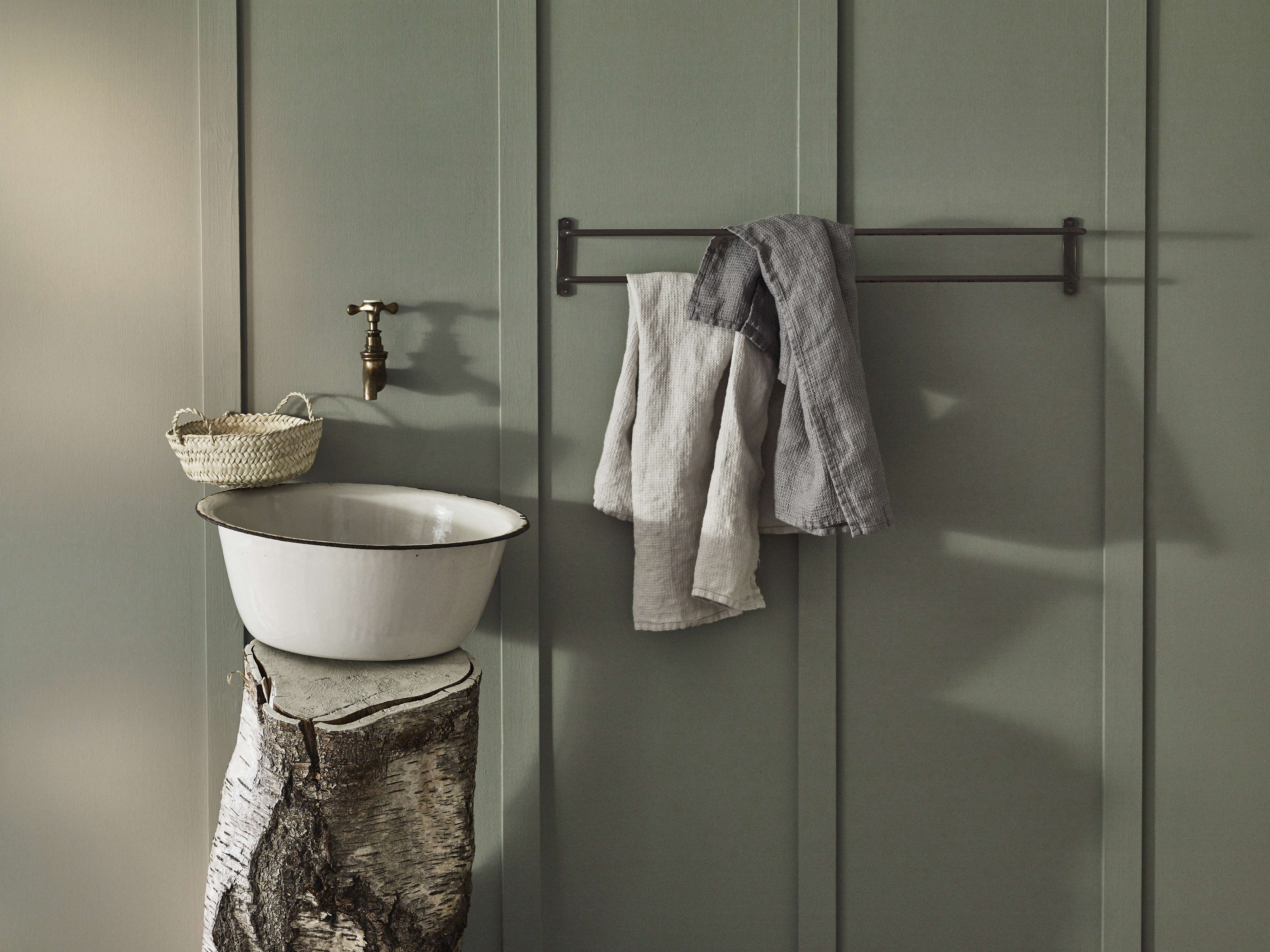
A beautiful bathroom rarely succeeds because of one spectacular bathtub or a heroic slab of marble. More often, the magic happens in the smaller decisions: the towel ring that feels satisfyingly solid, the mirror with just enough age in its finish, the bath caddy that holds soap without looking like it escaped from a plastic storage aisle. Rowen & Wren understands this quieter side of luxury exceptionally well.
The British homeware brand’s Bilton bathroom collection became a design favorite for its restrained vintage character, combining practical forms with solid brass, brushed finishes, exposed screws, simple wirework, and proportions that feel comfortably familiar rather than aggressively fashionable. When the collection was introduced to a wider design audience in 2018, pieces included a bathroom mirror, toothbrush holder, bath caddy, towel rails, towel ring, shelf, soap dish, toilet-roll holder, and towel rack. The collection has since continued to evolve, with Rowen & Wren still offering Bilton bathroom accessories in finishes such as antique brass, matt nickel, and blackened brass.
The result is what might be called vintage luxe: not a bathroom dressed like a Victorian movie set, but a modern room given warmth, texture, and a believable sense of history.
Why Vintage-Luxe Bathroom Design Still Feels Fresh
Traditional bathroom design has remarkable staying power because it is built on familiar materials and useful objects rather than one-season visual tricks. Marble, painted wood, warm metals, framed mirrors, freestanding tubs, classic tile, and substantial hardware can be mixed in countless ways. Current American design guidance continues to favor these timeless ingredients, particularly when historic references are balanced with modern functionality.
That balance is where Rowen & Wren’s bathroom accessories earn their keep. The pieces do not scream, “Behold, I am vintage!” There are no unnecessary flourishes, fake rust, or decorative scrolls attempting to recreate a mysterious manor house that never existed. Instead, the collection relies on material, weight, proportion, and finish.
This matters because the most convincing traditional bathrooms usually avoid overcommitting to a theme. A room can have a pedestal sink, an antique brass towel ring, a contemporary shower, and a crisp white wall and still feel coherent. In fact, many designers now recommend mixing old and new rather than filling a space with matching reproduction pieces. Vintage mirrors, patinated metals, art, wallpaper, and classic hardware can provide character while modern plumbing and storage keep daily life civilized.
The Bilton Collection: Traditional Character Without the Clutter
The Mirror That Sets the Tone
A bathroom mirror occupies serious visual territory, so it has more influence than its job description suggests. The Bilton bathroom mirror uses a simple square form with gently curved corners, a solid-brass frame, a hanging chain, and a visible wall plate with exposed screws. Those details create the impression of an object assembled rather than anonymously manufactured.
That distinction is important in a vintage-inspired bathroom. Large frameless mirrors can be useful, but a framed mirror behaves more like furniture or decoration. It gives the wall a focal point and introduces another material into what is often a room dominated by tile, porcelain, and glass. Current bathroom design advice frequently recommends replacing generic sheet mirrors with framed or characterful alternatives when the goal is a more timeless interior.
Placed above a compact console sink or painted vanity, a brass-framed mirror can do the decorative work of several smaller accessories. Add a pair of restrained wall sconces and suddenly the toothbrush has a much more distinguished address.
The Bath Caddy: Luxury That Actually Has a Job
The Bilton bath caddy is perhaps the collection’s clearest expression of functional luxury. Made from solid brass with a brushed finish, its wire-frame construction includes shallow and deeper areas for items such as soap, bottles, or bathing accessories. A curved arm hooks over the edge of the tub, while the open structure helps wet contents dry rather than marinate in a tiny puddle.
It also illustrates a useful design principle: luxury does not have to mean excess. A bath caddy can improve the experience of using a tub without requiring a remodel, new plumbing, or a contractor arriving at 7:12 a.m. with three radios and six opinions about grout.
On a freestanding tub, the brass caddy becomes part of the room’s visual composition. On a more conventional built-in bath, it adds warmth and gives everyday products a designated place. The effect is especially appealing when the rest of the room is simple: white tile, warm wood, linen towels, and perhaps one excellent candle rather than seventeen tiny jars of mystery salts.
Towel Rails, Rings, and Racks: The Supporting Cast Matters
Bathroom hardware is often selected late in a project, which is unfortunate because people touch it constantly. Rowen & Wren’s Bilton towel pieces use solid brass, curved corners, visible wall plates, and exposed fixings. Current versions include short towel rails, towel rings, double rails, and larger towel racks in several finishes.
The appeal comes partly from visual consistency. A towel ring beside the basin, a longer rail near the bath, and a toilet-roll holder with related detailing can make the room feel intentional without making everything perfectly identical. Major American bath brands and design retailers also emphasize coordinated accessories because repeated details help connect the functional zones of a bathroom.
For small bathrooms, wall-mounted hardware is particularly valuable. It keeps towels, paper, and toiletries accessible while preserving counter and floor space. A beautiful hook or rail can therefore serve two roles at once: storage and decoration. That is efficient design, and the bathroom loves efficiency almost as much as it loves pretending nobody owns a toilet brush.
Soap Pumps and Toothbrush Holders That Reduce Visual Noise
One of the fastest ways to make a carefully designed bathroom look chaotic is to cover the sink with brightly branded packaging. A refillable metal soap dispenser and a substantial toothbrush holder solve a surprisingly large visual problem.
Bilton toothbrush holders are made from solid brass and use a simple cylindrical form with a rolled edge, while the collection’s refillable soap pumps offer another way to replace disposable packaging with something more permanent. The designs are deliberately understated, allowing the finish and material to provide the character.
This approach works particularly well in traditional interiors because it makes the everyday objects feel like part of the room rather than temporary clutter placed on top of it.
The Power of Antique Brass, Matt Nickel, and Blackened Brass
Finish can completely alter the personality of bathroom hardware. Antique brass introduces warmth and looks particularly comfortable beside marble, cream tile, dark wood, green paint, and aged mirrors. Matt nickel feels quieter and slightly cooler, making it useful in bathrooms that combine traditional forms with a lighter, more contemporary palette. Blackened brass adds definition and can create a stronger architectural outline against pale walls.
These deeper, softer metal finishes also fit a broader move toward hardware with patina and material character. Recent American design coverage has highlighted burnished brass, dark bronze, oxidized finishes, and handcrafted metalwork as alternatives to flat, overly uniform surfaces. Designers often value finishes that can develop character rather than remaining visually frozen forever.
The key is restraint. Antique brass becomes more convincing when it appears in a few repeated places rather than on every object that can legally be plated. A mirror frame, towel rail, faucet, and small accessory may be enough. The room still needs visual breathing space.
How to Create a Rowen & Wren-Inspired Traditional Bathroom
Start with a Calm Architectural Background
Vintage-luxe accessories are easiest to appreciate against materials that are relatively quiet. Consider warm white walls, subway tile, marble, limestone, painted paneling, or small-scale traditional floor tile. These backgrounds provide enough texture to feel interesting without competing with the hardware.
A black-and-white floor, for example, can introduce historic character while brass adds warmth. American design publications continue to use this combination because it is graphic, familiar, and flexible enough to work with both old and new furnishings.
Choose One Dominant Metal Finish
Mixing metals is allowed; the design police have other paperwork. However, a small bathroom often looks calmer when one finish clearly leads. Antique brass might appear on the mirror, towel ring, and faucet, while a secondary metal is used only for a light fixture or door hardware.
Repeating a finish at several heights helps distribute it around the room. A brass mirror at eye level, a towel rail lower on the wall, and a bath caddy near the tub create a visual rhythm. This prevents one isolated gold-toned object from looking as though it wandered into the wrong bathroom.
Mix Refined Pieces with Humble Materials
Vintage luxe works best when everything is not trying to be luxurious at once. Pair solid-brass accessories with simple linen towels. Place a fine mirror above an old painted vanity. Combine marble with a woven basket. Add one framed print rather than turning the bathroom into a miniature auction house.
Current bathroom design coverage frequently recommends bringing in objects usually associated with other rooms, including art, vintage mirrors, decorative lighting, textiles, and small furniture. These additions make the bathroom feel lived in rather than purely technical.
Let Functional Objects Become the Decoration
A well-designed towel rack does not need another object hanging beside it to justify its existence. A beautiful soap dish does not require a decorative sign reminding visitors to “relax.” The strongest traditional bathrooms often allow useful objects to carry the style.
This is one reason the Bilton collection feels sophisticated. A wire shelf remains a shelf. A towel ring remains a towel ring. The design interest comes from the curve of the metal, the visible fixings, the finish, and the sense of craftsmanship.
Why the Look Works Especially Well in Small Bathrooms
Small bathrooms can benefit disproportionately from high-quality accessories because there are fewer objects competing for attention. In a powder room, a distinctive mirror, wall-mounted towel ring, refillable soap dispenser, and carefully chosen light fixture may be enough to establish an entire design direction.
Designers often treat compact bathrooms as opportunities for stronger personality, using vintage details, wallpaper, patterned tile, artwork, and characterful fixtures without overwhelming a larger living space.
The practical advantage is equally important. Wall-mounted rails and shelves free up surfaces. A compact towel ring places a hand towel exactly where it is needed. A proper mirror becomes decoration and equipment simultaneously. In a small room, every object should ideally earn its square inches.
Traditional Appeal Without Turning the Bathroom Into a Museum
The danger with vintage-inspired interiors is obvious: too many historical references can make a room feel staged. The solution is to use traditional accessories as accents rather than instructions.
A contemporary walk-in shower can coexist with antique brass. A modern vanity can sit beneath a chain-hung mirror. Clean white tile can support a blackened-brass towel rack. The contrast is often what makes the old-fashioned details feel fresh.
Leading bath manufacturers continue to revisit historic forms while integrating modern performance, demonstrating that traditional style does not require outdated functionality. Bridge faucets, classic silhouettes, solid-brass accessories, and heritage-inspired detailing are regularly paired with current plumbing technology and modern layouts.
In other words, you may admire the past without volunteering to bathe by candlelight because the electrical grid has not been invented yet.
Care, Patina, and the Reality of Living with Metal Accessories
Aged and brushed finishes are appealing partly because they are less visually sterile than mirror-polished metal. They may also change subtly with use, moisture, cleaning habits, and time. That is not necessarily a flaw; for many homeowners, the gradual development of patina is part of the attraction.
Rowen & Wren advises gentle cleaning for its Bilton brass accessories, using a soft damp cloth and avoiding harsh chemicals and abrasives when preserving the finish is important. Similar care is sensible for many specialty metal finishes.
In practical terms, this means bathroom cleaning should not resemble an industrial decontamination exercise. Check the manufacturer’s instructions before reaching for aggressive products, especially on decorative metal finishes.
The 500-Word Experience: What a Vintage-Luxe Bathroom Feels Like to Use
The real test of a bathroom accessory is not the product photograph. It is Tuesday morning.
That is when the room is full of steam, somebody is late, the hand towel has mysteriously relocated, and three bottles are competing for one square inch of sink. In daily use, thoughtfully designed accessories begin to justify themselves in very ordinary ways.
A towel ring beside the basin means the towel has an obvious home. A wall-mounted rail prevents damp fabric from collecting on the edge of the tub. A refillable soap pump removes one more disposable bottle from the countertop. A bath caddy keeps bottles upright and gives soap a place to drain. None of these improvements is dramatic by itself, but together they change the rhythm of the room.
There is also a sensory difference between lightweight accessories and substantial metal pieces. A solid-brass holder has weight. A properly mounted rail feels secure in the hand. A brushed finish catches light softly rather than flashing like a showroom appliance. These small tactile details contribute to the perception of quality because the user experiences them repeatedly, often several times a day.
Visually, the greatest benefit may be calm. Bathrooms naturally accumulate clutter because nearly everything used there is small: toothbrushes, razors, soap, skincare, cotton swabs, towels, brushes, and mysterious sample bottles that apparently reproduce overnight. When the permanent accessories are coherent, the room maintains some order even when daily life becomes less than magazine-ready.
Imagine a modest bathroom with white tile, a dark painted vanity, and a simple tub. Replace the anonymous mirror with a brass-framed one. Add a matching towel ring, a refillable soap pump, and a wire bath caddy. The room has not been renovated, yet its personality changes. The new pieces create points of warmth and establish a visual language that says traditional without requiring a clawfoot tub, antique plumbing, or an emergency purchase of floral wallpaper.
The experience is equally effective in a larger bathroom, where accessories can prevent the space from feeling empty or hotel-like. A substantial towel rack, framed mirror, bath caddy, and well-placed hooks create layers at human scale. They make a large room feel occupied and usable rather than merely photographed.
Perhaps the most appealing part of vintage-luxe design is that it can improve with imperfection. A slightly rumpled linen towel looks appropriate. A warm metal finish does not demand laboratory conditions. An old stool, vintage rug, framed sketch, or handmade ceramic cup can join the composition without ruining a perfectly matched set. The bathroom begins to feel collected rather than installed.
That does not mean every antique-looking accessory is automatically a success. Poorly made reproductions can feel theatrical, and too many distressed finishes can turn charm into costume. The strongest approach is selective: invest in a few pieces with convincing materials and useful functions, then allow the rest of the room to remain straightforward.
Over time, this kind of bathroom can become more personal rather than more dated. Towels change. Artwork moves. A plant arrives and, depending on the owner’s horticultural abilities, may eventually depart. The hardware remains as a stable framework. That longevity is one of the most persuasive arguments for traditional design: it gives changing tastes something solid to work around.
Conclusion: Small Details, Lasting Character
Rowen & Wren’s approach to bathroom accessories demonstrates why traditional design continues to attract homeowners who want warmth without clutter and luxury without unnecessary spectacle. The Bilton collection relies on solid materials, restrained forms, useful storage, exposed construction details, and finishes that complement both historic and contemporary interiors.
The lesson extends beyond one brand or one collection. A bathroom can become more beautiful without becoming busier. Choose accessories that solve real problems. Let good materials provide the decoration. Repeat finishes thoughtfully. Mix vintage character with modern convenience. Most importantly, pay attention to the objects you touch every day. They may be small, but they are the parts of the room you actually live with.
Note: Product availability, finishes, specifications, and pricing can change over time, so current details should be confirmed with the retailer before purchasing.