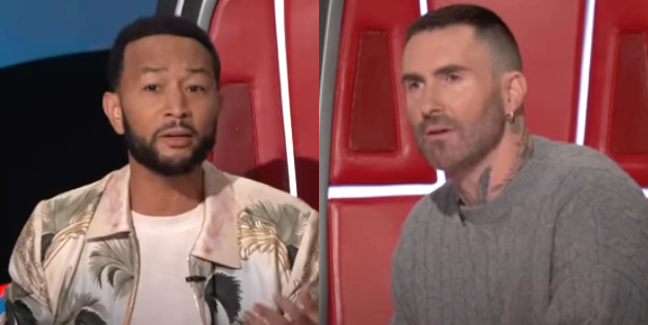
On The Voice, a chair turn is never just a chair turn. It is a declaration of war, a soft-launch of an artist-coach partnership, and occasionally the beginning of a comedy sketch nobody knew they needed. That is exactly what happened when John Legend and Adam Levine found themselves in a hilariously tense exchange during Season 27, after contestant Brook Wood delivered a moving Blind Audition that had the coaches leaning forward, listening closely, and preparing their sales pitches like four musicians trying to win the last slice of pizza.
The moment quickly became one of those classic Voice scenes fans love: strong vocals, competitive coaching, playful interruption, and just enough friendly chaos to remind everyone that the red chairs are basically musical thrones with cupholders. Adam Levine, returning to the show after years away from the coaching panel, jumped into the conversation with the confidence of an original coach who knows the game. John Legend, however, was not about to let Adam politely redirect the room without a little interruption of his own.
The result was an epic exchange between John Legend and Adam Levine that showed why The Voice remains more than a singing competition. It is also a personality contest, a strategy game, and a weekly reminder that famous people can be very funny when someone threatens their team-building plans.
The Moment That Sparked the John Legend and Adam Levine Exchange
The exchange happened during the March 3 episode of The Voice Season 27, when Brook Wood performed a heartfelt version of Jelly Roll’s “Save Me.” Her audition impressed the panel, which included John Legend, Adam Levine, Kelsea Ballerini, and Michael Bublé. In the Blind Auditions, coaches cannot see the artist at first. They only hear the voice, which is the entire point of the format and also the reason everyone watching at home suddenly becomes a vocal coach from the couch.
John Legend turned his chair for Brook, clearly hoping to bring her onto Team Legend. Then Kelsea Ballerini also hit her button, creating a direct battle between Team Legend and Team Kelsea. That alone would have been enough tension for a good TV moment, but Adam Levine made it more interesting by appearing to support Kelsea’s case. Instead of simply praising Brook and sitting back, Adam began steering his feedback in a way that seemed designed to help Kelsea land the artist.
John noticed. Of course he noticed. This is John Legend we are talking about: EGOT winner, velvet-voiced strategist, and a man who can smile warmly while detecting a coaching ambush from three chairs away.
As Adam started making his point, John jumped in and reminded Brook that he was still very much present. Then came the playful line that fans latched onto: John essentially asked Adam whether he was finished talking. It was funny because it was polite, competitive, and just a little bit spicy. Not hot-sauce spicy. More like “someone moved my Grammy and I have questions” spicy.
Why the Exchange Worked So Well on Television
The best reality TV moments are rarely the loudest. They are the ones where personality, timing, and stakes meet in the middle. This John Legend and Adam Levine exchange worked because it had all three.
1. The Stakes Were Clear
Brook Wood was not simply another audition. Her performance had emotional weight, and her tone made the coaches believe she could become a serious contender. When multiple coaches turn, the contestant gets to choose a team. That means every coach has to move from listener to recruiter in seconds. The performance may be about music, but the aftermath is pure persuasion.
John had turned and wanted Brook. Kelsea had turned and wanted Brook. Adam, who did not turn for her in that moment, still used his influence to support Kelsea. That gave John a reason to step in. If the Blind Audition stage is a chessboard, Adam tried to move Kelsea’s queen, and John immediately checked the rulebook.
2. Adam Levine Knows the Game
Adam Levine was one of the original coaches when The Voice premiered in 2011. He coached for the first 16 seasons before stepping away in 2019, then returned for Season 27. That history matters because Adam understands the show’s rhythm: when to praise, when to tease, when to recruit, and when to cause just enough trouble to make the segment unforgettable.
His support for Kelsea was not random. Season 27 introduced Kelsea Ballerini as a full-time coach, while Adam returned as a familiar face with years of red-chair experience. By helping Kelsea in the moment, Adam came across like a veteran teammate giving the rookie coach a push. It was charming, but it was also inconvenient for John, who was trying to win the artist. In other words: great television.
3. John Legend’s Timing Was Perfect
John Legend has a calm presence on The Voice, but calm does not mean passive. He often uses warmth, musical knowledge, and direct feedback to connect with artists. In this exchange, he mixed all three with comedy. Instead of snapping at Adam or overplaying the rivalry, John interrupted with a smile and turned the moment into a punchline.
That balance is why fans responded. John did not need to shout. He only needed to make it clear that Adam’s helpful little Kelsea campaign had been noticed, recorded, and entered into the court of Team Legend.
Brook Wood’s Audition Was the Real Center of the Moment
As entertaining as the banter was, Brook Wood’s performance created the situation in the first place. Her song choice, “Save Me,” is built for emotional storytelling. It requires vulnerability, control, and the ability to make a familiar lyric feel personal. Brook brought enough feeling to make John turn and enough promise to make Kelsea join the race.
That is the beautiful trap of The Voice: when a contestant performs well, the coaches become both mentors and marketers. They do not just say, “Great job.” They explain why their team is the right artistic home. John could offer experience with soulful, expressive singers. Kelsea could offer country-pop instincts and a fresh coaching perspective. Adam could offer veteran insight, even if he used it like a mischievous campaign manager for someone else’s team.
Brook ultimately chose Team Kelsea, which made the exchange even funnier in hindsight. John’s interruption became a memorable moment, but Kelsea still got the artist. Somewhere in the distance, a red chair probably squeaked in sympathy.
The Coach Chemistry in Season 27
Season 27 had a particularly interesting coaching lineup. John Legend brought polished musicianship and years of Voice experience. Adam Levine returned with the credibility of an original coach and the restless energy of someone who missed the red-chair chaos more than he wanted to admit. Michael Bublé brought charm, classic vocal knowledge, and the confidence of a coach coming off a winning season. Kelsea Ballerini brought a fresh full-time presence, country-pop fluency, and the advantage of being underestimated by absolutely no one after the auditions began.
That mix gave the show a fun balance. John and Adam represented two different types of veteran coach. John is smooth, thoughtful, and precise. Adam is fast, playful, and competitive. When they collide, the comedy comes from contrast. John sounds like he is hosting a piano lounge where everyone gets excellent advice. Adam sounds like he has three ideas, two jokes, and one strategic trap ready before the applause ends.
Viewers enjoy that contrast because it makes the coaching panel feel alive. A show like The Voice needs strong singers, but it also needs coaches who create memorable reactions. The audience wants to hear great performances, but it also wants to see the coaches fight over talent like it is the final day of a musical fantasy draft.
Why Fans Love Coach Banter on The Voice
Coach banter has always been part of the identity of The Voice. Adam Levine and Blake Shelton famously built years of comic rivalry during the show’s early seasons. Their back-and-forth became part of the brand: friendly insults, exaggerated eye-rolls, and the kind of bromance that looked like it survived entirely on sarcasm and protein shakes.
With Blake no longer in the red chair, Adam’s return gave fans a chance to see how his competitive personality would work with a newer mix of coaches. The answer: very well, especially when John Legend is available to calmly roast him with good manners.
The John Legend and Adam Levine exchange felt natural because it did not seem mean. It was competitive, but not cruel. It was strategic, but not stiff. It allowed the show to keep moving while giving viewers a clip-worthy moment. In the age of short-form video, that matters. A great audition might bring viewers in, but a funny coach exchange gives them something to share, quote, and replay.
What the Exchange Reveals About John Legend as a Coach
John Legend’s coaching style is rooted in musical precision. He listens for tone, phrasing, emotional control, and the artist’s ability to tell a story through a song. He is also excellent at explaining why a vocalist should trust him. That makes sense: John is not just a performer; he is a songwriter, producer, and EGOT-winning artist with a deep understanding of how music connects to audiences.
In the Brook Wood moment, John’s reaction showed another part of his coaching identity: he is competitive, but he competes with elegance. His interruption was funny because it stayed within his personality. He did not suddenly become chaotic. He became strategically charming, which is arguably more dangerous.
For contestants, that kind of coach can be appealing. John’s pitch often feels personal and grounded. He does not need fireworks; he uses credibility. But when Adam tried to steer the room toward Kelsea, John proved he could still jump into the comedy lane and land the joke.
What the Exchange Reveals About Adam Levine as a Coach
Adam Levine’s return to The Voice reminded viewers why he was such a major part of the show’s early success. He brings speed, humor, and a slightly rebellious energy to the panel. He is not afraid to comment, tease, or push a conversation in a surprising direction. That can make him unpredictable, which is exactly what a reality competition needs after dozens of seasons.
Adam’s move to support Kelsea during Brook Wood’s audition also showed his awareness of the larger panel dynamic. He understood that helping Kelsea would create tension with John, and tension, when handled playfully, makes the segment better. Adam was not only reacting to the audition; he was shaping the room.
That is the difference between a good coach and a seasoned television personality. A good coach hears talent. A seasoned Voice coach hears talent, reads the panel, spots the storyline, and somehow turns a recruiting pitch into a comedy beat.
How This Moment Fits Into The Voice Formula
The format of The Voice is built for these exchanges. During the Blind Auditions, the coaches must decide based only on sound. If more than one coach turns, the singer chooses. That simple mechanic creates instant drama because the power shifts from celebrity to contestant. The coaches may have awards, hit records, and famous friends, but in that moment, the artist has the final word.
That power shift is why the post-audition pitch matters so much. Coaches highlight their strengths, tease each other’s weaknesses, and sometimes recruit on behalf of another coach just to stir the pot. The format turns musical evaluation into a live debate. It is part talent show, part mentorship program, and part Thanksgiving dinner where everyone sings better than your relatives.
The John Legend and Adam Levine exchange is a perfect example of the formula working. A strong singer created competition. Competition created banter. Banter created a memorable TV moment. And the contestant still got to choose her path.
Specific Examples of the Strategy Behind the Banter
One strategic layer was Adam’s decision to back Kelsea. Since Kelsea was a newer full-time coach, his support framed her as a serious option rather than the underdog. That could help a contestant feel more confident choosing her team. It also made Adam look generous, which is a smart move when he was reintroducing himself to viewers after time away from the show.
Another layer was John’s immediate reminder that Brook should not forget him. In a multi-chair situation, attention is everything. If one coach dominates the conversation, another coach can fade into the background. John refused to fade. His interruption re-centered his pitch without becoming aggressive.
A third layer was Kelsea’s benefit from the chaos. When two veteran coaches spar over your potential team, you suddenly look like the most interesting choice in the room. Brook choosing Kelsea after all that made the moment feel like a win for the newcomer coach and a funny loss for John, who delivered the line but did not land the artist.
Why the Clip Had Shareable Energy
The moment had all the ingredients of a shareable entertainment story: famous coaches, a talented contestant, a clean punchline, and a low-stakes rivalry. Nobody needed a long explanation to understand it. Adam was trying to help Kelsea. John wanted Adam to stop helping Kelsea. The audience laughed because the situation was instantly clear.
That clarity is powerful. In entertainment coverage, the best moments are often easy to summarize but fun to analyze. This one was both. It could be described in one sentence, but it also opened the door to talk about coach chemistry, competitive strategy, Adam’s return, John’s humor, and Kelsea’s growing confidence as a coach.
Experience Section: What Watching This Exchange Feels Like as a Viewer
Watching the John Legend and Adam Levine exchange feels like sitting in the front row of a very polite musical argument. At first, you are focused on Brook Wood’s voice. Her performance pulls the room into a serious mood, the kind where everyone stops checking snacks and starts pretending they understand vocal placement. Then the chairs turn, and suddenly the emotional audition becomes a strategic free-for-all.
For longtime viewers, Adam’s involvement probably felt familiar. He has always had a restless energy on The Voice, like he is two seconds away from making a joke, challenging another coach, or deciding that the entire room needs more Maroon 5 energy. His return brought back that classic spark. Even when he is not the main coach fighting for a contestant, he finds a way to influence the moment. It is part of his appeal. He treats the panel like a band rehearsal where everyone is talented, but someone still has to be the drummer causing trouble.
John’s response, meanwhile, is satisfying because it feels so completely John. He does not flail. He does not yell. He does not act shocked as if Adam has committed a federal crime against Team Legend. He simply steps in with calm comic timing and lets Adam know the campaign speech has gone on long enough. It is the kind of interruption that works because it is both classy and petty in the smallest, funniest way.
As a viewer, moments like this make The Voice feel less mechanical. Singing competitions can sometimes become predictable: audition, compliment, decision, applause. But when coaches reveal their personalities in real time, the show becomes warmer and more human. You see not just the polished celebrity image, but the competitive instincts underneath. John wants the artist. Adam wants to help Kelsea. Kelsea wants to win. Michael Bublé is nearby, probably charming everyone within a five-mile radius. The whole panel becomes a tiny ecosystem of ambition, humor, and musical taste.
The best part is that the exchange never overshadows Brook’s talent. Instead, it confirms it. Coaches do not bicker over an audition unless the artist gives them a reason. The banter becomes a compliment in disguise. If the panel is willing to interrupt, tease, and strategize, it means the singer has created a moment worth fighting for.
That is why fans remember scenes like this. They are not just funny clips; they are proof that a performance shifted the energy in the room. Brook Wood came in to sing. She left with two chair turns, a spot on Team Kelsea, and a coach exchange that gave viewers one of Season 27’s most entertaining little fireworks shows. Not bad for a few minutes on a stage, especially when the chairs are doing half the drama and Adam Levine is apparently available for freelance mischief.
Conclusion
The epic exchange between Voice coaches John Legend and Adam Levine worked because it captured the heart of the show: great singing, real competition, and coach chemistry that feels spontaneous. Brook Wood’s Blind Audition gave the panel a reason to react, Adam Levine’s playful support for Kelsea Ballerini raised the stakes, and John Legend’s perfectly timed interruption turned the moment into a fan-friendly highlight.
For viewers, it was a reminder that The Voice is at its best when the music and the personalities work together. The show may begin with a voice, but the memories often come from what happens after the chairs turn. In this case, the performance was emotional, the coaching battle was funny, and the John Legend-Adam Levine exchange proved that even after many seasons, those red chairs still know how to produce a little magic.