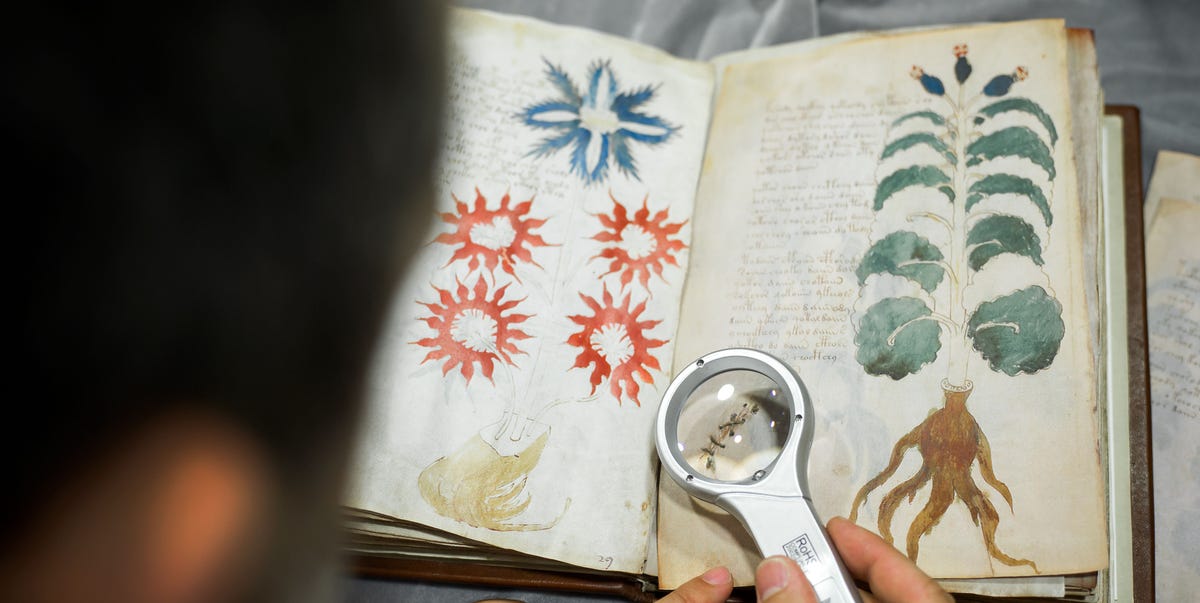
The Voynich Manuscript is the rare book world’s most charming troublemaker: old, beautiful, impossible to read, and apparently proud of it. It looks like a medieval handbook for herbalists, astrologers, pharmacists, bathhouse engineers, and people who enjoy drawing plants that seem to have escaped from another planet. Yet the real drama is not only in the pictures. It is in the writing, a flowing script often called “Voynichese,” which has resisted scholars, linguists, codebreakers, artificial intelligence tools, and generations of very confident people with magnifying glasses.
Named after rare-book dealer Wilfrid M. Voynich, who acquired it in 1912, the Voynich Manuscript is now housed at Yale University’s Beinecke Rare Book & Manuscript Library. It is cataloged as Beinecke MS 408 and remains one of the most studied undeciphered manuscripts in the world. Its pages contain botanical illustrations, zodiac diagrams, mysterious bathing scenes, pharmaceutical-looking jars, foldouts, stars, roots, pipes, and text that appears structured but refuses to give up its meaning. In other words, it is either a lost masterpiece, an elaborate cipher, a natural-language puzzle, a medieval intellectual experiment, or the most overachieving prank in book history.
What Is the Voynich Manuscript?
The Voynich Manuscript is an illustrated codex written on parchment, probably produced in Europe during the 15th century. The exact place, author, purpose, and language remain unknown. That uncertainty is the gasoline on the fire. Unlike many medieval books, which announce their intentions with saints, prayers, recipes, royal records, or medical instructions, this manuscript politely refuses to explain itself.
The book contains more than 200 pages, though some pages are missing. Many folios are filled with text written from left to right in an unknown script. The letters, or glyphs, look consistent enough to suggest a writing system rather than random scribbling. Words repeat. Patterns appear. Certain characters seem to prefer the beginning or ending of a word. Some pages are packed with paragraphs, while others include labels around drawings. The script behaves like language in some ways, but no one has convincingly identified what language it represents.
The manuscript is not simply strange because nobody can read it. It is strange because it looks so organized. A meaningless doodle book is easy to dismiss. The Voynich Manuscript is much harder to wave away because it has structure, recurring visual themes, and a scribal confidence that says, “Of course this makes sense. The problem is you.”
A Brief History of the Voynich Manuscript
Before Wilfrid Voynich
The early history of the manuscript is partly documented and partly foggy. One famous trail begins with a 17th-century letter from Johannes Marcus Marci, a Prague physician and scholar, to Jesuit polymath Athanasius Kircher. The letter indicates that the manuscript had once been associated with the court of Holy Roman Emperor Rudolf II, who was famous for collecting unusual scientific, magical, and artistic objects. That does not prove Rudolf owned it beyond all doubt, but it places the manuscript inside the kind of world where alchemy, astronomy, medicine, cryptography, and ambition all shared the same dinner table.
The manuscript also passed through the hands of figures connected with Prague’s intellectual circles. It was reportedly owned by Georg Baresch, an alchemist who was puzzled by it and sought help from Kircher. Later it moved into Jesuit collections. Then, like a magician slipping behind a curtain, it largely disappeared from view until the early 20th century.
Wilfrid Voynich and the 1912 Discovery
Wilfrid Voynich acquired the manuscript in 1912 from a collection connected with the Jesuit order near Rome. Voynich was a skilled dealer with a flair for mystery, and he promoted the book as a potentially earth-shaking discovery. For a time, one popular theory attributed the manuscript to Roger Bacon, the 13th-century English philosopher and friar. That theory helped create excitement, but modern scholarship has not accepted Bacon as the author.
After Voynich’s death, the manuscript passed through several hands before arriving at Yale. Since 1969, it has been preserved at the Beinecke Library, where high-resolution digital images have made it available to scholars and curious readers around the world. That online access has turned the Voynich Manuscript into a global puzzle table. Anyone with an internet connection can stare into its pages and join the centuries-long chorus of “Wait, what is this?”
What Do the Pages Show?
Because the text cannot be read, researchers often organize the Voynich Manuscript by its illustrations. These visual sections are not official chapter titles written by the author; they are modern categories that help readers describe what appears on the pages.
The Botanical Section
The largest section resembles a herbal, a type of medieval book that described plants and their uses. Each page typically shows one or more plants with text arranged around the illustration. The problem is that many of the plants do not match known species clearly. Some look partly familiar: a leaf here, a root there, a blossom that almost behaves itself. Then the drawing turns into botanical jazz. Roots twist like sea creatures. Leaves seem borrowed from one plant and attached to another. If this is a garden, it is a garden with secrets.
Some scholars think the plants may be stylized, symbolic, copied badly from other sources, or assembled from multiple species. Others suggest that the drawings were never meant to identify real plants precisely. The botanical section remains one of the biggest reasons the manuscript attracts herbal historians, botanists, artists, and people who have ever killed a houseplant and now feel strangely understood.
Astronomy, Astrology, and Zodiac Images
Another section includes circular diagrams with suns, moons, stars, and zodiac symbols. Medieval Europe often treated astronomy and astrology as deeply connected, so the presence of celestial imagery is not surprising by itself. What is surprising is the way the manuscript presents it. Some pages show zodiac signs surrounded by groups of female figures holding stars. These scenes look meaningful, possibly calendrical or astrological, but their exact purpose remains unresolved.
For modern readers, these diagrams are a reminder that medieval knowledge was not divided the way it is today. Medicine, stars, seasons, plants, and the human body were often understood as parts of a connected system. If the Voynich Manuscript has a real underlying purpose, it may belong to that broad medieval tradition of linking the heavens, nature, and health.
The “Biological” or Bathing Section
One of the most famous and puzzling parts of the manuscript shows small nude female figures standing or bathing in greenish pools, tubs, and networks of tubes. Some wear crowns. Some appear connected to pipes or flowing liquid. The scenes have been interpreted in many ways: medical bathing, reproductive symbolism, anatomy, alchemy, cosmology, or something else entirely.
This section is where the manuscript becomes especially difficult to classify. It does not look like an ordinary medical manual, but it does seem to care about bodies, fluids, and systems. It might be symbolic rather than literal. Then again, “symbolic rather than literal” is what we say when the medieval plumbing starts getting weird.
Pharmaceutical and Recipe-Like Pages
The pharmaceutical section includes drawings of containers, jars, roots, leaves, and plant parts. These pages look more practical at first glance, like they might relate to medicine-making or apothecary work. Near the end, pages of shorter text entries are marked with star-like symbols, leading many researchers to call that area the “recipes” section. Whether these are actual recipes, remedies, notes, charms, observations, or structured nonsense remains unknown.
Why Has No One Decoded It?
The short answer is: because the manuscript is extremely rude. The better answer is that the Voynich Manuscript creates several problems at once. First, the script is unknown. Second, the language behind the script, if there is one, has not been identified. Third, the manuscript may use encryption, abbreviation, invented symbols, artificial language, or multiple layers of transformation. Fourth, there may be missing pages and reordered folios, which means the original structure of the book may not be intact.
Codebreakers like William F. Friedman studied the manuscript, and many professional and amateur researchers have tried to crack it. Some have argued that it is a cipher hiding Latin, Italian, Hebrew, or another language. Others have proposed that it is an invented language. Some believe it is meaningful but encoded through an unusual system. Still others suspect it may be a sophisticated hoax that imitates meaningful writing without containing a readable message.
The hoax theory is tempting because it explains why nobody has solved the text. But it also raises a difficult question: why would someone create such a large, elaborate, visually rich, statistically patterned manuscript just to fool people? Medieval people certainly enjoyed puzzles, secrecy, and intellectual games, but producing a book like this required time, materials, skill, and commitment. If it is a hoax, it is not a lazy one. It is a hoax wearing a velvet cape.
Main Theories About the Voynich Manuscript
The Cipher Theory
One of the most popular theories is that the manuscript contains real text encoded through a cipher. This would explain the regularity of the symbols and the repeated word-like groups. The challenge is that no proposed cipher has produced a convincing translation accepted by experts. A true solution would need to explain not just a few words or isolated labels, but the entire system: grammar, repetition, illustrations, page structure, and historical context.
The Unknown Language Theory
Some researchers suggest that Voynichese may represent a natural language written in an unfamiliar script. This could be a known language transformed beyond recognition, a lost dialect, or a language recorded by someone outside its culture. The problem is that linguistic comparisons have not yielded a widely accepted match. The manuscript seems language-like, but “language-like” is not the same as readable.
The Artificial Language Theory
Another possibility is that the manuscript records an invented or constructed language. This idea has appealed to some cryptologists because the text’s patterns do not behave exactly like ordinary European languages. If the manuscript uses a synthetic language, it may have been designed for secrecy, philosophy, medicine, magic, or private study. That would make it less a code to be cracked and more a system to be reconstructed.
The Hoax Theory
The hoax theory argues that the manuscript’s text may be meaningless, generated to look like language. Research has shown that it is possible to produce fake text with some Voynich-like features using rule-based methods. Recent cipher experiments have also demonstrated ways that medieval-available tools, such as dice or playing cards, might generate text that resembles Voynichese. These studies do not prove the manuscript is meaningless, but they make the question sharper: is the text hiding meaning, simulating meaning, or doing something in between?
Why the Voynich Manuscript Still Matters
The Voynich Manuscript matters because it sits at the intersection of history, language, art, cryptography, material science, and human curiosity. It reminds us that not every artifact arrives with a tidy label. Some objects survive while their context vanishes. The manuscript’s parchment, pigments, binding, illustrations, and ownership trail can be studied scientifically and historically, but its central text remains silent.
That silence is powerful. In a world where search engines answer questions in less than a second, the Voynich Manuscript offers the rare pleasure of not knowing. It is a book that refuses to be reduced to a headline. Every confident “solution” must face the same test: does it explain the whole manuscript better than competing theories? So far, no answer has cleared that bar.
For SEO purposes, the phrase “Voynich Manuscript” attracts readers because it promises mystery, but the deeper value is not just mystery. It is the disciplined study of uncertainty. The manuscript teaches patience. It rewards careful looking. It invites collaboration across fields. And yes, it also gives the internet something beautiful and baffling to argue about, which is basically oxygen for the modern web.
Experiences Related to the Voynich Manuscript
Experiencing the Voynich Manuscript today is very different from encountering it a century ago. In Wilfrid Voynich’s time, a person needed access to private collections, printed photographs, or scholarly circles to examine the book. Now, high-resolution images allow readers to explore the manuscript online. That changes the relationship between the public and the artifact. You no longer have to be a cryptologist with a government office, a medievalist with archive privileges, or a suspiciously well-funded treasure hunter. You can open the pages from your desk and begin the same strange journey.
The first experience many people have is visual wonder. The manuscript is simply fun to look at. The plant drawings are bold and odd, the zodiac pages feel ceremonial, and the foldouts create the sense of a world larger than the book itself. Even before asking what the text says, readers often ask what kind of mind arranged these images. Was the creator a physician, artist, collector, student, monk, court intellectual, or someone working from several traditions at once? The manuscript encourages questions faster than it answers them.
A second experience is frustration, but it is a productive kind of frustration. As you scan the lines of Voynichese, the text seems almost readable. The handwriting flows smoothly. Words repeat. Paragraphs look intentional. Labels seem to point to plants or stars. Your brain wants to find a pattern. After a while, you may start to recognize recurring glyphs and word shapes, which creates the dangerous feeling that a breakthrough is one cup of coffee away. This is how the manuscript gets you. It does not look impossible. It looks almost possible.
For teachers and students, the Voynich Manuscript is a useful doorway into research literacy. It shows why evidence matters. A viral claim that the manuscript has been “finally decoded” may sound exciting, but serious analysis asks harder questions. Does the proposed translation work across many pages? Does it match the illustrations? Does it fit the manuscript’s historical period? Can other experts reproduce the method? In classrooms, the manuscript can teach medieval history, cryptography, art interpretation, manuscript studies, and the difference between curiosity and confirmation bias.
For writers and artists, the Voynich Manuscript is a creative engine. Its unreadable pages have inspired novels, music, visual art, games, and speculative fiction. The reason is obvious: it gives just enough detail to spark imagination and withholds enough meaning to keep the door open. A normal book tells a story. The Voynich Manuscript makes the reader invent one, then challenges that invention with every new page.
The best way to experience the manuscript is slowly. Pick one folio and study it like a detective with nowhere else to be. Notice whether the text wraps around the image. Compare plant roots. Look at repeated symbols. Ask what the page is trying to organize. Then resist the urge to declare victory after finding one resemblance. The Voynich Manuscript has survived centuries of certainty. It deserves attention, humility, and maybe a little humor. After all, any book that can confuse emperors, scholars, cryptologists, and the internet has earned its reputation.
Conclusion
The Voynich Manuscript remains one of the greatest unsolved puzzles in manuscript history. Its unknown script, strange illustrations, uncertain origin, and stubborn resistance to decipherment have made it famous far beyond academic circles. Yet its real appeal is not only that it is mysterious. It is that the mystery is anchored in a real medieval object: parchment, ink, paint, binding, ownership marks, letters, theories, and centuries of human attention.
Maybe the manuscript is an encrypted medical text. Maybe it preserves an unknown language. Maybe it is an artificial system, a scholarly experiment, or a brilliant medieval hoax. Until a solution explains the whole book convincingly, the Voynich Manuscript remains what it has long been: a beautiful locked door in the history of knowledge. And naturally, everyone wants the key.