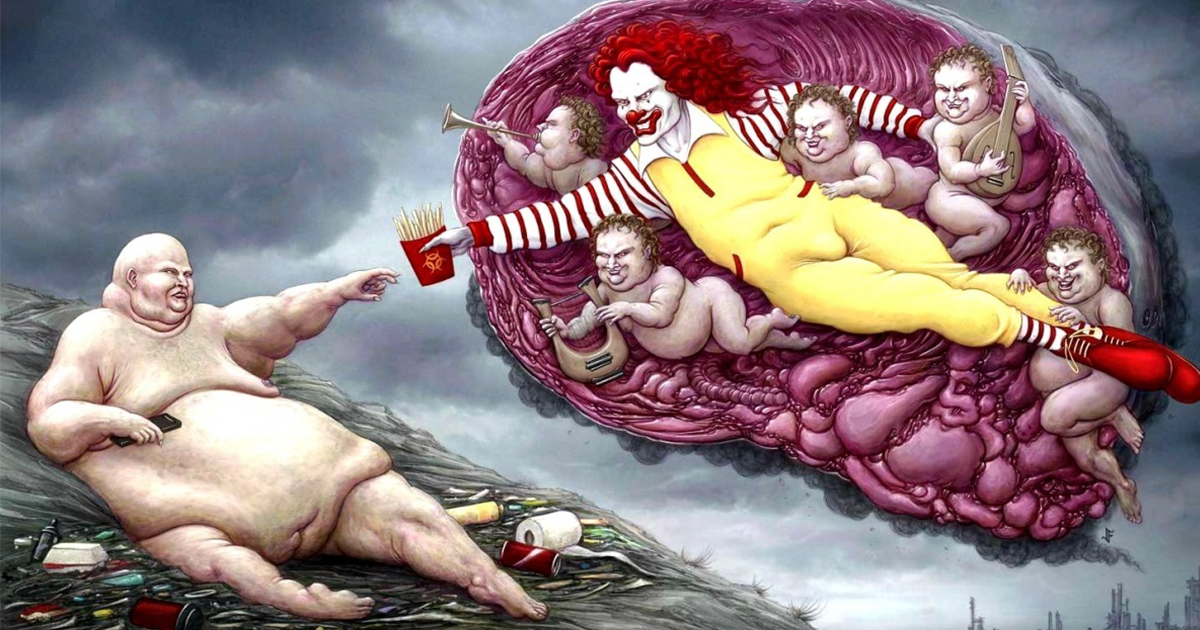
Some truths arrive in a 90-page report. Others arrive as a drawing of a family eating dinner while every face glows blue from a phone. The second version takes two seconds to understandand may stay in the mind much longer.
That is why illustrations about modern society feel so powerful. They turn invisible habits into visible absurdities: people collecting followers while losing friends, workers automating everything except their exhaustion, and shoppers buying storage boxes for objects purchased to make life simpler. The humor lands because the target is not some mysterious villain. It is us, our systems, and the incentives we rarely stop to examine.
So, what is wrong with today’s society? Not one single thing. The deeper problem is misalignment. Tools designed for connection, convenience, information, and productivity often reward distraction, comparison, surveillance, outrage, and endless consumption instead.
Why Social Commentary Illustrations Hit So Hard
A satirical illustration removes the polite packaging around everyday behavior. It can place an entire social contradiction in one frame: a lonely person surrounded by message bubbles, a burned-out employee standing beneath a “Wellness Week” banner, or a polluted planet advertised as an eco-friendly limited edition.
Illustration also makes gradual harm easier to see. Attention disappears five minutes at a time. Privacy is surrendered one “Accept All” button at a time. Burnout grows through one late email and one skipped lunch. A skilled artist compresses those tiny compromises into a single image and asks, without delivering a lecture, “Does this look normal to you?”
1. We Are Connected Everywhere and Present Nowhere
The glowing dinner-table problem
One recurring image shows people sitting together physically while living in separate digital worlds. The joke is simple, but the concern is not. Communication technology can increase contact without creating intimacy.
The U.S. Surgeon General has emphasized that social connection supports health and community well-being, while distinguishing loneliness from objective social isolation. Federal time-use data also show that Americans were less likely to socialize and communicate on an average day in 2025 than in 2015. A person may therefore have hundreds of contacts and still feel emotionally stranded.
The illustration is not saying every group chat is fake friendship. Digital tools can sustain distant families and help people find support. The warning is that a notification can imitate connection without delivering the attention, patience, and vulnerability that relationships require.
2. Attention Has Become a Product
The infinite scroll has no finish line
Another familiar illustration turns a phone into a slot machine, with a person feeding it hours instead of coins. Many platforms benefit when users remain engaged, and emotionally charged content is especially effective at keeping thumbs moving.
Stanford researchers who analyzed nearly 30 million social media posts found that highly arousing negative news was especially likely to spread. Pew Research Center has also found that social media news users value convenience and speed while frequently complaining about inaccuracy. The feed is quick, dramatic, and always open; verification tends to arrive later, wearing sensible shoes.
Satirical art makes the business model visible by drawing brains on leashes, clocks being swallowed by apps, or users running on hamster wheels labeled “engagement.” The message is not “technology is evil.” It is “notice who profits when you cannot stop.”
3. Life Has Become a Performance
Comparison culture edits out the messy parts
In social media criticism, one character photographs a perfect picnic while another hides the trash, arguments, and mosquitoes outside the frame. That image captures online comparison: people measure their unedited lives against someone else’s selected highlights.
A sunset becomes content. A workout becomes evidence. A vacation becomes a temporary media company with one tired employee. Sharing joy is not dishonest, but trouble begins when an experience feels incomplete until it is posted and approved by strangers.
The most pointed illustrations show people polishing their public image while neglecting the life behind it. The joke asks a serious question: are we enjoying the moment, or producing proof that we enjoyed it?
4. We Have More Information and Less Shared Reality
Opinion wearing a fake mustache labeled “fact”
Modern illustrations often show two crowds looking at the same object and seeing incompatible realities. RAND describes “Truth Decay” as a combination of growing disagreement about facts, blurred boundaries between opinion and evidence, and declining trust in formerly respected information sources. Gallup’s recent polling likewise shows historically low trust in mass media.
Disagreement itself is not the problem. Healthy societies need argument. The danger appears when every correction is treated as tribal aggression and every emotionally satisfying claim receives diplomatic immunity from evidence.
Illustrators capture the problem with megaphones louder than books, rumors riding rockets, and facts waiting at an empty bus stop. Falsehood often has better stage presence.
5. Productivity Has Become a Personality
Burnout inside a motivational quote frame
A common image shows an office worker climbing an endless staircase marked “Hustle,” “Optimize,” and “Almost There.” It mocks a culture that treats rest as a technical error and hobbies as businesses that have not yet been monetized.
The American Psychological Association reported that a majority of workers in its 2024 Work in America findings experienced at least one outcome often associated with burnout. Illustrators translate that into low-battery employees, candles burning at both ends, and octopuses answering email with all eight arms.
Ambition is not the villain. The distortion occurs when productivity becomes a measure of human worth. Under that logic, sleep is laziness, lunch is a scheduling failure, and a peaceful afternoon requires a written defense.
6. Financial Pressure Is Unevenly Distributed
One economy, very different ladders
Illustrations about inequality often show two runners heading toward the same finish line, except one begins on a paved track and the other starts inside a hole holding three jobs. The image challenges the comforting belief that outcomes always reflect effort alone.
Federal Reserve research shows that financial well-being differs substantially by education, age, disability status, neighborhood income, and other circumstances. Census findings also show that income changes are not distributed evenly across groups or across the income ladder. That makes “just budget better” sound less like analysis and more like advice from a decorative pillow.
Good satire does not claim personal choices are irrelevant. It shows that choices are made within structures. Telling someone to climb faster is less useful when the drawing clearly reveals who owns the ladder.
7. Consumer Culture Sells Identity by the Cartful
Buy now, become complete later
Advertising rarely sells only an object. It sells an imagined version of the buyer. The right shoes promise confidence. The right kitchen promises family harmony. The right phone promises a fresh personality, now with improved battery life.
The environmental cost is harder to hide when artists draw mountains of packaging or a planet trying to return an unwanted shipment. The EPA estimated that the United States generated 292.4 million tons of municipal solid waste in 2018, about 4.9 pounds per person per day.
The contradiction is almost too easy for satire: people seek simplicity by purchasing more containers for possessions they bought to simplify their lives.
8. Privacy Is Exchanged for Convenience
The free app that knows where you slept
Illustrators often portray digital services as cheerful shopkeepers accepting personal data instead of cash. The user receives convenience; behind the counter, a machine records preferences, behavior, contacts, and possibly how long the user stared at a pair of socks.
A Federal Trade Commission staff report found that major social media and streaming companies collected and retained extensive user data, including information from data brokers, while raising concerns about safeguards and data sharing. The joke about unread privacy policies is therefore grounded in a genuine imbalance of knowledge and power.
Convenience can be valuable. The problem is participation without meaningful understanding or choice.
9. We Fear Environmental Collapse While Ordering Overnight Delivery
The reusable cup beside the pile of packages
Climate illustrations thrive on contradiction: a corporation paints a smokestack green, a shopper posts “Save the planet” beside a tower of disposable products, or a melting Earth asks whether anyone kept the receipt.
Research highlighted by the National Institute of Environmental Health Sciences connects extreme heat and climate-related disasters with harmful mental health outcomes, with young and vulnerable populations facing particular risks. Climate anxiety is therefore not merely fashionable pessimism, although nonstop alarming content can also turn concern into paralysis.
The strongest illustrations draw responsibility to scale. They place personal habits beside corporate practices, infrastructure, public policy, and unequal exposure to environmental harm.
10. Outrage Is Easier Than Empathy
Everyone has a microphone; nobody brought ears
Many illustrations show people shouting from opposite cliffs while the bridge between them remains unfinished. Online spaces reward speed, certainty, and dramatic conflict. Empathy requires slower work: asking questions, tolerating ambiguity, and recognizing that a stranger is more complicated than one post.
The cure is not bland agreement. Empathy does not mean pretending harmful ideas are harmless. It means understanding that humiliation rarely produces wisdom and that winning a comment section is one of the least impressive ways to lose an evening.
What These Illustrations Ask Us to Do
The best social commentary illustrations are not instruction manuals. They are alarms, mirrors, and occasionally pies thrown at collective hypocrisy. Still, their recurring messages suggest a practical response.
Recover attention
Set boundaries around feeds, notifications, work messages, and news consumption. Attention is not merely a productivity resource; it is the substance of experience.
Practice inconvenient connection
Real relationships involve pauses, repetition, awkwardness, and people without mute buttons. Shared meals, neighborhood conversations, clubs, and unhurried calls may look inefficient. That inefficiency is often where trust grows.
Reward depth instead of velocity
Before sharing a dramatic claim, check its origin, date, context, and independent confirmation. Ask whether outrage informs useful action or merely rents space in the nervous system.
Use human measures of success
A healthy society cannot be judged only through clicks, output, purchases, and growth. Time, dignity, health, belonging, clean air, trust, and the freedom to rest also counteven when no dashboard sends a congratulatory animation.
Experiences Related to What’s Wrong With Today’s Society Captured In Illustrations
The following scenes are composite experiences based on familiar modern situations, not claims of personal autobiography. They explain why satirical illustrations often feel less like fantasy and more like someone secretly sketched Tuesday.
The café where nobody was aloneand nobody was together
Imagine a crowded café. One customer edits a photo of coffee they have barely tasted. Another answers work messages during a day off. Two friends sit across from each other, each sending memes to somebody elsewhere. The room is full of people, but the loudest relationships are happening through glass.
Then the internet briefly fails. Heads rise. Someone jokes that civilization has ended. A stranger asks whether the pastry is good, and a real conversation begins. Technology did not destroy connection; it simply became the default route even when direct connection was sitting three feet away.
The meeting about efficiency that consumed the afternoon
A team gathers to discuss productivity. The presentation has forty-seven slides. Participants answer emails about the meeting during the meeting. At the end, everyone receives a new form for documenting how much time they spend documenting their time.
An illustrator needs only one frame: workers building a machine labeled “Efficiency” that consumes all their energy. Management wants measurable activity; employees want uninterrupted time for meaningful work. Both use the word productivity, but they are describing different species.
The perfect family photo with the invisible argument
At a scenic overlook, a family takes twelve versions of the same smiling photo. Minutes earlier, they argued about parking, directions, and who forgot the water. The final image receives cheerful comments: “Perfect day!” The smiles may be genuine, but the frame removes every rough edge.
A viewer at home compares that polished image with a sink full of dishes, a lonely weekend, or a crying child. Human beings have always compared themselves with others; platforms industrialized the supply of carefully selected evidence.
The grocery cart divided by two realities
In one checkout line, a shopper removes items as the total climbs. In another, someone buys an oversized package because it is discounted, then throws away what spoils. Nearby, an advertisement promises happiness through a limited-edition snack flavor.
The scene contains financial strain, persuasive design, waste, and unequal choices without requiring a speech. The shopper with less cash may pay more per unit because bulk buying demands money and storage. The hurried household may waste food because time is scarce. Strong social commentary resists easy villains and shows the pressures surrounding ordinary decisions.
The neighborhood that rediscovered itself during an outage
Finally, imagine a block losing power on a warm evening. Wi-Fi disappears. People step outside, first to complain and then to talk. Someone brings a flashlight. Children invent a game. A neighbor checks on an older resident. The outage is inconvenient, but it reveals a social resource that had been present all along.
This is the hopeful side of illustrations about modern society. A sharp image does more than diagnose failure. It reminds viewers that attention can move, habits can change, and systems can be redesigned. The people staring at separate screens can look up. The bridge between cliffs can be completed. The giant machine can be switched off long enough to ask whether it serves human life or merely keeps itself running.
Conclusion: The Drawing Is a Mirror, Not a Verdict
What’s wrong with today’s society is a collection of mismatches: connection without intimacy, information without shared standards, work without recovery, consumption without satisfaction, convenience without privacy, and environmental concern without systems that make sustainable choices easy.
Illustrations make those contradictions visible. They turn normalized behavior strange again and leave room for agency. A mirror shows the mess, but it also shows the hands capable of cleaning it.
Note: This article interprets recurring themes in contemporary social commentary and satirical illustration. Its scenes are composite examples, not descriptions of one specific artwork, artist, or individual.