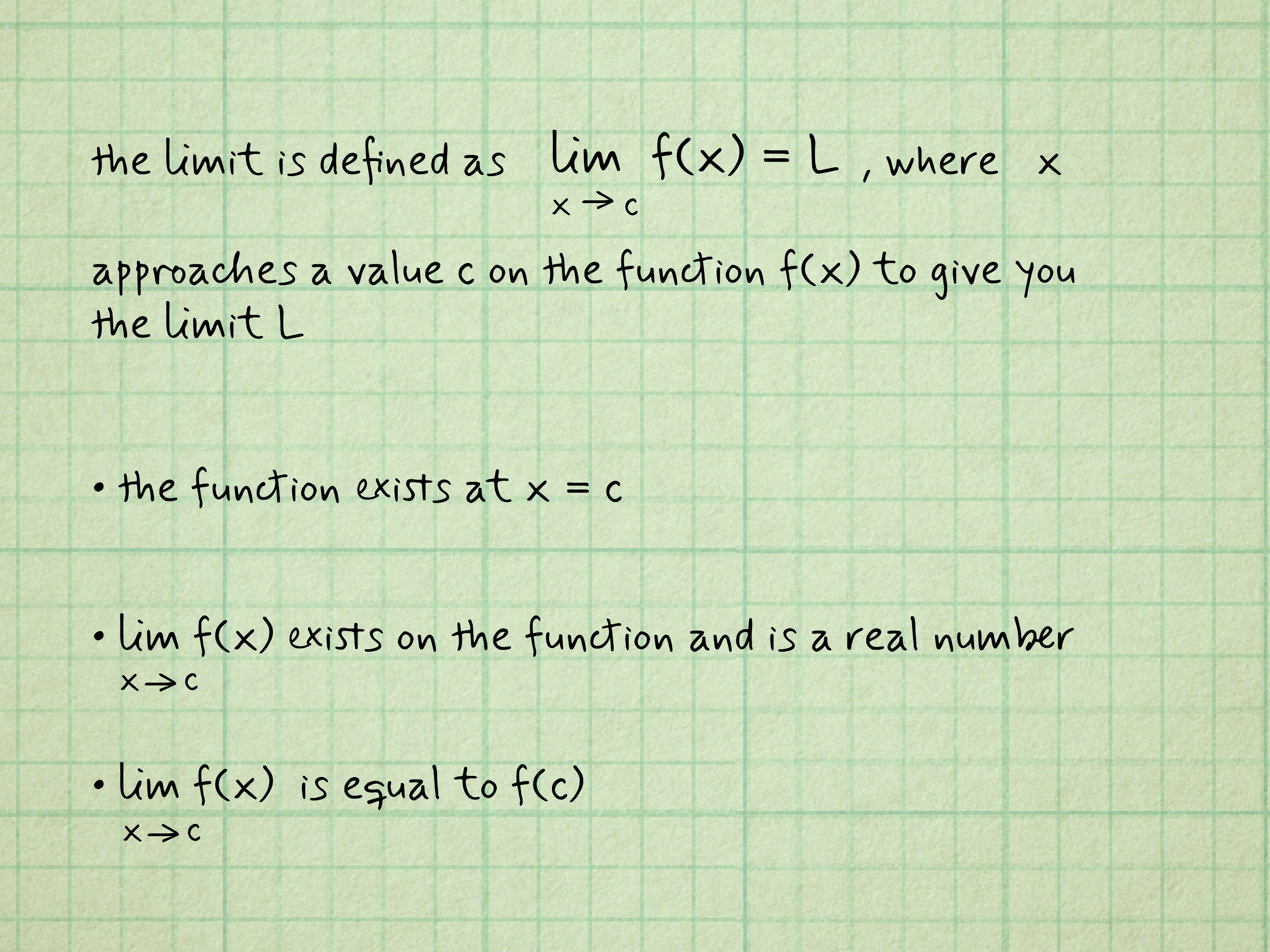
A limit is supposed to answer a simple question: as x gets closer and closer to a certain value, what number does the function get closer to? Most of the time, calculus behaves politely. The graph approaches a clean number, the algebra works out, and everyone gets to go home before the coffee gets cold.
But sometimes the function refuses to settle down. It jumps. It shoots toward infinity. It wiggles like it drank three espressos. Or it approaches a boundary where a two-sided limit cannot even be tested. That is when we say the limit does not exist, often written as DNE.
In this guide, we will break down the four most common cases where a limit does not exist, explain why each one happens, and walk through clear examples that make the idea much less mysterious.
What Does It Mean for a Limit to Exist?
A limit exists when the output values of a function approach one specific real number as the input approaches a certain value. The important phrase is one specific real number. A function does not need to be defined at the target point for the limit to exist. It only needs to approach the same value from nearby inputs.
For example, the function f(x) = (x² - 1) / (x - 1) is not defined at x = 1, because direct substitution gives division by zero. But after factoring, we get:
f(x) = (x - 1)(x + 1) / (x - 1)
For all values near 1, except 1 itself, this behaves like x + 1. So as x approaches 1, the function approaches 2. The limit exists even though the function has a hole. Calculus is surprisingly forgiving sometimes. It is like a math teacher saying, “I see what you meant.”
A limit does not exist when the function fails to approach one real number. The failure usually happens in one of four ways.
Case 1: The Left-Hand and Right-Hand Limits Are Different
Why this limit does not exist
The most common reason a two-sided limit does not exist is that the function approaches different values from the left and the right. For a limit lim x→a f(x) to exist, both one-sided limits must exist and must be equal.
That means:
lim x→a⁻ f(x) = lim x→a⁺ f(x)
If the left-hand limit and right-hand limit disagree, the two-sided limit does not exist. Think of it like two friends giving you directions to the same restaurant. One says, “Turn left,” and the other says, “Turn right.” At that point, your dinner plans are in trouble.
Example: A jump in the graph
Consider this piecewise function:
f(x) = 2, if x < 1
f(x) = 5, if x > 1
Now ask for:
lim x→1 f(x)
As x approaches 1 from the left, the function values stay at 2. So:
lim x→1⁻ f(x) = 2
As x approaches 1 from the right, the function values stay at 5. So:
lim x→1⁺ f(x) = 5
Because 2 is not equal to 5, the limit does not exist.
Real graph behavior
This situation often appears in piecewise functions, step functions, tax brackets, shipping-rate charts, and any model where the rule suddenly changes at a boundary. The graph has a jump discontinuity. It does not glide smoothly into one value; it teleports like a poorly written sci-fi villain.
Case 2: The Function Grows Without Bound
Why this limit does not exist
A limit can also fail to exist when the function values increase or decrease without approaching a finite number. This is called unbounded behavior. In many textbooks, you may see a statement like:
lim x→0 1/x² = ∞
This notation is useful because it describes what the graph is doing. However, in the strict real-number sense, the limit does not exist because infinity is not a real number. The function is not approaching a finite output; it is racing upward forever.
Example: A vertical asymptote
Consider:
f(x) = 1 / x²
We want:
lim x→0 1/x²
Try values close to zero:
x = 0.1 → f(x) = 100
x = 0.01 → f(x) = 10,000
x = 0.001 → f(x) = 1,000,000
From both sides, the function climbs higher and higher. It does not approach a real number. It has a vertical asymptote at x = 0.
So the limit does not exist as a finite real-number limit, even though we may describe the behavior by saying the function approaches infinity.
Another example: opposite infinities
Now consider:
f(x) = 1 / x
As x approaches 0 from the right, 1/x becomes very large and positive:
lim x→0⁺ 1/x = ∞
As x approaches 0 from the left, 1/x becomes very large and negative:
lim x→0⁻ 1/x = -∞
The two sides are not approaching the same behavior, so the limit definitely does not exist. It is not just indecisive; it is dramatically indecisive.
Case 3: The Function Oscillates and Never Settles
Why this limit does not exist
Some functions fail to have limits because they oscillate endlessly near the target point. Oscillation means the function keeps bouncing between values instead of settling down to one number.
This is one of the most famous “limit does not exist” cases in calculus, and the celebrity example is:
f(x) = sin(1/x)
We ask:
lim x→0 sin(1/x)
As x gets closer to 0, 1/x grows larger in magnitude. The sine function keeps cycling between -1 and 1 faster and faster. The graph near zero looks like it is vibrating at maximum chaos mode.
Because sin(1/x) never approaches one fixed value, the limit does not exist.
Why the squeeze theorem does not save it
Students sometimes notice that sin(1/x) is trapped between -1 and 1. That is true, but being trapped is not enough. A limit exists only if the function approaches one particular number.
For comparison, the function:
g(x) = x sin(1/x)
does have a limit as x approaches 0. Since sin(1/x) stays between -1 and 1, multiplying by x squeezes the whole function toward 0. In that case:
lim x→0 x sin(1/x) = 0
But without the shrinking factor x, sin(1/x) keeps oscillating forever. It does not calm down, take a seat, or fill out the proper paperwork.
Case 4: The Function Is Only Approached From One Side in Its Domain
Why this limit may not exist as a two-sided limit
A two-sided limit requires approaching the target value from both the left and the right. But sometimes the function is only defined on one side of the point. In that case, the two-sided limit may not exist because one side is missing from the domain.
This often happens with square root functions, logarithmic functions, and functions restricted to closed intervals.
Example: A square root endpoint
Consider:
f(x) = √x
Now ask:
lim x→0 √x
Over the real numbers, √x is defined only for x ≥ 0. You can approach 0 from the right, and the function approaches 0:
lim x→0⁺ √x = 0
But you cannot approach 0 from the left within the real-number domain, because √x is not real for negative x. Therefore, the ordinary two-sided limit is not available in the usual real-valued setting.
However, the right-hand limit exists. This is why teachers and textbooks are careful about language. The two-sided limit and one-sided limit are not the same request. One is asking for traffic from both directions; the other is checking only one lane.
How to Tell When a Limit Does Not Exist
When you are trying to determine whether a limit exists, do not panic and start throwing algebra at the wall. Use a simple checklist.
1. Check direct substitution first
If substituting the target value gives a real number and the function is continuous there, the limit exists. For example:
lim x→3 (x² + 1) = 10
Polynomial functions are continuous everywhere, so this limit exists.
2. Check the left and right sides
If direct substitution creates uncertainty, examine the one-sided limits. If the left-hand and right-hand limits are different, the two-sided limit does not exist.
3. Look for vertical asymptotes
If the denominator approaches zero while the numerator does not also cancel to zero, the function may grow without bound. This often means the limit does not exist as a finite value.
4. Watch for oscillation
Functions involving sin(1/x), cos(1/x), or similar expressions may oscillate infinitely near a point. If the function keeps bouncing and never settles, the limit does not exist.
5. Check the domain
Before declaring a two-sided limit, make sure the function can actually be approached from both sides within its domain. Endpoints require special care.
Common Mistakes Students Make With DNE Limits
Mistake 1: Thinking “undefined” always means the limit does not exist
A function can be undefined at a point and still have a limit there. A removable hole does not automatically destroy the limit. What matters is nearby behavior, not the exact value at the point.
Mistake 2: Treating infinity like a regular number
Writing that a function approaches infinity describes unbounded behavior. But infinity is not a real-number limit. In many calculus contexts, that means the finite limit does not exist.
Mistake 3: Checking only one side
A two-sided limit requires both sides. If you only check the right side, you have not finished the job. Calculus is not impressed by half-detective work.
Mistake 4: Assuming a messy expression means DNE
Some ugly-looking limits exist after factoring, rationalizing, simplifying, or using known limit laws. The expression may look like a raccoon got into the algebra drawer, but it can still clean up nicely.
Quick Comparison Table: 4 Cases Where Limits Do Not Exist
| Case | What Happens | Example | Why DNE? |
|---|---|---|---|
| Different one-sided limits | Left and right approach different values | |x| / x as x→0 |
The two sides disagree |
| Unbounded behavior | Function grows toward infinity or negative infinity | 1 / x² as x→0 |
No finite real value is approached |
| Oscillation | Function keeps bouncing between values | sin(1/x) as x→0 |
No single value is approached |
| Domain endpoint | Function can only be approached from one side | √x as x→0 |
The ordinary two-sided limit is not available |
Experience-Based Notes: How to Learn DNE Limits Without Losing Your Mind
One practical experience with learning limits is that students often understand the formal rule before they understand the feeling behind it. They can memorize “left side equals right side,” but when a graph jumps, wiggles, or shoots upward, they are not always sure what they are seeing. The best way to build intuition is to look at limits visually before solving them algebraically.
For example, when I explain a jump discontinuity, I like to imagine two tiny hikers walking along the graph toward the same cliff edge. One hiker comes from the left and arrives at height 2. The other comes from the right and arrives at height 5. They are both near the same x-value, but they are standing at different heights. The limit cannot exist because the function does not give one shared destination. This picture is much easier to remember than a rule floating alone in a notebook.
Another useful habit is to make a small table of values. For 1/x² near zero, the table quickly reveals the problem. Values such as 100, 10,000, and 1,000,000 show that the function is not approaching a normal number. It is blasting upward like a rocket with no return ticket. This helps students understand why “infinity” describes behavior but does not count as a finite limit.
Oscillating limits require even more patience. A graph of sin(1/x) near zero can look intimidating, but the core idea is simple: the function never chooses one final value. It keeps revisiting highs and lows. In my experience, students benefit from comparing sin(1/x) with x sin(1/x). The first one does not settle; the second one is squeezed toward zero. That contrast makes the squeeze theorem feel useful instead of decorative.
Domain endpoints are also worth practicing because they teach precision. If a problem asks for a two-sided limit at the endpoint of a domain, you must ask whether both sides are available. With √x at zero, the right-hand limit exists, but the ordinary two-sided real limit does not. This is not a trick; it is a reminder that math language is very literal. Calculus does not read minds. It reads symbols.
The biggest lesson is this: do not decide that a limit does not exist just because the expression looks weird. First simplify. Then check both sides. Then look for unbounded behavior, oscillation, and domain restrictions. A calm checklist beats panic every time. Limits are less like magic and more like detective work. The function leaves clues; your job is to stop yelling “DNE!” until the evidence actually supports it.
Conclusion
A limit does not exist when a function fails to approach one specific real number as the input approaches a target value. The four major cases are different one-sided limits, unbounded behavior, endless oscillation, and missing two-sided approach because of domain restrictions.
The key is to focus on nearby behavior, not just the value of the function at the point. A hole may still have a limit. A jump does not. A vertical asymptote may describe infinity, but it does not produce a finite real-number limit. An oscillating function may stay bounded, yet still fail because it never settles. And a domain endpoint may allow only a one-sided limit.
Once you understand these patterns, “limit does not exist” stops sounding like a scary final verdict and starts sounding like a useful diagnosis. The function is not broken; it is simply telling you, in its own dramatic mathematical language, that there is no single destination.
Note: This article is original SEO content based on standard calculus principles and examples. It avoids copied source text and unnecessary citation placeholders.