There is a strange little fantasy floating around the modern information economy: What if we could replace the old newsroom with a faster, cheaper, tireless machine? No coffee breaks. No union meetings. No editor sighing over a misplaced comma. Just a large language model, humming politely in the cloud, ready to explain the world before the world has even finished happening.
It sounds efficient. It also sounds like replacing a fire department with a smoke-scented candle because both involve flames.
The title “Why You Shouldn’t Trade Walter Cronkite For An LLM” is not an argument against technology. Large language models can summarize, brainstorm, translate, outline, classify, and help humans move faster through mountains of text. Used carefully, they can support journalism. But they are not Walter Cronkite. They are not reporters. They are not eyewitnesses. They do not knock on doors, smell tear gas, build sources, challenge a mayor, comfort a grieving parent, or decide that a fact matters because a democracy depends on it.
Walter Cronkite became a symbol of trustworthy journalism because he represented more than a good voice and a serious face. He represented verification, restraint, judgment, public duty, and accountability. An LLM can imitate the tone of authority. Cronkite had to earn it.
The Cronkite Standard: Trust Was Built, Not Generated
Walter Cronkite anchored the CBS Evening News from 1962 to 1981, a period when television became the central fireplace of American public life. Families gathered around the screen to hear about Vietnam, the civil rights movement, the assassination of President John F. Kennedy, Watergate, the Apollo 11 moon landing, and the long, anxious drama of the Cold War.
Cronkite was often called “the most trusted man in America,” not because every viewer agreed with every word he said, but because his style carried a rare discipline. He separated fact from opinion. He moved slowly when the truth was unclear. He understood that confidence was not the same thing as certainty. That distinction matters even more today, when the internet can turn a rumor into a national argument before breakfast has cooled.
His famous sign-off, “And that’s the way it is,” worked because viewers believed he had done the work to know what “it” was. That phrase was not a magic spell. It was the final brick in a daily structure of reporting, editing, standards, and reputation.
What An LLM Actually Does
A large language model is not a newsroom. It is a statistical language system trained to predict and generate text. It can produce sentences that look polished, organized, and impressively human. It can explain complex subjects in plain English. It can mimic styles, compare viewpoints, and produce a clean first draft faster than most people can find the caps lock key.
But an LLM does not “know” in the way a journalist knows. It does not witness an event. It does not verify a source’s motive. It does not feel professional embarrassment after getting a story wrong. It does not call a second person to confirm what the first person claimed. It does not understand courage, duty, fairness, or public consequence. It generates probable language based on patterns.
That is useful. It is also dangerous when people mistake fluency for truth. A confident answer can feel trustworthy simply because it is grammatically smooth. This is the tuxedo problem of artificial intelligence: a bad claim looks much more respectable when it is wearing formalwear.
Why Journalism Is More Than Information Delivery
Many people talk about news as if it were just content. That is like describing a hospital as a building where bandages happen. Journalism is a process. It includes gathering facts, evaluating evidence, ranking what matters, excluding what cannot be proven, correcting errors, and explaining uncertainty without turning every story into fog.
Good journalism also has friction. Editors ask irritating but necessary questions. Lawyers review sensitive claims. Reporters argue over wording. Standards desks slow things down. Fact-checkers ruin everyone’s afternoon in the best possible way. This friction is not a bug. It is the safety rail.
An LLM removes much of that friction by design. It gives the user an answer immediately. That speed is helpful for low-risk tasks, but news is rarely low-risk. A false report can damage reputations, mislead voters, distort public policy, or panic communities. When the subject is war, health, elections, crime, markets, or civil rights, “close enough” is not close enough. It is the first cousin of wrong.
The Problem With AI Hallucinations
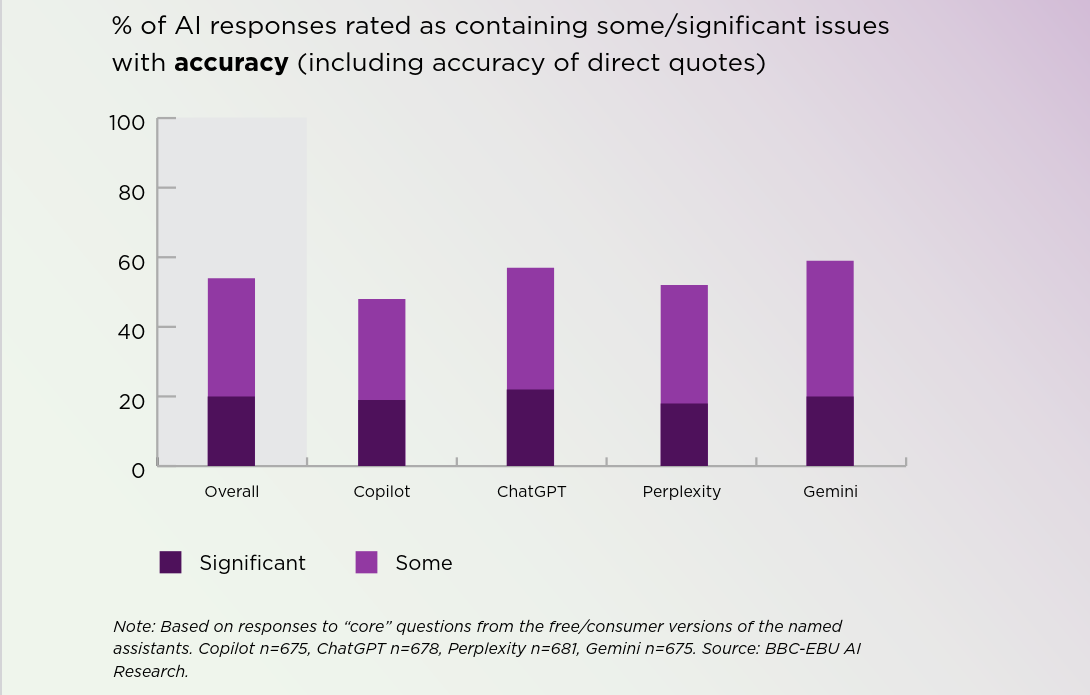
One of the biggest risks with LLMs is hallucination: the production of information that sounds factual but is false, unsupported, outdated, or invented. The word “hallucination” can make the issue sound quirky, like the chatbot saw a tiny dragon wearing reading glasses. In reality, hallucination is a credibility problem.
An LLM may invent a quote, misattribute a study, merge two real events into one fake event, or present an outdated claim as current. The result can be especially hard to detect because the text often sounds polished. A human reader may think, “This is written so well; it must be right.” Unfortunately, style is not evidence. A beautifully written falsehood is still a falsehood, just with better shoes.
Journalists can make mistakes too. The difference is that professional journalism has a culture of correction, responsibility, and traceable authorship. If a reporter gets something wrong, there is a byline, an editor, an outlet, a correction policy, and a reputational cost. With AI-generated material, accountability can become slippery. Who owns the mistake: the tool, the user, the newsroom, the vendor, the editor who trusted it, or the executive who wanted “efficiency” with a suspiciously tiny budget?
Real Newsroom Experiments Show The Risk
The warning is not theoretical. Several media organizations have already tested AI-generated or AI-assisted content with mixed results, and some experiments have produced public embarrassment. CNET faced scrutiny after publishing AI-written finance articles that required corrections. Gannett paused AI-generated high school sports recaps after awkward, repetitive writing drew online mockery. Gizmodo’s AI-generated entertainment article about Star Wars became a cautionary tale after readers and staff pointed out errors. Sports Illustrated’s owner faced backlash after reports described questionable AI-generated author profiles and product content.
These cases matter because they reveal a pattern. AI is often introduced with the promise that it will handle routine work. Then the “routine” work turns out to involve facts, context, nuance, names, dates, audience trust, and the dignity of not sounding like a toaster trying to cover varsity basketball.
The issue is not that AI can never help. The issue is that AI-generated journalism can become a shortcut around the very practices that make journalism credible. When a newsroom uses AI to support reporters, readers may benefit. When a newsroom uses AI to replace reporting, readers become beta testers in a truth experiment they never agreed to join.
Why Cronkite’s Vietnam Moment Still Matters
Walter Cronkite’s 1968 commentary after visiting Vietnam remains one of the most discussed moments in American broadcast history. After reporting from the region, he concluded that the war appeared mired in stalemate. The mythology around that broadcast is sometimes overstated, but its deeper lesson remains powerful: Cronkite’s words mattered because they followed reporting, not because they were produced by vibes.
He did not simply scan existing opinions and generate a smooth paragraph. He went there. He observed. He listened. He evaluated official claims against reality. Then, with caution unusual for his role, he told viewers what he believed the evidence showed.
That is precisely where human journalism differs from automated text generation. A reporter can be morally accountable to reality. A model can only be technically aligned to a prompt. Cronkite could decide that the official story no longer matched the facts on the ground. An LLM may summarize official statements, public reactions, and historical context, but it cannot independently stand in the mud and recognize that the national story has cracked.
Trust Requires A Human Chain Of Custody
Trustworthy news depends on a chain of custody. Where did the information come from? Who verified it? What is the evidence? What is missing? What does the reporter know, and what remains uncertain? This chain allows readers to evaluate credibility.
LLMs often blur that chain. They can summarize information without making the source trail obvious. They can produce an answer that feels complete while hiding gaps in evidence. They can flatten differences between a peer-reviewed study, a press release, a partisan blog, a social media rumor, and an outdated article. To the model, these may all become ingredients in a language soup. Some soups are delicious. Some require a public correction and a long meeting with management.
For journalism, source quality is not a decorative feature. It is the whole building. A claim from a named public health agency is not the same as a claim from a random account with twelve followers and an eagle avatar. A court filing is not the same as a campaign email. A reporter’s job is to know the difference and explain it clearly.
Objectivity Is Not Robotic Neutrality
Some people argue that AI could improve journalism because machines are “neutral.” That sounds comforting until you remember that AI systems are trained on human-created data, shaped by human design choices, filtered by human policies, and deployed by human institutions with business incentives. Neutrality is not automatically produced by removing a human face from the screen.
Journalistic objectivity does not mean having no judgment. It means using disciplined methods to reduce bias: verification, fairness, evidence, transparency, and a willingness to correct the record. A good journalist does not become objective by becoming emotionless. A good journalist becomes more reliable by following standards even when personal instincts, audience pressure, or institutional interests pull in another direction.
Cronkite’s strength was not that he was a robot. His strength was that he was human in a professional way. He could show gravity without theatrical outrage. He could deliver terrible news without turning it into performance art. He knew when the story required restraint and when it required moral clarity.
The Speed Trap: Faster Is Not Always Better
LLMs are fast. That is one of their greatest advantages. It is also one of their greatest temptations. In a digital media economy obsessed with clicks, rankings, and instant publication, speed can become a false god with excellent Wi-Fi.
News organizations already face pressure to publish quickly. Social media rewards the first take, the hottest take, and occasionally the take that should have remained inside someone’s head. AI can intensify that pressure by making it easier to produce more content with fewer people. But a democracy does not need more words if fewer of them are checked.
The Cronkite model valued finality only after verification. The AI content model can produce final-sounding text before the reporting is done. That reversal is dangerous. Journalism should move from evidence to language, not from language to a desperate search for evidence afterward.
Where LLMs Can Help Journalism
Rejecting the replacement fantasy does not mean rejecting AI entirely. LLMs can be useful assistants in newsrooms when humans remain firmly in charge. They can help transcribe interviews, organize research notes, draft headline options, translate background material, summarize public documents, identify patterns in large datasets, or create checklists for editors.
The key word is “assistants.” An LLM should function like a smart intern with no memory of consequences: helpful, quick, occasionally brilliant, and absolutely not allowed to publish sensitive work unsupervised. Human journalists must verify every factual claim, review every source, and decide what belongs in the final story.
Responsible AI use in journalism should include disclosure when appropriate, editorial approval, clear standards, source verification, bias testing, privacy safeguards, and corrections when errors slip through. AI should make better reporting possible, not make worse reporting cheaper.
Why Readers Still Need Human News Judgment
The public does not only need facts. It needs judgment. Which facts matter today? Which claims deserve skepticism? Which story is a distraction? Which quiet development will affect people for years? Which official statement hides more than it reveals?
These are not simple text-generation tasks. They require experience, memory, ethical reasoning, and sometimes courage. A journalist may choose to pursue a story that is difficult, unpopular, or expensive because it matters. A model has no public-service instinct. It does not wake up bothered by a contradiction in a city budget. It does not protect a confidential source. It does not understand why one small missing detail can change the meaning of an entire investigation.
That is why trading Cronkite for an LLM would be a category mistake. One is a professional model of public trust. The other is a powerful tool for producing language. A wrench is useful, but you would not ask it to chair the ethics committee.
The Better Future: Cronkite Plus Tools, Not Cronkite Versus Tools
The best future for journalism is not nostalgic. We do not need to recreate 1968, complete with ashtrays, rotary phones, and ties wide enough to land aircraft. The media world has changed. Audiences are fragmented. Trust is lower. News moves across platforms Cronkite never had to pronounce. Artificial intelligence is now part of the information environment, whether newsrooms like it or not.
But the values that made Cronkite credible are not obsolete. Accuracy, verification, fairness, independence, humility, and accountability are more important in the AI era, not less. The more synthetic content floods the web, the more valuable human judgment becomes. When everything can sound authoritative, readers need institutions and individuals who can show how they know what they know.
The right question is not, “Can an LLM write like a journalist?” The right question is, “Can journalism use LLMs without surrendering the human standards that make journalism worth trusting?” That answer can be yes, but only if newsrooms treat AI as a tool, not a substitute for reporting.
Experiences And Reflections: What This Debate Feels Like In Real Life
Anyone who has spent time using AI tools for research has probably felt the strange mix of wonder and suspicion they create. One minute, the model explains a complicated issue with impressive clarity. The next minute, it confidently misnames a person, invents a source, or turns a half-true detail into a full marching band of nonsense. The experience is both magical and mildly like trusting a golden retriever to do your taxes.
That emotional whiplash is important. It teaches us that AI can feel reliable before it has proven itself reliable. In daily work, an LLM can be an excellent starting point. It can help outline an article, suggest angles, simplify technical language, and reveal blind spots in structure. But when the topic involves real people, public events, law, medicine, politics, finance, or history, the user must slow down and verify. The machine may sound calm, but calmness is not a credential.
In content writing, the temptation is especially strong. AI can generate a clean draft in seconds. For SEO work, it can suggest keywords, headings, meta descriptions, and related questions. That is genuinely useful. But the danger appears when speed replaces curiosity. A strong article is not just a pile of optimized headings. It needs a point of view, accurate context, fresh examples, and a sense that a thinking human has weighed the evidence. Readers can often feel the difference between content created to serve them and content created merely to occupy a search result.
The Cronkite comparison is helpful because it reminds us that trust is experiential. Viewers trusted Cronkite over time. They watched him handle national trauma, uncertainty, triumph, and scandal with steadiness. He did not need fireworks. He did not shout “breaking” every nine seconds like a caffeinated alarm clock. His authority came from consistency.
Modern audiences are hungry for that consistency, even if they consume news through phones, podcasts, newsletters, and social feeds. They want speed, but they also want someone to say, “We know this, we do not yet know that, and here is how we checked.” That kind of transparency is deeply human. It admits limits. It respects the reader. It does not pretend that every question has an instant answer.
My practical experience with AI-assisted writing points to a balanced rule: use the model for momentum, not for final authority. Let it help organize the workshop, but do not hand it the keys to the newsroom. Ask it for questions, not just answers. Use it to generate possibilities, then use human judgment to decide what survives. Treat every factual claim like a guest at airport security: polite screening, no exceptions.
This is especially true for articles about media, democracy, and public trust. If a writer uses AI to discuss why AI cannot replace trusted journalism, the process itself should prove the point. The final piece must reflect research, verification, editorial judgment, and a human sense of responsibility. Otherwise, it becomes a snake eating its own search-optimized tail.
The goal is not to choose between the past and the future. The goal is to carry the best of the past into the future without letting shiny tools dissolve hard-won standards. Walter Cronkite belonged to another media age, but the reason people still invoke his name is simple: he represented a promise that news should serve the public before it serves the machine. That promise is not old-fashioned. It is the whole job.
Conclusion: Keep The Anchor, Use The Tool
You should not trade Walter Cronkite for an LLM because journalism is not merely the production of fluent sentences. It is the disciplined pursuit of verified truth in the public interest. LLMs can help writers and reporters work faster, but they cannot replace eyewitness reporting, editorial responsibility, ethical judgment, or earned trust.
The future of news should include smart technology. It should also include human reporters who ask hard questions, editors who demand proof, and institutions brave enough to correct themselves. Cronkite’s legacy is not a demand that journalism remain frozen in black-and-white television. It is a reminder that credibility is built through standards. In an age when machines can generate endless words, the rarest thing may be a human being willing to say only what can be responsibly known.
Note: This article is written as publish-ready HTML body content and is based on real information from reputable journalism, media research, AI policy, and technology reporting sources. Source links are intentionally excluded from the article body as requested.