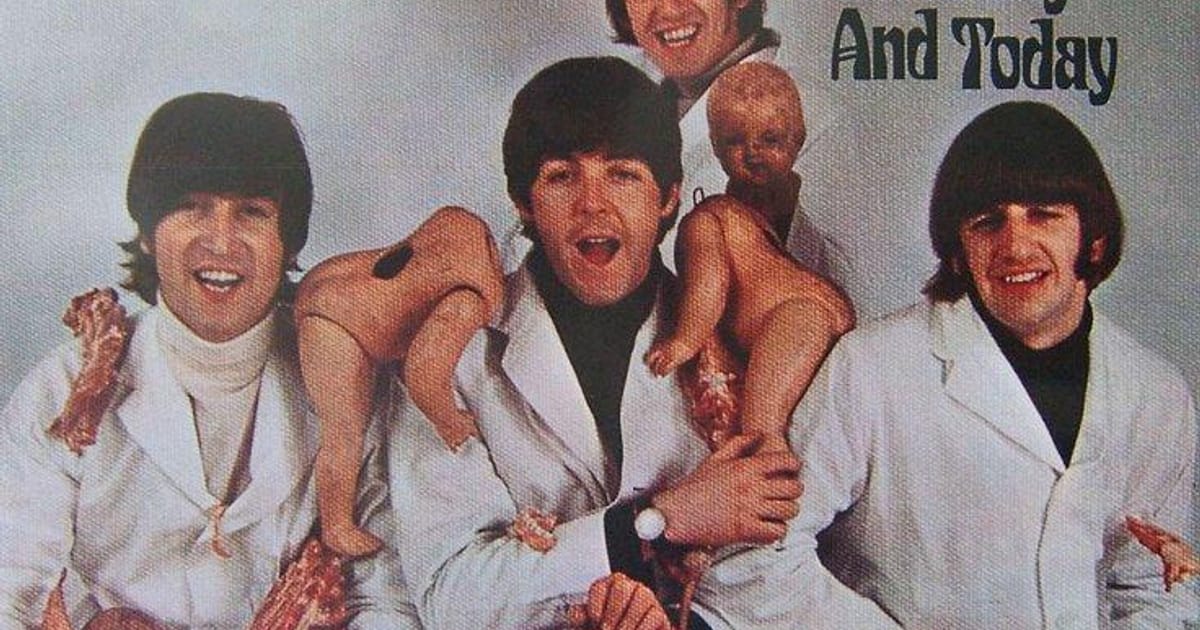
Yesterday & Today is one of those Beatles albums that walks into the room wearing two outfits at once: a hit-packed 1966 Capitol Records release and a pop-culture controversy with a meat cleaver in its back pocket. It was not a standard U.K. Beatles album, and that is exactly why people still argue about it. Some fans call it a brilliant American sampler. Others call it Capitol’s musical leftovers casserole. Both sides have a point, and both sides probably own more Beatles records than they admit.
Released in the United States during the wild middle chapter of Beatlemania, Yesterday & Today pulled together songs from Help!, Rubber Soul, a major double A-side single, and three tracks that would later belong to Revolver outside North America. In other words, it is not a carefully planned artistic statement in the way Rubber Soul or Revolver is. It is more like a very stylish suitcase packed by someone running late for the airport: strange, uneven, but somehow full of treasures.
Why Yesterday & Today Still Matters
The main reason Yesterday & Today keeps showing up in Beatles discussions is simple: the songs are too good to ignore. Even if the album was assembled for the U.S. market rather than designed by the band as a unified project, its track list contains some of the group’s most beloved work. “Yesterday,” “Day Tripper,” “We Can Work It Out,” “Nowhere Man,” “Drive My Car,” “I’m Only Sleeping,” and “And Your Bird Can Sing” are not filler. If those songs are leftovers, then most bands would like to speak to the chef.
The album also captures a fascinating moment in Beatles history. The group was moving from lovable mop-top pop stars into studio-minded artists with sharper lyrics, stranger sounds, and stronger individual identities. You can hear that transition clearly. “Act Naturally” still winks at the older entertainment tradition. “Drive My Car” kicks open the door to a more confident, adult Beatles sound. “I’m Only Sleeping” floats into psychedelic territory. “Yesterday” looks backward with heartbreak; “And Your Bird Can Sing” looks forward with electric bite.
The Butcher Cover: The Controversy That Refused to Retire
No serious discussion of Yesterday & Today can avoid the infamous “butcher cover.” The original sleeve showed John Lennon, Paul McCartney, George Harrison, and Ringo Starr in white butcher coats, surrounded by raw meat and dismembered baby dolls. Subtle? Absolutely not. A safe choice for 1966 retail shelves? Also no. Capitol quickly recalled the cover and replaced it with the more polite “trunk cover,” where the Beatles posed around a steamer trunk looking like they had just been told to behave themselves.
Over time, the withdrawn cover became one of the most famous collectibles in rock history. First-state butcher covers, meaning copies that were never covered over with the trunk image, are the most prized. Second-state copies have the trunk slick pasted over the original butcher image. Third-state copies are peeled versions, where owners tried to remove the trunk cover and reveal the forbidden artwork underneath. This created a mini-industry of careful peeling, bad peeling, professional restoration, and heartbreak. Nothing says “record collecting” like sweating over old glue while whispering, “Please don’t tear Ringo.”
Editorial Track Ranking: Best Songs on Yesterday & Today
Because the album is a compilation-style release, ranking its songs is tricky. We are not judging how each track fits into a grand concept; we are judging impact, replay value, songwriting, performance, and how strongly each song represents the Beatles’ mid-1960s evolution. Here is a clear, opinionated ranking.
1. Yesterday
“Yesterday” takes the top spot because it is nearly impossible to overstate its cultural weight. Paul McCartney’s vocal, acoustic guitar, and the string quartet created a Beatles recording that barely sounded like a Beatles recording at all. That was the magic. It showed that pop music could be intimate, elegant, and devastating without turning into a puddle of melodrama. It is simple, but not shallow. It is sad, but not soggy. That is harder than it looks.
2. We Can Work It Out
“We Can Work It Out” is one of the best examples of Lennon and McCartney’s contrasting personalities working inside the same song. McCartney brings optimism and negotiation; Lennon darkens the hallway with emotional urgency. The shifting rhythm gives the track a clever twist, making it more than a sweet little plea for peace. It is mature, catchy, and still useful for arguments between couples, bands, coworkers, and anyone fighting over the last slice of pizza.
3. Day Tripper
“Day Tripper” earns its high ranking with one of the most recognizable guitar riffs in rock history. It has swagger, humor, and just enough bite to prove the Beatles were not content to stay in neat little pop boxes. Compared with the gentler songs on the album, this track brings muscle. It is the moment when the record puts on sunglasses indoors and somehow gets away with it.
4. I’m Only Sleeping
Dreamy, odd, and quietly revolutionary, “I’m Only Sleeping” points directly toward Revolver. John Lennon turns laziness into philosophy, while the backward guitar textures make the song feel like time has misplaced its shoes. It is not the loudest track here, but it may be the coolest. The song proves that experimentation does not always need to shout; sometimes it can yawn beautifully.
5. Nowhere Man
“Nowhere Man” is a major step forward in Beatles songwriting because it moves away from romance and into character study. Lennon’s lyric feels sharp without being cruel, and the harmonies are clean enough to make the existential anxiety go down smoothly. It is the kind of song that sounds bright until you listen closely and realize the sunshine has a leak.
6. And Your Bird Can Sing
This track is pure electric confidence. The guitar work sparkles, the melody moves fast, and the whole thing feels like the Beatles racing through a pop-rock maze without touching the walls. It may not carry the emotional gravity of “Yesterday” or “Nowhere Man,” but it has a thrilling snap. If songs wore jackets, this one would have a very good one.
7. Drive My Car
“Drive My Car” is funky, witty, and loaded with attitude. As an opener on the U.K. Rubber Soul, it announces a new chapter. On Yesterday & Today, it still works as a shot of energy, even if the surrounding album context is different. The playful gender reversal in the lyric gives it extra charm, while the groove reminds everyone that the Beatles could be clever and physical at the same time.
8. If I Needed Someone
George Harrison’s “If I Needed Someone” is graceful, jangly, and heavily tied to the folk-rock atmosphere of the mid-1960s. It is not Harrison at his deepest, but it shows his growing confidence as a songwriter. The ringing guitar texture gives the track a cool, breezy quality. It may not dominate the album, but it absolutely deserves its place.
9. Act Naturally
Ringo Starr singing Buck Owens is exactly the sort of thing that makes early Beatles albums feel like variety shows with better haircuts. “Act Naturally” is light, funny, and charming. Is it one of the deepest Beatles recordings? No. Does Ringo sell it with perfect comic timing? Yes, and that counts. Sometimes personality is the whole arrangement.
10. Doctor Robert
“Doctor Robert” has a memorable bounce and an intriguing edge, but it sits lower because it feels less fully developed than the strongest material here. It is historically interesting and musically enjoyable, yet compared with “I’m Only Sleeping” or “And Your Bird Can Sing,” it does not strike as hard. Still, even mid-tier Beatles is a luxury problem.
11. What Goes On
“What Goes On” lands at the bottom, not because it is bad, but because the competition is unfair. The song is pleasant country-flavored Beatles, and Ringo gives it warmth. However, on an album containing “Yesterday,” “Day Tripper,” and “We Can Work It Out,” pleasant is not enough to win the crown. It is the musical equivalent of bringing cookies to a sword fight.
Fan Opinions: Why Listeners Disagree
Opinions about Yesterday & Today usually fall into a few camps. The first camp includes U.K. album purists, who argue that the Beatles’ real artistic progress is best understood through the British discography. For them, the Capitol albums interrupt the band’s carefully developing story. They see Yesterday & Today as a commercial reshuffle rather than a true Beatles album.
The second camp includes American listeners who grew up with the Capitol versions. To them, this album is not an error; it is memory. It is the version they found in stores, played at home, discussed with friends, and maybe stared at while wondering why the Beatles were sitting around a trunk. For those fans, the album has emotional authenticity even if it lacks canonical purity.
The third camp is made of collectors, and collectors view Yesterday & Today through a different lens entirely. For them, matrix numbers, mono versus stereo copies, paste-over clues, shrink wrap, seam splits, and cover states are part of the story. The music matters, of course, but the object itself matters too. This is where the album becomes not just sound, but archaeology.
Is Yesterday & Today a Great Album or a Great Playlist?
The honest answer is: both, depending on what you want from it. As a unified artistic statement, Yesterday & Today cannot compete with Rubber Soul, Revolver, or Sgt. Pepper’s Lonely Hearts Club Band. It was not built with that purpose. Its sequencing can feel odd because the songs come from different creative moments. The transitions are sometimes smooth and sometimes “who packed this suitcase?”
But as a listening experience, it is remarkably strong. The album moves between heartbreak, humor, social observation, folk-rock, early psychedelia, country charm, and riff-heavy pop. That variety is part of its appeal. It is not a cathedral; it is a fantastic record-store bin find. And sometimes a bin find gives you more joy than a museum piece.
Experiences Related to Yesterday & Today Rankings And Opinions
One of the best ways to understand Yesterday & Today is to experience it like a real listener rather than a courtroom judge. Put it on without worrying about the U.K. catalog, the Capitol strategy, or whether a song “belongs” somewhere else. Suddenly, the album becomes less of a historical argument and more of a lively conversation. “Drive My Car” starts the engine, “I’m Only Sleeping” rolls down the window, and “Nowhere Man” begins asking questions that are a little too accurate for comfort.
Listening to this album today can feel surprisingly modern because playlists have trained us to accept mixed sources and shifting moods. In the streaming era, people jump from a ballad to a rocker to a deep cut without asking whether the transition was approved by an artistic committee in 1966. In that sense, Yesterday & Today accidentally predicts how many fans now consume music. It is part album, part curated experience, part greatest-hits detour, and part historical puzzle.
The ranking experience also changes depending on mood. On a quiet evening, “Yesterday” feels untouchable. Its sadness is so clean that it barely needs explanation. On a road trip, however, “Day Tripper” may suddenly become the obvious winner because that riff makes the steering wheel feel like a musical instrument. On a lazy Sunday morning, “I’m Only Sleeping” rises several positions because the song understands the sacred art of not getting up. The best rankings are not fixed monuments; they are weather reports for your ears.
Collectors experience the album differently again. Imagine finding an old trunk-cover copy and noticing the faint shadow of the butcher image underneath. That tiny visual clue can turn a normal record into a mystery. Is it a second-state cover? Has it been peeled? Is the condition strong? Should anyone touch it? Suddenly, an album becomes a detective story with a soundtrack. That is part of why Yesterday & Today remains so fascinating: it rewards both listeners and hunters.
For newer Beatles fans, the album can also serve as a useful gateway into the band’s middle period. It contains the emotional directness of “Yesterday,” the social awareness of “Nowhere Man,” the collaborative brilliance of “We Can Work It Out,” and the experimental curiosity of “I’m Only Sleeping.” In one slightly chaotic package, you get a snapshot of a band changing faster than the industry could comfortably organize. The result may be messy, but it is a very human kind of messy.
That is the real charm behind Yesterday & Today rankings and opinions. The album refuses to be only one thing. It is a chart success, a collector’s trophy, a controversial artwork story, a Capitol-era debate, and a genuinely enjoyable group of songs. You can criticize its construction and still love playing it. You can prefer the U.K. albums and still admit this record has firepower. You can rank “Yesterday” first today and “Day Tripper” first tomorrow. The album can handle the argument. In fact, it has been handling arguments since 1966, and judging by Beatles fans, it is not getting a quiet retirement anytime soon.
Conclusion
Yesterday & Today remains one of the most debated Beatles releases because it sits at the intersection of music, marketing, memory, controversy, and collecting. It may not be the cleanest artistic statement in the Beatles catalog, but it is one of the most interesting American Beatles albums ever issued. Its best songs are undeniable, its cover history is legendary, and its ranking debates are still fun because there is no single correct answer.
If you approach it as a traditional studio album, you may notice the seams. If you approach it as a mid-1960s Beatles time capsule, it becomes far more rewarding. The album shows a band in motion: still charming, increasingly restless, and already pushing pop music into stranger, smarter territory. That is why Yesterday & Today survives not just as a collectible object, but as a listening experience worth revisiting.
Note: This article uses an editorial ranking format based on documented release history, chart performance, collector context, and widely discussed fan and critic perspectives. The rankings are opinion-based, not an official Beatles or chart-authorized order.