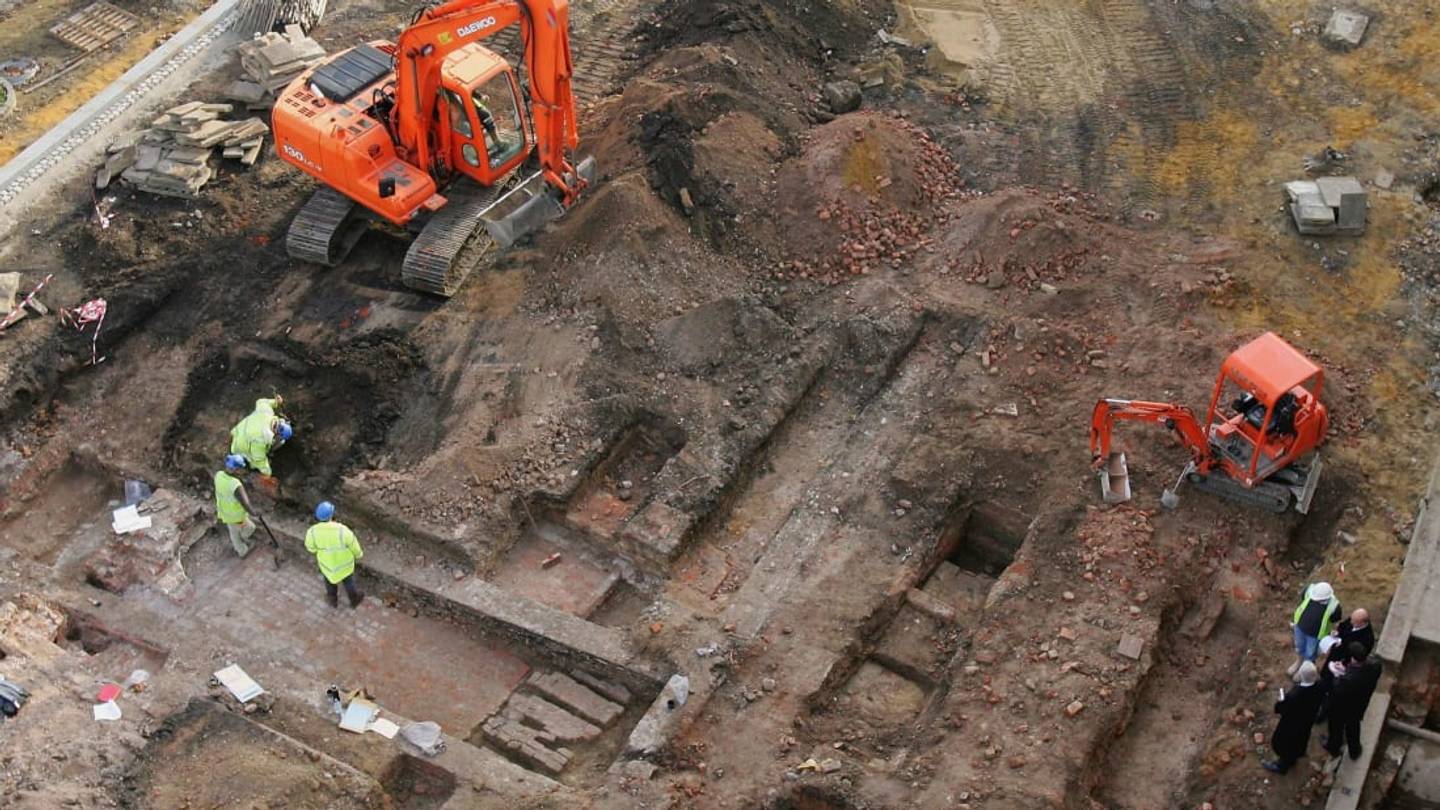
Parking lots are not exactly famous for glamour. They are the places where coffee spills, shopping carts migrate like confused metal wildlife, and everyone forgets where they parked. But beneath all that asphalt, striped concrete, and “compact cars only” signage, history sometimes waits patiently like it has a reservation.
Across the world, archaeologists and construction crews have discovered astonishing things buried under parking lots: lost kings, ancient jewelry, Roman cemeteries, forgotten churches, royal chapels, and even a dinosaur fossil hiding deep below a museum’s own pavement. These finds prove one thing: the most boring-looking patch of land in town might be sitting on centuriesor millions of yearsof drama.
This article explores 11 real things found buried under parking lots, with context, analysis, and a little humor because, honestly, a medieval king being found beneath a parking space deserves at least one raised eyebrow.
Why So Many Discoveries Happen Under Parking Lots
Parking lots often cover land in older city centers, former religious sites, demolished neighborhoods, and long-forgotten burial grounds. In many places, development moved faster than documentation. A monastery became a market. A market became a municipal building. A municipal building became a parking lot where someone later complained about hourly rates. The result is a layered urban cake: modern asphalt on top, history underneath.
Urban archaeology thrives in these places because construction projects often require surveys before digging. When workers peel back the surface, they sometimes reveal evidence that maps, legends, and archives could only hint at. Here are 11 of the most fascinating examples.
1. King Richard III’s Remains in Leicester, England
The most famous parking lot discovery may be the remains of King Richard III, the English monarch killed at the Battle of Bosworth Field in 1485. For centuries, his burial location was uncertain. Stories suggested his bones had been lost, moved, or tossed away during later upheavals.
Then, in 2012, archaeologists excavating a municipal parking lot in Leicester uncovered a skeleton at the site of the former Greyfriars friary. Scientific testing, including DNA analysis, helped confirm that the remains belonged to Richard III. It was a stunning moment: a king who had inspired plays, arguments, legends, and historical debates had spent centuries beneath parked cars.
The find changed the way many people saw urban archaeology. It proved that even heavily developed city centers can preserve extraordinary evidence. It also turned a plain parking area into one of the most talked-about archaeological sites of the 21st century.
2. The Lost Greyfriars Church
Richard III was not alone beneath that Leicester parking lot. The excavation also uncovered the remains of Greyfriars Church, the medieval friary church where the king had been buried after his death. The church had disappeared from view after the dissolution of the monasteries in the 16th century, when many religious houses in England were closed, sold, dismantled, or repurposed.
Finding the church mattered because it helped archaeologists confirm the location of Richard’s grave. It also gave historians a clearer understanding of medieval Leicester’s religious landscape. In this case, the parking lot was not just hiding a body; it was hiding the architectural footprint of a vanished religious institution.
That is what makes parking lot archaeology so compelling. A site may look flat and empty, yet beneath it lies a map of vanished streets, sacred spaces, and social memory.
3. A Lead Coffin Near Richard III
During further work around the Greyfriars site, archaeologists also investigated a stone coffin containing a lead coffin. Inside were the remains of an elderly woman, possibly a high-status individual or benefactor connected with the friary. At first, some expected the coffin might contain a knight or friar. Instead, it revealed another human story from the same lost religious world.
Lead coffins were expensive and unusual, which suggests the woman had importance, wealth, or strong social connections. Her discovery reminds us that archaeology is not only about famous names. Richard III got the headlines, but nearby burials can reveal equally important clues about class, faith, health, and community life.
In other words, the parking lot was not merely a royal hiding place. It was a layered burial landscape with stories still waiting to be sorted out.
4. Henry VIII’s Lost Royal Chapel in Greenwich
In Greenwich, south London, workers discovered the remains of a Tudor royal chapel beneath a parking lot. The site was connected with the Palace of Placentia, a major royal residence associated with the Tudor dynasty. Henry VIII, Mary I, and Elizabeth I all had strong connections to Greenwich, making the area deeply important to English royal history.
The discovery included tiled flooring and structural remains from a chapel that had long vanished from public view. The idea that a place once used by monarchs for worship could later become a parking lot is both funny and oddly poetic. History does not always disappear with a dramatic explosion; sometimes it gets quietly covered by clay, gravel, and a few badly parked sedans.
The find helped reconnect modern Greenwich with its Tudor past. It also showed how royal landscapes can survive in fragments beneath everyday urban surfaces.
5. A Medieval Knight’s Grave in Edinburgh
In Edinburgh, Scotland, construction work at a former parking lot uncovered a medieval grave marked by a carved stone slab bearing a cross and sword. The grave was linked to the area of a former Dominican friary, and archaeologists believed the burial may have belonged to a knight or nobleman.
Further excavation revealed additional skeletons nearby, possibly part of a family crypt or burial area. This was not simply a random lone grave; it pointed to a larger medieval religious and social setting beneath the modern city.
The carved slab made the discovery especially striking. A sword motif was a strong visual symbol, suggesting status and identity. It is the kind of detail that turns “construction delay” into “historical event.” For urban planners, it may be a headache. For archaeologists, it is a jackpot with a trowel attached.
6. A Roman Cemetery Under a Leicester Car Park
Leicester appears to have a talent for parking-lot surprises. In another part of the city, archaeologists uncovered a Roman-era cemetery beneath a car park near Oxford Street and Newarke Street. The burials dated to the later Roman period, when Leicester was part of Roman Britain.
The site included men, women, and children, along with different burial orientations and practices. That variety matters because it suggests a diverse community with multiple beliefs or traditions. Some burials seemed to reflect Christian influence, while others preserved older or different customs.
This discovery helps historians understand life and death in Roman Leicester. Cemeteries are not just places of loss; they are records of identity, belief, migration, and social change. Under the car park, archaeologists found evidence of a city negotiating cultural transitions almost 1,700 years ago.
7. The Ancient Greek Fortress of Acra in Jerusalem
One of the most historically significant parking lot discoveries happened at the Givati Parking Lot excavation in Jerusalem’s City of David. Archaeologists uncovered evidence believed to be the ancient Greek fortress known as the Acra, associated with the rule of Antiochus IV in the second century BCE.
The location of the Acra had been debated for more than a century. Ancient texts described it, but pinning it down on the modern map was difficult. Excavations beneath the parking lot revealed fortification remains that helped support the identification.
This discovery is important because the Acra was tied to major political and religious tensions in ancient Jerusalem. It was not just a military structure; it represented control, conflict, and imperial pressure. Beneath a modern parking area, archaeologists found evidence connected to one of the city’s most debated ancient mysteries.
8. A 2,000-Year-Old Gold Earring
The Givati Parking Lot has produced more than walls and fortifications. Archaeologists also discovered a delicate gold earring dating to the Hellenistic period. The ornament, decorated with the figure of a horned animal, offered a rare glimpse into fashion, wealth, and craftsmanship in ancient Jerusalem.
Jewelry discoveries are powerful because they feel personal. A fortress tells us about power. A wall tells us about construction. But an earring suggests a person: someone who owned it, wore it, lost it, treasured it, or passed it along. It is a small object with a strangely intimate voice.
That is the magic of archaeological artifacts. A tiny gold object can make the ancient city feel less like a textbook and more like a living place filled with real people who cared about beauty, status, and style.
9. The Feet of Pharaoh Amenhotep III
In Egypt’s Sohag Governorate, workers developing a parking lot uncovered part of a black granite statue connected to Pharaoh Amenhotep III, one of ancient Egypt’s most powerful rulers of the 18th Dynasty. The fragment included the feet of the statue, along with inscriptions that helped identify the royal figure.
Finding only the feet of a pharaoh sounds like the setup for a museum-themed comedy, but the discovery was genuinely important. Statue fragments can help scholars reconstruct ancient landscapes, religious sites, and patterns of reuse or destruction. Even a partial piece of a monument can carry names, titles, artistic style, and political meaning.
Amenhotep III ruled during a period of enormous wealth, artistic achievement, and royal building projects. So when a piece of his statue appears beneath a modern parking area, it is a reminder that ancient Egypt’s monumental world still lies scattered in unexpected places.
10. A Roman Imperial Cult Temple in Spello, Italy
In Spello, Italy, archaeologists led by researchers connected with Saint Louis University uncovered the remains of what may be a Roman imperial cult temple beneath a grass-covered parking lot. The discovery was linked to a fourth-century inscription associated with Emperor Constantine’s era.
The site is fascinating because it complicates a simple version of history. Many people imagine the Roman Empire switching from pagan traditions to Christianity like flipping a light switch. Archaeology shows something messier and more human. Old customs, imperial honors, civic rituals, and new religious identities overlapped for generations.
The temple remains may help scholars better understand how communities navigated that transition. Beneath a quiet parking area, researchers found evidence that religious change in the late Roman world was not neat, sudden, or tidy. History rarely is. It prefers messy footnotes and surprise holes in the ground.
11. A Dinosaur Fossil Beneath the Denver Museum’s Parking Lot
In 2025, the Denver Museum of Nature & Science made a discovery that sounds almost too perfect: a dinosaur fossil beneath its own parking lot. During a geothermal drilling and scientific coring project, researchers found a partial vertebra deep below the surface, likely from a plant-eating dinosaur that lived in the Late Cretaceous period.
The fossil was found hundreds of feet underground, making it very different from the shallow archaeological discoveries on this list. Instead of a medieval church or ancient jewelry, this parking lot concealed a window into Denver’s prehistoric environment, when the area was home to dinosaurs, vegetation, and ecosystems far removed from today’s city streets.
The discovery is almost poetic. A museum dedicated to natural history drilled below its own pavement and found natural history looking back. Somewhere, a dinosaur probably deserves a reserved parking space.
What These Parking Lot Discoveries Teach Us
These discoveries reveal a common truth: modern cities are built on older worlds. Parking lots may look temporary and ordinary, but they often sit on land that has been used, abandoned, rebuilt, renamed, and forgotten many times.
They also show why archaeological surveys matter. Without careful investigation, a royal grave might remain unknown, a Roman cemetery might be destroyed, or an ancient temple might be reduced to rubble before anyone understands what it is. Construction and archaeology can feel like opponents, but when handled responsibly, development can become a doorway into the past.
The best parking lot discoveries also challenge our assumptions about importance. We expect history in castles, museums, temples, and national parks. We do not expect it between a faded white line and a payment kiosk. Yet history is not impressed by our expectations. It hides wherever it survived.
Experience Section: What It Feels Like to Explore Hidden History Beneath Everyday Places
The most exciting part of stories like these is not only the discovery itself. It is the strange feeling they create afterward. Once you learn that kings, chapels, Roman graves, ancient jewelry, and dinosaur fossils have been found beneath parking lots, ordinary spaces stop feeling ordinary. A dull corner of a city suddenly becomes suspicious. A cracked pavement line starts looking like a clue. Even a “No Overnight Parking” sign begins to feel like it may be guarding a secret.
For travelers, these discoveries create a different way to experience historic cities. Instead of only visiting famous landmarks, pay attention to the gaps between them: service roads, courtyards, construction fences, vacant lots, and modern plazas. Many great discoveries happen not in postcard-perfect locations but in places people pass without thinking. That shift in attention makes travel richer. You begin to read a city vertically, not just horizontally. The street is the present; beneath it are older versions of the same place.
Museums and visitor centers connected to these discoveries can make the experience even more powerful. The Richard III Visitor Centre in Leicester, for example, turns a parking lot discovery into a story about science, identity, politics, and memory. Sites like this show how archaeology is not only about digging things up. It is about interpreting evidence carefully and helping the public understand why it matters.
There is also a lesson for local communities. People often think their town has “nothing interesting,” especially if it is full of supermarkets, garages, office blocks, and yes, parking lots. But history does not care whether a place looks cinematic. A former churchyard may become a shopping center. A Roman road may lie under a traffic route. A prehistoric fossil may rest below a museum’s asphalt. The landscape remembers more than the modern eye can see.
For anyone writing, researching, or creating content about hidden history, parking lot discoveries are gold. They combine surprise, mystery, science, and human stories. They are easy for readers to understand because the setting is so familiar. Everyone knows what a parking lot looks like. That is why the twist works so well: the ordinary surface contrasts with the extraordinary depth beneath it.
The next time you walk across a parking lot, you do not need to bring a shovelplease do not, property owners tend to dislike spontaneous archaeology. But you can bring curiosity. Ask what stood there before. Look up old maps. Visit local history archives. Notice plaques, street names, and odd changes in elevation. Sometimes the past announces itself with a monument. Other times, it waits quietly under the place where someone parked a minivan.
Conclusion
The 11 things found buried under parking lots prove that history is not always locked away in grand monuments. Sometimes it survives beneath asphalt, behind shopping centers, under former car parks, and deep below places designed for the most modern of habits: leaving your vehicle somewhere while you do errands.
From Richard III’s grave to a Roman temple in Italy, from a gold earring in Jerusalem to a dinosaur fossil in Denver, these discoveries remind us that the ground beneath our feet is not empty. It is layered with memory. Parking lots may be practical, plain, and occasionally overpriced, but beneath them may lie the next big story waiting for a careful dig.
Note: This publishable article is based on real reported archaeological and historical discoveries from museums, universities, archaeology organizations, and major science/history publications. Source links are intentionally not inserted into the article body for clean web publication.