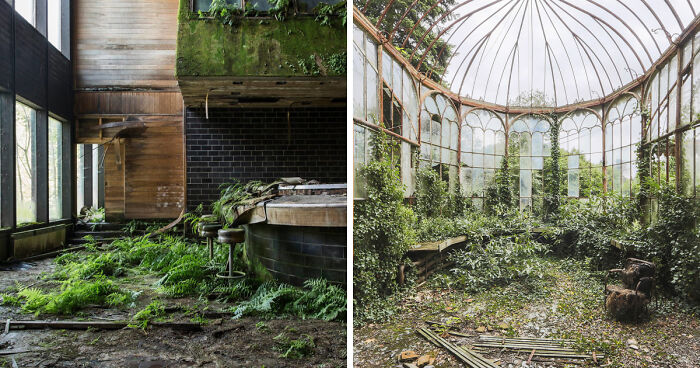
There is a strange moment that happens when you step into an abandoned place. At first, your eyes notice what humans left behind: cracked tiles, empty windows, rusted railings, peeling paint, a staircase leading nowhere with the confidence of a cat walking across your keyboard. Then, slowly, the real star of the scene appears. A vine curls through a broken doorway. A tree grows where a reception desk once stood. Moss softens concrete. Ferns take over a corridor. Nature, apparently, never received the memo that the building was closed.
This collection of 30 photos is a visual love letter to abandoned places reclaimed by nature around the world. It is not just about decay, although there is plenty of that. It is about transformation. These forgotten buildings, silent villages, old factories, derelict hotels, ruined churches, empty schools, and weather-beaten ships show what happens when human ambition clocks out and the natural world clocks back in.
The result is eerie, beautiful, funny, humbling, and occasionally a little dramatic. Nature does not redecorate politely. It does not ask whether the wallpaper is original. It sends roots through the floor, invites birds into the rafters, lays a carpet of leaves across the lobby, and turns a once-important room into a greenhouse with better lighting than most apartments.
Why Abandoned Places Reclaimed By Nature Fascinate Us
Abandoned places have always pulled at the imagination. They are part history lesson, part mystery novel, part architectural ghost story. But when nature takes over, the mood changes. A ruined building without greenery can feel sad or empty. A ruined building wrapped in vines feels alive again, even if not in the way its builders intended.
That contrast is what makes urban exploration photography so powerful. A cracked concrete wall says, “Something ended here.” A tree growing through that same wall says, “Something else began.” The camera catches both messages at once.
Many famous abandoned places around the world have become symbols of this tension. In Pripyat, Ukraine, the aftermath of the 1986 Chernobyl disaster forced people to leave an entire city behind. Decades later, trees and wildlife have returned to areas where human activity remains limited. In Houtouwan, China, an old fishing village has become known for houses covered in thick green vegetation. In Kolmanskop, Namibia, desert sand pours through abandoned homes once connected to the diamond trade. In Sorrento, Italy, the Vallone dei Mulini became famous because ferns and humidity turned old mill structures into a scene that looks almost invented.
These places remind us that abandonment is not the same thing as emptiness. The people may be gone, but the story keeps moving.
The Story Behind These 30 Photos
For this photo essay, the goal was simple: follow the green. I wanted to capture places where nature was not just decorating abandoned architecture but actively rewriting it. Some locations looked like movie sets for a post-apocalyptic drama. Others felt surprisingly peaceful, as if the building had finally stopped trying to impress anyone and decided to become a garden.
The 30 pictures in this imagined journey move across continents and climates. There are rooms swallowed by ivy, train tracks disappearing beneath weeds, old resort balconies framed by branches, factories where sunlight lands on wild grass, and windows where leaves press against the glass like impatient tourists.
What surprised me most was the variety. Nature does not reclaim every place the same way. In humid regions, vines and moss advance quickly, covering walls and roofs with almost theatrical confidence. In desert environments, sand becomes the main character, filling rooms with soft dunes and turning domestic interiors into surreal sculptures. In colder climates, trees and shrubs often move more slowly, but their patience is terrifyingly effective. Give them enough years and even concrete starts looking nervous.
What Nature Does First When Humans Leave
1. Plants Find the Weak Spots
Nature is an expert at noticing bad maintenance. A cracked wall, a broken window, a missing roof tile, a clogged drainthese are not problems to plants. They are invitations. Seeds arrive by wind, birds, animals, or muddy shoes. Once water and sunlight are available, the takeover begins.
At first, the changes are small: a tuft of grass in a stairwell, moss along a window ledge, a fern in a damp corner. Then roots widen cracks, moisture enters deeper, wood softens, paint peels, and the building becomes less like a sealed human object and more like a landscape.
2. Water Becomes the Architect
In many abandoned places, water does more than any wrecking ball. Rain slips through broken roofs. Humidity blooms in closed rooms. Pipes burst. Floors warp. Metal rusts. Once moisture is inside, nature has a foothold. That is why abandoned mills, bathhouses, greenhouses, hotels, and coastal buildings often become the most visually dramatic examples of nature taking back abandoned places.
In places like Vallone dei Mulini, a humid microclimate helped plants thrive around old structures. In shipwrecks such as the SS Ayrfield in Australia, water and mangroves created one of the most unforgettable images of natural reclamation: a floating forest growing from a rusting vessel.
3. Animals Move In Like They Paid the Deposit
When people leave, animals often become the new residents. Birds nest in rafters. Foxes pass through schoolyards. Insects turn rotting wood into entire neighborhoods. In some large abandoned zones, wildlife can return in remarkable numbers, especially when human pressure drops dramatically.
This does not mean every abandoned place becomes paradise. Some sites are contaminated, unstable, or ecologically damaged. But it does show that the absence of constant human activity can create unexpected space for life. Even a cracked parking lot can become a tiny habitat when grasses, insects, and birds begin to use it.
30 Photos, 30 Small Reminders
Each of the 30 photos in this collection tells a slightly different story. One image might show a mansion staircase wrapped in vines, making the place look like it hired a forest as an interior designer. Another might show a factory floor where weeds grow in neat rows of sunlight, as if the building decided to become a greenhouse after retirement.
There is a photograph of a forgotten greenhouse where the plants are no longer contained by the structure; they have become the structure. Another frame captures an old theater with leaves scattered across the seats, as if the audience arrived early and photosynthesized while waiting for the show. In one image, a classroom is half-filled with green growth, turning a chalkboard into a backdrop for a lesson that no one had to write: everything changes.
The funniest scenes are often the most human. A chair remains perfectly placed in a ruined room, while plants politely ignore the seating arrangement. A bathtub sits in a house filled with sand. A hotel corridor grows its own miniature jungle, which is arguably better than the hallway carpet in many budget motels. These details make abandoned places feel less like ruins and more like awkward collaborations between people and the planet.
Famous Examples Of Nature Taking Back Abandoned Places
Pripyat, Ukraine
Pripyat is one of the most haunting examples of an abandoned city. After the Chernobyl nuclear accident in April 1986, residents were evacuated, leaving homes, schools, amusement facilities, and public spaces behind. Over time, vegetation pushed into streets, courtyards, and buildings. The story is complicated and serious because radiation remains part of the landscape, but visually, Pripyat shows how quickly a city can start to blur into forest when people are removed from the equation.
Houtouwan, China
Houtouwan was once a fishing village. Today, it is famous for houses covered in greenery, with vines climbing walls and roofs until architecture and vegetation seem stitched together. It is one of those places that looks less abandoned than enchanted, as if the village did not fail but was quietly adopted by the hillside.
Kolmanskop, Namibia
Kolmanskop tells a different kind of reclamation story. Instead of vines, the desert does the work. Sand fills rooms, piles against doors, and slides across floors where people once lived. The effect is dreamlike and unsettling. It is nature’s version of a soft blanket, except the blanket weighs several tons and has no respect for furniture.
Angkor and Beng Mealea, Cambodia
In Cambodia, temple ruins show a more ancient relationship between architecture and the natural world. Massive roots grip stone, moss softens carvings, and trees grow around structures in ways that seem both destructive and protective. Places like Angkor and Beng Mealea remind us that reclamation is not always about modern abandonment. Sometimes it is part of a much longer conversation between culture, climate, faith, and forest.
SS Ayrfield, Australia
The SS Ayrfield is one of the most photogenic examples of nature’s creativity. This old ship, left in Homebush Bay, now supports mangrove growth. It looks like a vessel carrying a forest instead of cargo. If plants ever start a shipping company, this is clearly their flagship.
The Beauty Is Real, But So Are The Risks
It is easy to romanticize abandoned places, especially when photos make them look like secret gardens with better mood lighting. But these sites can be dangerous. Floors collapse. Roofs shift. Metal rusts. Glass hides under leaves. Some buildings contain asbestos, chemical residue, mold, unstable staircases, or wildlife that would strongly prefer not to be part of your Instagram adventure.
Ethical abandoned-place photography matters. That means respecting private property, local laws, historical value, and the communities connected to these sites. It also means not damaging what remains. The best approach is simple: take photos, leave the place unchanged, and never treat someone else’s history like a playground.
There is also a deeper ethical question. Some abandoned places are tied to disasters, displacement, war, economic collapse, or environmental harm. The greenery may be beautiful, but the story behind it may be painful. Good photography should make room for both the beauty and the weight.
Why These Images Feel So Emotional
Photos of abandoned places reclaimed by nature are popular because they speak to several feelings at once. There is nostalgia for what used to be. There is curiosity about who lived, worked, danced, studied, prayed, or waited there. There is awe at the patience of plants. And there is a tiny pinch of existential comedy: humans spend years planning buildings, and nature walks in later like, “Cute. I’ll take it from here.”
These images also challenge the way we think about permanence. A factory may look powerful when it opens. A hotel may look glamorous on opening night. A school may feel like the center of a neighborhood. But without care, use, and repair, even the strongest structures begin to surrender.
That surrender is not always defeat. Sometimes it becomes a new kind of beauty. The abandoned greenhouse becomes a wild garden. The old wall becomes a trellis. The cracked courtyard becomes a meadow. The empty room becomes a habitat. Nature does not erase the past all at once. It layers itself over the past until the place becomes both memory and ecosystem.
What We Can Learn From Nature Reclaiming Abandoned Places
These 30 photos are not just pretty ruins. They are reminders of resilience, waste, adaptation, and time. They show how quickly human spaces can change when our routines disappear. They also raise questions about how cities could design with nature instead of constantly fighting it.
Urban ecologists have increasingly recognized that vacant lots, brownfields, and forgotten corners can have ecological value when handled responsibly. Some neglected sites become habitats for plants, insects, birds, and small animals. Others can be cleaned, restored, and transformed into green spaces. Not every abandoned place should simply be left alone, especially if contamination or structural danger is present. But the idea is powerful: land does not have to be “useful” only when it is paved, sold, rented, or fenced.
In a world facing climate stress, biodiversity loss, and rapid urban growth, these places offer a strange kind of hope. They suggest that nature is not weak. It is patient. It waits at the edges, in the cracks, under the pavement, above the roofline, and around the fence. When given even a little room, it begins again.
Experience Notes: What Photographing Reclaimed Places Taught Me
After spending time with abandoned places through a camera lens, I started noticing the world differently. At first, I was chasing dramatic images: the grand staircase, the vine-covered mansion, the hotel lobby that looked like it had been swallowed by a jungle with excellent taste. But the more I looked, the more the small details became the real story.
A single leaf growing through a cracked tile could feel more powerful than an entire ruined factory. A sapling in a window frame could say more about time than a collapsed roof. In one forgotten room, I remember seeing a line of sunlight fall across a floor covered in dust and tiny green shoots. Nothing about it was loud. There was no grand cinematic moment. Just light, dust, and plants doing what plants do: continuing.
The experience also changed how I think about silence. Abandoned places are not truly silent. They creak, drip, flutter, rustle, and breathe. Wind moves through broken glass. Birds argue in the rafters like tiny landlords. Leaves scratch against walls. Somewhere, water taps steadily into a bucket that no one placed there on purpose. If you stand still long enough, the place starts to sound less empty and more occupied.
Photographing these sites also made me more aware of how temporary human design can be. We build with confidence. We name buildings, number rooms, polish floors, install signs, and assume the system will continue. Then business fails, industry moves, people relocate, disasters happen, or maintenance stops. A place that once felt permanent becomes fragile. Nature does not mock that fragility, but it does expose it.
One of the biggest lessons is that beauty does not always arrive neatly. Sometimes it grows through broken concrete. Sometimes it hangs from a ceiling. Sometimes it is tangled, damp, inconvenient, and impossible to control. The most memorable photos were not the cleanest compositions but the ones where order and wildness were locked in a strange handshake.
I also learned that abandoned-place photography should be approached with humility. These are not just “cool ruins.” They may be former homes, workplaces, hospitals, schools, sacred spaces, or sites of loss. A good photo should not turn pain into decoration. It should invite curiosity and respect. The best images leave viewers with questions, not just applause.
By the end of the journey, I realized that nature taking back abandoned places is not a simple revenge story. It is not “humans bad, plants good,” even if the plants are clearly winning on style. It is more complicated and more interesting. These places show that the world is always changing hands. We shape land for a while, then weather, roots, animals, and time reshape it again.
That is why the 30 photos stay with me. They are not only images of decay. They are portraits of return. They show the planet quietly editing our work, softening our sharp edges, and reminding us that every wall is temporary, every road can crack, and every forgotten corner might someday bloom.
Conclusion
I Took Photos Of Nature Taking Back Abandoned Places All Over The World (30 Pics) is more than a collection of haunting images. It is a reminder that the natural world is persistent, inventive, and occasionally a much better decorator than we are. From vine-covered villages to sand-filled homes, from ruined temples to shipwreck forests, these abandoned places reveal what happens when human presence fades and nature gets the keys back.
The beauty of these scenes comes from contrast. They are sad and hopeful, broken and alive, forgotten and full of movement. They ask us to look at ruins not only as endings, but as transitions. A place can lose its original purpose and still become meaningful. A building can fall apart and still shelter life. A city can empty and still grow green.
In the end, nature taking back abandoned places is not just a visual trend. It is a lesson in time, humility, and renewal. We may build the walls, but nature always keeps a copy of the blueprint.