Earth is supposed to be reliable. It spins, it orbits, it stubbornly insists on making us drop toast butter-side down. Gravity, in particular, is usually the steady grown-up in the room. So when scientists later discovered that Earth’s gravity field developed a strange, continent-scale anomaly over the eastern Atlantic in the late 2000s, it sounded less like normal geophysics and more like the planet quietly muttering, “Don’t panic, but something weird just happened.”
The event was invisible to people on the ground. No one spilled coffee because of it. No city alarm went off. No dogs looked suspiciously at the floorboards. But satellites noticed. Years later, researchers analyzing data from the GRACE mission found a giant gravity anomaly that built up between 2006 and 2008 and peaked in January 2007. The best explanation so far was not a storm, not an ocean wobble, and not some dramatic Hollywood crack in the crust. Instead, the answer appears to have been far deepernear the base of the mantle, close to the boundary above Earth’s core.
That makes this story one of the most fascinating kinds in modern science: a discovery where the clue came from space, the suspect was hidden 1,800 miles underground, and the evidence had to be reconstructed from tiny changes in mass, mineral structure, and magnetic behavior. In other words, geology decided to dress up as a detective thriller.
What actually “glitched” in Earth’s gravity?
First, a helpful reality check: Earth’s gravity did not shut off, reverse, or forget its job for a weekend. What changed was the gravity fieldthe subtle way gravity varies from place to place depending on how mass is distributed inside and on the surface of the planet.
That variation is completely normal. Mountains, ocean trenches, groundwater, ice sheets, and dense rock formations all affect gravity slightly. The strange part here was the scale, timing, and pattern. Scientists identified a north-south-oriented anomaly over the eastern Atlantic, stretching roughly 4,350 miles. One zone showed stronger-than-expected gravity next to a zone with weaker-than-expected gravity, like the planet had briefly shifted weight from one cosmic foot to the other.
The signal did not behave like the usual surface-level suspects. Water movement, ocean circulation, and other near-surface mass changes explain a lot of what GRACE normally sees, but not this event on its own. After testing those possibilities, researchers concluded that surface processes could not fully account for the anomaly’s intensity and structure.
That is where the story gets deliciously weird. When surface explanations fall short, geophysicists start looking down. Way down.
How satellites caught a mystery humans could not feel
The anomaly was found in data from the Gravity Recovery and Climate Experiment, or GRACE, a twin-satellite mission launched in 2002. GRACE did not measure gravity by dangling a cartoon apple from orbit. Instead, the two satellites flew in tandem and tracked tiny changes in the distance between them.
If the leading satellite passed over a region with slightly stronger gravity, it sped up first, stretching the distance between the pair. When the trailing satellite reached the same region, it caught up. By measuring those minute changes again and again, scientists built maps of Earth’s shifting gravity field over time.
That method is brilliant because gravity is basically mass made visible by mathematics. If mass moveswhether as groundwater, ice, ocean water, or dense material deep inside Earththe gravity field changes too. GRACE became famous for tracking ice loss, drought, and water storage, but its data can also reveal subtler geophysical events when researchers know where and how to look.
In this case, the satellites recorded a signal that stood out from the usual environmental noise. The anomaly was not obvious to everyday life because the effect was tiny at the surface. But from a planetary science perspective, it was a flashing neon sign that some mass somewhere had rearranged itself on a very large scale.
Why scientists think the answer was underground
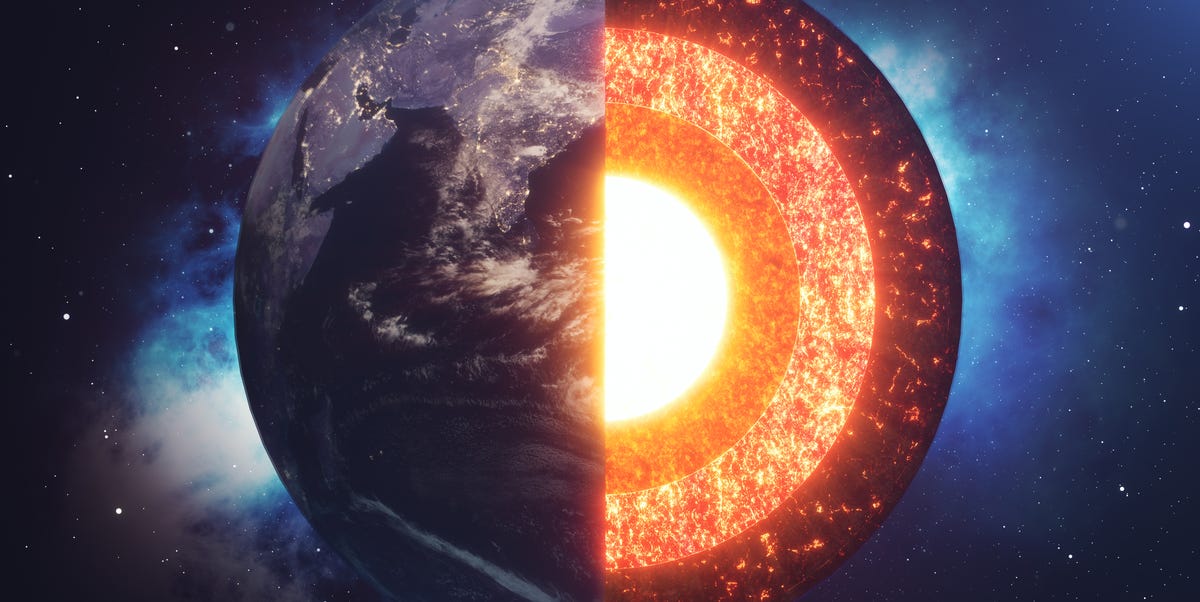
The leading explanation points toward the lowermost mantle, near the core-mantle boundary. That boundary sits about 2,900 kilometers, or roughly 1,800 miles, below the surface. It is one of the most extreme neighborhoods on Earth: crushing pressure, searing temperatures, and the awkward reality that the rocky mantle meets the liquid outer core there.
This zone matters because it helps govern how heat and material move through the planet. It also appears to influence the behavior of Earth’s magnetic field. So if something changed rapidly near that boundary, it could leave fingerprints in more than one dataset.
That is exactly what made the 2007 event so intriguing. The gravity anomaly appeared around the same time as a geomagnetic jerkan abrupt change in the rate of variation of Earth’s magnetic field. Geomagnetic jerks are still not fully understood, but scientists know they reflect fast changes linked to processes in or near the core. Having a gravity anomaly and a magnetic event show up in the same broad region and time window is the kind of coincidence that makes researchers sit up very straight.
They did not jump straight to a dramatic conclusion, because science is less “Eureka!” and more “Let’s rule out twelve boring possibilities first.” But the overlap suggested that a deep-Earth process may have influenced both gravity and magnetism.
The mineral plot twist: bridgmanite and post-perovskite
To understand the proposed cause, we need to meet a mineral most people have never heard of: bridgmanite. It is believed to be the most abundant mineral on Earth, which is a little rude considering how rarely it gets invited into ordinary conversation.
Bridgmanite exists in the lower mantle under intense pressure and temperature. Under even more extreme conditions near the base of the mantle, it can transform into another structure called post-perovskite. That transformation is known as a phase transitionsame general chemistry, different crystal structure, different physical behavior.
Why does that matter? Because phase transitions can alter density. And when density changes across a large region deep inside Earth, mass gets redistributed. Move enough mass, and the gravity field notices. If that rearrangement also modifies topography at the core-mantle boundaryor changes how heat and flow behave nearbyit could help explain why a magnetic jerk appeared around the same time.
In plain English: a hidden mineral makeover deep inside Earth may have reshaped mass distribution enough for satellites in space to catch it. That is absurdly cool.
Researchers proposed that rapid mass redistribution linked to this lower-mantle phase transition may have produced the anomaly. The key word, of course, is may. This is currently the best-supported explanation, not a final signed confession from the planet itself. Earth does not do press conferences.
Why the finding matters beyond one odd signal
This is not just a story about a one-off gravity anomaly. It is a story about how dynamic Earth’s deep interior may be on relatively short timescales. For a long time, the deepest parts of the mantle were often imagined as slow-motion territory, where important things happen over millions of years and nobody should expect a plot twist by next Tuesday.
The new interpretation suggests some deep processes may unfold over a span of just a few years. That is a big deal. It means the deep mantle may not always be a geological sloth. Sometimes it might be a sloth with a deadline.
If future studies confirm that phase transitions near the core-mantle boundary can generate measurable, fast changes in gravity and possibly affect magnetic behavior, scientists gain a new tool for probing Earth’s interior. Instead of relying only on seismic waves and laboratory mineral physics, they can also use satellite gravimetry and magnetic observations as a kind of remote diagnostic kit for the inaccessible deep planet.
That matters for the broadest possible reason: the deep Earth helps shape the world above it. Mantle convection affects volcanism, plate tectonics, heat transfer, and long-term planetary evolution. The core helps drive the magnetic field that protects Earth and supports navigation systems. Understanding how those systems interact is not just an academic flex. It is part of understanding how the planet actually works.
What the discovery does not mean
Let’s calmly kick a few bad interpretations into a tidy bin.
No, gravity did not fail.
This was not a global collapse of gravity or anything people would have directly experienced in daily life. It was a subtle regional anomaly in the gravity field, detectable through precision satellite measurements.
No, this was not a disaster warning people missed.
The event was discovered in archived data and interpreted years later. There is no evidence that it caused surface chaos, and there is no reason to imagine people in 2007 were secretly walking around in a science-fiction episode.
No, the mystery is not completely solved forever.
The proposed explanation is strong and physically plausible, but deep-Earth science is hard. We cannot stroll down to the core-mantle boundary with a clipboard and a flashlight. The hypothesis now needs further modeling, comparison with other datasets, and a search for similar events in the GRACE and GRACE-FO record.
Why this story grabs people so hard
Because it reminds us that Earth is not a finished object. It is an active system with hidden machinery. We live on the skin of a planet whose deeper layers still keep secrets from us, and every now and then one of those secrets leaks upwardnot as lava, not as an earthquake, but as a whisper in data.
There is also something deliciously humbling about the scale of it. Human beings were busy in 2007 launching phones, posting online, commuting to work, and arguing about coffee prices while a vast geophysical event may have been unfolding 1,800 miles below the Atlantic. The planet was running background processes like an overachieving operating system, and we did not notice until satellites and patient scientists reconstructed the evidence years later.
That is the charm of modern Earth science. It turns invisible processes into stories we can follow. A fluctuation in satellite spacing becomes a clue. A magnetic jerk becomes corroborating evidence. A mineral phase transition becomes the deep-Earth mechanism. Suddenly, a seemingly goofy headline about a gravity glitch becomes a serious and fascinating case study in how science pieces together reality from almost impossibly tiny signals.
Experience: what it feels like to chase an invisible planetary event
One of the most relatable parts of this story is not the mineral physics or the satellite engineering. It is the human experience of discovery when the subject is something no one can directly see, hear, or feel. A gravity anomaly like this does not arrive with drama. It arrives as datanumbers, residuals, suspicious patterns, and the unnerving possibility that your software is either brilliant or lying to you.
For researchers, that kind of experience is usually less like a movie montage and more like a long, stubborn conversation with uncertainty. First comes curiosity: a signal appears that does not fit expectations. Then comes skepticism. Is it instrument noise? A processing artifact? An unmodeled ocean effect? A weird seasonal fluke? Scientists are trained to distrust exciting answers until boring answers have been thoroughly interrogated. That discipline may sound dull, but it is actually the engine of reliable discovery.
There is also a strange emotional texture to working on deep-Earth problems. You are trying to understand a place you cannot visit, cannot sample directly, and cannot observe in any normal sense. The lowermost mantle is not just remote; it is fundamentally beyond human reach. So the experience becomes one of translation. Researchers learn to treat gravity, magnetism, seismic behavior, and mineral experiments as different dialects of the same hidden language. When those dialects begin to agree, the feeling is not merely intellectual. It is almost intimate, as if the planet has finally decided to answer one question while generating five more.
For science readers, the experience is different but equally compelling. Stories like this reshape your sense of ordinary life. You realize that while you are checking the weather, the planet has a deep interior engaged in processes vast enough to alter gravity and subtle enough to hide from human senses. That realization can make everyday existence feel larger, stranger, and frankly more fun. Suddenly “solid ground” stops sounding so simple.
There is wonder in that, but also perspective. Discoveries like this remind us that not all important events announce themselves loudly. Some are only visible after years of observation, careful modeling, and the patience to revisit old data with new questions. In a culture obsessed with instant answers, that may be the most valuable experience of all: seeing how science rewards humility, persistence, and the willingness to say, “Something is off here. Let’s keep looking.”
And maybe that is why this gravity story sticks. It is not just about a glitch in Earth’s field. It is about the experience of living on a planet that is still introducing itself.
Conclusion
So what happened 18 years agomore precisely, from 2006 to 2008 with a peak in January 2007was not a failure of gravity but a remarkable shift in Earth’s gravity field. Satellites detected the signature long before humans understood it. Researchers now think the most likely cause was a rapid redistribution of mass deep in the mantle, possibly triggered by a mineral phase transition near the core-mantle boundary.
If that interpretation holds up, the discovery marks a major step in deep-Earth science. It suggests that the planet’s interior can change in measurable ways over only a few years, and that satellite gravimetry can reveal events unfolding far below the crust. That is a stunning thought: the deep Earth is not silent, and space-based instruments are learning how to hear it.
In the end, the headline is irresistible because it is both dramatic and true in spirit. Earth’s gravity really did do something odd. And the answer really was undergroundvery, very underground.