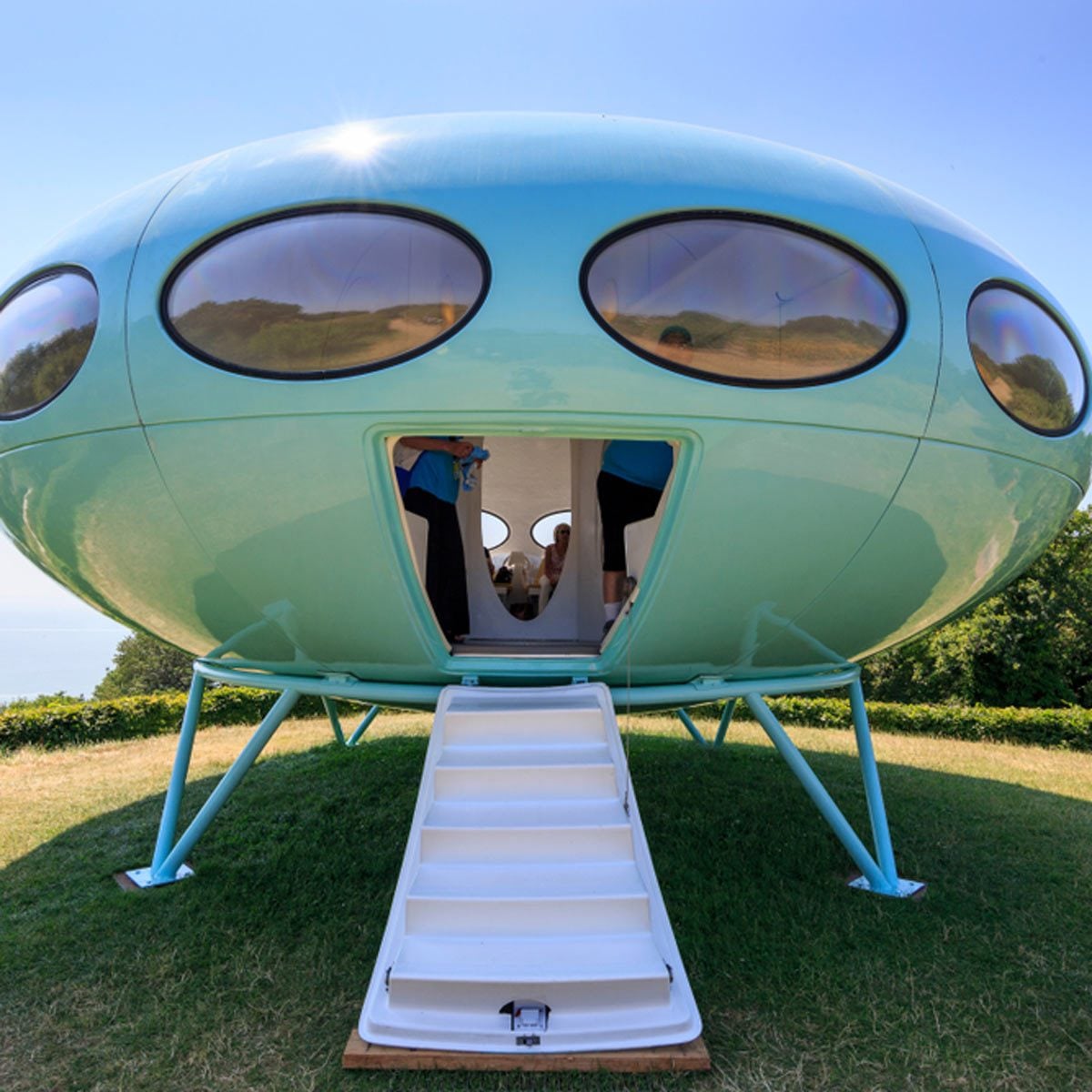
Some houses politely blend into the neighborhood. Others look as if they landed during a lightning storm, scanned the humans, and decided the cul-de-sac would do nicely. These are the homes that make delivery drivers slow down, tourists whisper “Is that legal?”, and architecture fans reach for their cameras before their coffee.
Alien-looking houses are not just weird for the sake of weirdness. Many of them come from serious architectural movements: Space Age optimism, organic architecture, desert modernism, biomimicry, sustainable off-grid design, and the eternal human desire to say, “What if the living room was shaped like a spaceship?” From UFO cabins to mirror houses, from concrete creatures to dome homes that resemble moon bases, these residences prove that imagination can move in, unpack, and install a very strange front door.
Below are 26 real houses and house-like retreats that could easily convince you an extraterrestrial has excellent taste in real estate.
Why Alien-Looking Houses Fascinate Us
The best unusual houses create a tiny glitch in reality. We expect homes to have predictable roofs, square rooms, polite windows, and a front porch that does not appear to be preparing for takeoff. When a house is round, mirrored, buried, balanced on a column, or shaped like a shell, our brains immediately file it under “possible alien activity.”
But futuristic homes often solve practical problems. Domes can be efficient and strong. Earth-sheltered homes can help regulate temperature. Mirrored facades can reduce visual impact in delicate landscapes. Organic architecture can make a building feel like part of the terrain instead of a box dropped on top of it. In other words, the weirdness usually has a job. It just happens to wear silver boots while doing it.
26 Alien-Looking Houses That Actually Exist
-
Futuro House, Idyllwild, California
The Futuro House is the celebrity of UFO-style architecture. Designed by Finnish architect Matti Suuronen in the late 1960s, its flying-saucer form, porthole windows, and portable concept made it look ready for both ski weekends and interplanetary errands. The Idyllwild example, tucked among California pines, feels like a spaceship that chose a quiet mountain retirement.
-
Area 55 Futuro House, Joshua Tree, California
Joshua Tree already looks like a planet NASA forgot to label, so a restored Futuro House fits perfectly. With its rounded shell and desert setting, Area 55 gives off strong “friendly alien vacation pod” energy. It is retro, compact, and wonderfully dramatic against the wide-open sky.
-
Marston Park Futuro, United Kingdom
This restored Futuro sits in a woodland setting and proves that a UFO does not need flashing lights to be theatrical. The contrast between soft greenery and glossy saucer geometry makes it look as if the forest has accepted a new species of mushroomone with better insulation and a taste for midcentury design.
-
Nevlunghamn Futuro, Norway
Used as a summer house, this Futuro shows how Space Age design can feel playful instead of cold. Its round body, elevated stance, and compact interior suggest a home built for people who pack lightly and think rectangles are overrated.
-
Dombai Futuro, Russia
Perched in a mountain landscape, the Dombai Futuro has the cinematic confidence of a base camp for cosmic explorers. It is one of those structures that makes you wonder whether the owner is serving tea or receiving transmissions from Saturn.
-
Spaceship House, Signal Mountain, Tennessee
The Spaceship House in Tennessee is not subtle, and thank goodness. Raised on legs with a saucer-like body and a dramatic entrance, it looks like it accidentally parked near Chattanooga and decided the view was too good to leave. Inside, its rounded rooms complete the illusion that you are living inside a very polite spacecraft.
-
UFO Welcome Center, Bowman, South Carolina
Part folk art, part roadside legend, the UFO Welcome Center was built as a place where aliens could theoretically stop, rest, and perhaps ask for directions. Even though the structure is now gone, its story remains a perfect example of outsider architecture: handmade, humorous, sincere, and impossible to ignore.
-
Sculptured House, Genesee, Colorado
Also known as the Sleeper House, this elliptical home sits high in the Colorado landscape like a sleek alien observation deck. Its curved shell and mountaintop position give it a futuristic profile that made it famous long before “viral architecture” became a phrase.
-
Chemosphere, Los Angeles, California
John Lautner’s Chemosphere is one of America’s great gravity-defying houses. Balanced on a concrete column above a steep Los Angeles hillside, the octagonal home looks like a UFO decided to respect local zoning by becoming a permanent residence. It is futuristic, elegant, and still astonishing decades after its completion.
-
Volcano House, Newberry Springs, California
A saucer-shaped home on top of an extinct volcanic cinder cone sounds like a villain’s hideout, a sci-fi film set, and an extreme Airbnb wishlist item all at once. The Volcano House rises over the Mojave Desert with panoramic views that make ordinary backyards seem tragically undercommitted.
-
Invisible House, Joshua Tree, California
The Invisible House is less “alien landed here” and more “alien activated stealth mode.” Its mirrored facade reflects the desert so completely that the long rectangular home appears to vanish into rocks, sky, and sunlight. If a spaceship wanted privacy, this would be its dream address.
-
Doolittle House, Joshua Tree, California
Designed by Kendrick Bangs Kellogg, the Doolittle House looks like the fossilized skeleton of a desert creature from another galaxy. Its ribbed concrete structure rises from the boulders, while handcrafted interiors make the home feel less built than grown. It is organic architecture with a dramatic desert opera soundtrack.
-
Robert Bruno’s Steel House, Ransom Canyon, Texas
Robert Bruno’s Steel House is a hulking, hand-welded sculpture that happens to contain living space. With its dark steel body, stained glass, and creature-like stance above Ransom Canyon, it could be a spacecraft, an insect, a dragon, or the architectural version of heavy metal music.
-
Flintstone House, Hillsborough, California
The Flintstone House is famous for its bulbous domes, bright colors, and cartoonish landscaping. While people often compare it to a prehistoric fantasy, it also has a strangely extraterrestrial quality, like a colony of cheerful moon bubbles that got lost near Interstate 280.
-
Mushroom House, Cincinnati, Ohio
The Cincinnati Mushroom House feels like something that sprouted after a meteor shower. Designed with shingled, fungal forms and a bulbous roofline, it turns a city street into a fairytale scene. If aliens studied mushrooms before designing Earth homes, this might be the result.
-
Frey House II, Palm Springs, California
Albert Frey’s hillside home in Palm Springs incorporates a massive boulder directly into the interior. The result is minimal, modern, and slightly surreal. It feels less like humans conquered the desert and more like the desert agreed to share a room.
-
Elrod House, Palm Springs, California
Another John Lautner masterpiece, the Elrod House is famous for its circular living room, sculptural concrete dome, and cinematic desert glamour. The house feels like a luxury command center for someone who hosts cocktail parties and occasionally checks the orbit of Venus.
-
Circular Sun House, Phoenix, Arizona
Frank Lloyd Wright’s Circular Sun House, also known as the Norman Lykes House, wraps around the landscape in curves rather than corners. Its circular forms and desert setting make it feel futuristic without losing warmth, proving that alien-looking architecture can still be deeply human.
-
Earthship Homes, Taos, New Mexico
Earthships look like eco-conscious moon bases built by people who know how to reuse tires, bottles, and sunlight. These off-grid homes are designed for self-sufficiency, using thermal mass, recycled materials, and passive solar principles. They are strange, smart, and refreshingly rebellious.
-
Wonder Haus, Pagosa Springs, Colorado
Wonder Haus is an earth-sheltered retreat with a stargazing tower, which is frankly the kind of feature every alien-looking house should include. Built into the ground for efficiency, it combines hobbit charm, space observatory vibes, and the cozy suspicion that something magical is happening upstairs.
-
Shell House, Catskills, New York
A monolithic dome home in the Catskills, Shell House has the soft, curved silhouette of a futuristic bunker with better manners. Its half-moon form and dramatic window wall make it feel both protective and open, like a spacecraft designed by someone who loves forest views.
-
Geodesic Dome House, Becket, Massachusetts
Geodesic dome homes are architectural geometry with a sense of adventure. A renovated dome in the Berkshires shows how triangular structure can become surprisingly warm and livable. From the outside, however, it still looks ready for a science fair judged by extraterrestrials.
-
Grotto Dome House, Lake Austin, Texas
The Grotto Dome House in Austin turns organic curves into waterfront living. Its rounded form, skylight, and nature-heavy atmosphere create the feeling of stepping into a gentle cave from the future. It is less “take me to your leader” and more “take me to the lake.”
-
Casa Orgánica, Naucalpan, Mexico
Javier Senosiain’s Casa Orgánica is a landmark of organic architecture, with curving walls, earth-hugging forms, and spaces that feel more grown than assembled. It looks like a soft underground organism designed for comfort, color, and the complete elimination of boring hallways.
-
Bubble Palace, Théoule-sur-Mer, France
Bubble Palace, designed by Antti Lovag and associated with Pierre Cardin, is a wild Mediterranean fantasy of interconnected spheres. With round rooms, porthole windows, gardens, pools, and an amphitheater, it looks like a luxury resort built for a civilization that banned right angles for emotional reasons.
-
Casa Bola, São Paulo, Brazil
Eduardo Longo’s Casa Bola is a spherical home built above an urban structure, turning the dream of portable, lightweight living into a real architectural experiment. Its ball-like form feels playful, radical, and surprisingly practicala tiny planet for one very imaginative Earthling.
What These Extraterrestrial Houses Teach Us About Design
The most memorable futuristic homes share one important quality: they challenge the default settings of domestic life. A normal house says, “Here is a bedroom, here is a kitchen, here is a roof.” An alien-looking house asks, “What if the roof was the personality? What if the window was a porthole? What if the living room was a cave, a cockpit, or a bubble?”
These unusual houses also prove that strange architecture is not always a gimmick. The Futuro House explored prefabrication and portability. Earthships reimagined waste as building material. The Invisible House uses reflection to blend with its landscape. Frey House II and the Doolittle House treat desert rocks not as obstacles but as collaborators. Even the funniest homes on the list have something to say about risk, craft, identity, and the joy of refusing to be beige.
For homeowners, the lesson is not that everyone needs a flying saucer in the backyard, although that would certainly improve neighborhood meetings. The real lesson is that houses can be more than containers. They can be arguments, artworks, experiments, shelters, jokes, symbols, and personal manifestos with plumbing.
Experience: What It Feels Like to Visit an Alien-Looking House
Visiting an extraterrestrial-looking house is different from visiting a normal landmark. With a regular historic home, you admire the trim, read the plaque, and behave like a responsible adult. With a UFO house, all dignity leaves your body immediately. You slow down, squint, circle back, and say something deeply scholarly like, “Whoa.”
The first sensation is usually scale confusion. Photos rarely prepare you for how odd these homes feel in their actual setting. A Futuro House in a forest looks smaller than a spaceship but stranger than a cabin. The Invisible House in the desert plays tricks with distance because the sky appears to run across its walls. A dome house beside ordinary homes can make the whole street look like someone accidentally mixed two video games together.
Then comes the texture. Alien-looking houses are not just shaped differently; they feel different before you even touch them. Steel seems heavier. Concrete ribs feel ancient. Mirrored glass feels untouchable, like it belongs to the horizon. Earthship walls have a handmade toughness that makes conventional drywall seem emotionally fragile. These materials change your mood. You start imagining weather, heat, silence, echo, and night skies.
The best part is watching other visitors react. People do not simply look at these houses; they negotiate with them. Some laugh. Some take thirty photos from the same angle, because apparently one saucer picture is never enough. Some become instant architecture critics, making confident statements about load-bearing curves despite never having built anything more complicated than a bookshelf. Children usually understand these homes fastest. They do not ask why a house looks like a spaceship. They ask where the aliens sleep.
Inside, when tours or rentals are available, the experience becomes even stranger. Curved walls make movement feel cinematic. Round rooms soften your sense of direction. Low, earth-sheltered interiors can feel like caves, while glassy desert houses can make you feel exposed to the entire universe. You become aware of habits you never noticed: reaching for corners, expecting flat ceilings, assuming windows will behave. These houses politely disrupt all of that.
There is also a quiet emotional surprise. Many alien-looking homes are funny at first glance, but the longer you look, the more sincere they become. Someone cared enough to weld steel by hand for decades, preserve a fragile Futuro pod, build sustainably from discarded materials, or shape concrete around boulders because ordinary construction was not enough. That commitment is moving. Weirdness, in architecture, can be a form of devotion.
Leaving one of these houses can make everyday buildings seem temporarily sleepy. The grocery store becomes just a box with cereal. The apartment hallway looks suspiciously flat. Your own front door may seem underdressed. But that is the gift of bizarre homes: they stretch your idea of what a house can be. They remind you that shelter can protect the body while also waking up the imagination.
So the next time you see a round house, a mirrored house, a dome house, or a building that appears to have arrived from another constellation, do not dismiss it as merely weird. It might be a serious experiment. It might be an artwork. It might be a love letter to the future. Or, yes, it might be an extraterrestrial with excellent curb appeal.
Conclusion
Alien-looking houses are proof that architecture becomes unforgettable when it dares to be strange. Whether shaped like a UFO, hidden in the desert, tucked into the earth, balanced above a canyon, or inflated into a cheerful bubble, these homes challenge the idea that domestic design must be predictable. They invite curiosity, reward imagination, and make the world feel slightly larger than it did before.
Most of us will probably not live in a flying saucer, a steel creature, or a spherical home above São Paulo. But we can still borrow their spirit. A home does not need to be ordinary to be comfortable. It does not need to be square to be practical. And it definitely does not need to apologize for making people smile from the sidewalk.
Note: Some properties mentioned are private residences, historic landmarks, rentals, museums, or no longer standing. Admire them respectfully through approved tours, public viewpoints, official booking platforms, or published photography.