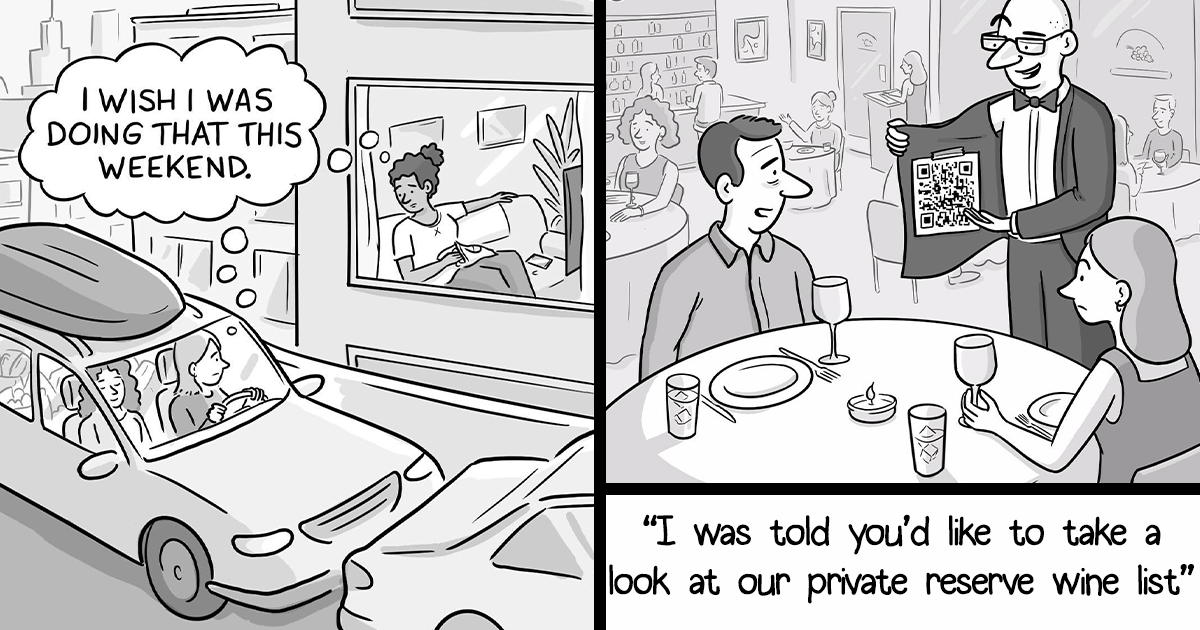
Editorial note: This original article discusses Matt Reuter’s public cartooning style, creative background, and the appeal of one-panel humor without reproducing copyrighted comic images or captions.
Why Matt Reuter’s One-Panel Comics Land So Fast
Some comics need a whole storyline, a cast of characters, a dramatic arc, and possibly a spreadsheet. Matt Reuter’s one-panel comics need only one frame, one clever setup, and a punchline that sneaks up like a cat pretending it was not just knocking your glass off the table. That is the charm behind 29 Humorous One-Panel Comics By Matt Reuter: the humor arrives quickly, but the thought behind it keeps echoing after the laugh.
Reuter is known as a cartoonist, designer, art director, and illustrator based in Brooklyn, New York. His public portfolio describes a creative career that spans brand campaigns, art direction, design management, identity work, and illustration. That professional design background matters. His cartoons often feel clean, deliberate, and economical, as though every line had to earn rent in a very expensive New York apartment.
His one-panel cartoons fit comfortably into the great tradition of smart American gag cartooning. The format looks simple: a single image, often paired with a caption. But simplicity is the trapdoor. In one panel, the artist must build a world, create tension, deliver context, and then flip the reader’s expectations. Done badly, it feels like a greeting card that forgot to be funny. Done well, as in Reuter’s work, it feels like a tiny comedy machine with very few moving parts and excellent mileage.
Who Is Matt Reuter?
Matt Reuter is a designer, art director, illustrator, and cartoonist whose public work includes brand projects, commercial illustration, social content, and cartoons. His portfolio has featured projects connected to campaigns, marathon-themed sticker work, and cartoons associated with The New Yorker. That mix of advertising discipline and cartoon timing gives his work a polished but not overworked feel.
Many readers first discover Reuter through online collections of funny one-panel comics. These galleries often highlight his ability to turn normal daily life into something just strange enough to feel painfully accurate. A coffee shop, an office, a living room, a phone screen, a street corner, or a tiny social awkwardness can become the stage for a joke. His cartoons do not need explosions. They usually prefer the quieter disaster of being a person with email.
In public descriptions of his work, Reuter has been presented as a cartoonist who captures everyday absurdity, modern culture, social habits, and human contradictions. That is a very polite way of saying his comics look at us, tilt their head, and ask, “Are we all seeing this, or is everyone pretending the meeting invite was normal?”
The Appeal of One-Panel Comics
One-panel comics are the espresso shot of visual humor. They are small, concentrated, and dangerous when consumed too quickly. Unlike comic strips, which can build a joke over several frames, a single-panel comic must compress everything into one instant. It gives the reader just enough visual information to understand the scene, then uses the caption or dialogue to twist the meaning.
This is why the form works so well online. People scroll quickly, but a strong one-panel comic can stop the thumb. There is no need to memorize character names or follow continuity. The joke lives in the moment. You see the drawing, read the line, and suddenly the ordinary world becomes slightly more ridiculous.
Reuter’s cartoons use that speed beautifully. His one-panel comics often feel like jokes that have been edited until only the useful bones remain. There is usually no clutter, no long explanation, and no desperate elbowing from the artist saying, “Please laugh here.” Instead, the humor often arrives through contrast: old-fashioned visual framing with modern anxieties, polite social situations with absurd emotional baggage, or casual dialogue that reveals something hilariously uncomfortable about the way people live now.
What Makes These 29 Humorous One-Panel Comics Memorable?
1. The Humor Is Smart Without Acting Superior
Some clever cartoons make readers feel like they are being quizzed by a professor with excellent cheekbones. Reuter’s comics are smart, but they do not usually feel smug. The jokes are accessible because they begin with situations people recognize: work stress, digital distraction, relationship awkwardness, social pressure, cultural contradictions, and the tiny humiliations of modern adulthood.
The best one-panel humor often depends on shared recognition. A reader laughs not only because the joke is funny, but because it confirms a suspicion: yes, life really has become this strange. Reuter’s comics are good at making the absurd feel familiar and the familiar feel newly absurd.
2. The Drawing Style Supports the Joke
Reuter’s visual style has a classic cartoon sensibility. The line work tends to serve the gag rather than compete with it. Characters are expressive enough to sell the moment, but the art rarely becomes so busy that the reader gets lost. That restraint is important. In one-panel comics, the drawing is not decoration; it is timing.
A raised eyebrow, a stiff posture, an empty room, a small object placed in the right cornerthese details can carry the setup before the reader even reaches the caption. Good cartooning is visual editing, and Reuter’s design background shows in how efficiently he arranges a scene.
3. The Captions Have a Dry, Modern Bite
Reuter’s captions often work because they sound casual. The line may feel like something a person would actually say, except the situation around it makes the sentence ridiculous. That contrast is a classic engine of single-panel comedy. The drawing sets up one expectation; the caption calmly opens another door, and behind that door is a raccoon wearing a name badge.
Modern readers especially enjoy captions that mix understatement with absurdity. When everyone is already overwhelmed by notifications, deadlines, social performance, and world events, a deadpan joke can feel more honest than a loud one. Reuter’s humor often trusts the reader to catch the angle without overexplaining it.
Common Themes in Matt Reuter’s Comics
Modern Life and Its Tiny Nonsense
One reason Reuter’s one-panel comics connect with readers is that they often draw from everyday life. Modern life is full of small, ridiculous rituals: pretending to be calm on video calls, treating phone batteries like emotional support animals, apologizing to furniture after bumping into it, and using productivity tools to avoid productivity. Reuter’s comics are at home in this universe.
His humor works especially well when it takes something normal and shifts it slightly. A common situation becomes a miniature social experiment. An ordinary room becomes a stage. A familiar phrase becomes a punchline. The reader does not need a long introduction because the joke starts in a world they already know.
Technology and Social Behavior
Technology is one of the great comedy engines of the current age. Phones, apps, screens, algorithms, and social media have changed how people communicate, avoid communicating, and then post about how authentic they are being. Reuter’s comics often tap into that tension.
The humor is not simply “phones are bad.” That joke has been tired since approximately five minutes after the first smartphone. Instead, the sharper comedy comes from showing how technology changes human behavior in subtle ways. People become distracted, performative, anxious, or strangely dependent on digital approval. A one-panel comic can expose that shift quickly because the image shows the behavior and the caption reveals the contradiction.
Work, Burnout, and Professional Absurdity
Few environments are richer for one-panel humor than the workplace. Offices have their own language, rituals, and imaginary emergencies. Corporate culture can turn simple ideas into six-slide decks and call it alignment. Reuter’s background in design and creative work likely gives him a fluent understanding of professional absurdity.
In one-panel workplace humor, the joke often comes from the gap between official language and actual feelings. People say “circle back” when they mean “please let this disappear.” They say “quick question” before launching a submarine-sized request. They discuss innovation in rooms where the projector does not work. Reuter’s cartoons thrive in that gap between polished behavior and internal screaming.
Social Awkwardness and Human Contradiction
Many of Reuter’s best humorous ideas feel rooted in contradiction. People want connection but avoid vulnerability. They want simplicity but buy more tools. They want rest but check notifications in bed. They want authenticity but carefully edit it before posting. These contradictions are funny because they are true, and also because admitting them is cheaper than therapy.
One-panel comics are perfect for this kind of comedy because they capture a single revealing instant. A character does not need a full biography. A sentence, expression, or setting can reveal everything. The reader fills in the rest, which makes the laugh feel personal.
Why Readers Love “29 Humorous One-Panel Comics By Matt Reuter”
A collection of 29 comics works because it gives readers variety without exhaustion. Twenty-nine is enough to show range: social satire, observational humor, absurd scenes, modern anxiety, and quick visual jokes. But it is not so many that the reader begins to feel like they are studying for a final exam in cartoon appreciation.
Online comic collections also create a satisfying rhythm. Each panel is a quick reset. One joke may be about daily habits, another about public life, another about private weirdness, and another about the strange ways people adapt to modern culture. The reader moves from joke to joke, building a sense of the artist’s worldview. In Reuter’s case, that worldview seems alert, dry, amused, and quietly suspicious of anything described as “seamless.”
Readers also appreciate the lack of unnecessary explanation. A good one-panel comic respects the audience. It invites them to participate. The joke is not shoved across the table; it is placed there with confidence. Reuter’s cartoons often succeed because they let readers make the final connection themselves.
The Craft Behind a Great One-Panel Joke
The Setup Must Be Instant
In a single-panel comic, the setup must happen almost immediately. The reader has to recognize the scene in a second or two. Is it an office? A home? A street? A meeting? A therapy session? A fairy-tale setting? The faster the reader understands the basic world, the faster the cartoon can twist it.
Reuter’s comics often use familiar visual environments for this reason. A recognizable setting gives the joke a runway. The reader enters comfortably, then the caption turns off the lights and rearranges the furniture.
The Caption Must Change the Meaning
The caption in a one-panel comic is not just a label. It is often the switch that changes the entire scene. Before the caption, the reader sees one situation. After the caption, the image means something else. That little flip is where the comedy lives.
Reuter’s captions tend to work because they are concise. They do not explain the joke; they complete it. The best captions feel inevitable after you read them, even though you did not see them coming. That is the magic trick: surprise that makes perfect sense.
The Drawing Must Leave Room for the Reader
A crowded cartoon can suffocate a joke. Too much visual information forces the reader to hunt for meaning. Reuter’s stronger panels understand negative space, expression, and composition. The drawing gives enough context, then steps back. The caption gets room to breathe.
This is also why one-panel comics often age well when they focus on human behavior rather than only on passing trends. Technology changes, slang changes, and apps come and go, but awkwardness appears to be fully renewable.
Matt Reuter and the New Yorker-Style Cartoon Tradition
The one-panel gag cartoon has long been associated with a particular kind of American wit: polished, compact, ironic, and often a little sideways. The New Yorker tradition especially values jokes that combine drawing, caption, social observation, and a touch of intellectual mischief. Reuter’s work fits naturally in that atmosphere while still feeling contemporary.
What makes this kind of cartooning difficult is that it must look effortless. The reader sees the final panel and thinks, “That’s simple.” But simple is often the result of ruthless editing. The artist has to remove every unnecessary line, word, and idea until the joke clicks. A great one-panel comic is not small because the idea is small. It is small because everything extra has been cut away.
Reuter’s design career likely sharpens that instinct. Designers learn hierarchy, spacing, emphasis, and clarity. Cartoonists learn timing, character, and surprise. When those skills meet, the result can be a panel that looks clean but lands with a satisfying snap.
How to Read These Comics for Maximum Enjoyment
There is no wrong way to enjoy a funny cartoon, unless you are reading it aloud to someone and explaining the punchline before they get there. That is not reading; that is comedy vandalism. Still, one-panel comics reward a slower glance than most social media posts receive.
First, look at the image before rushing to the caption. Notice the setting, the characters, the expressions, and any odd details. Then read the caption. After that, look back at the image. Often the funniest part is how the caption changes the drawing. A chair, a phone, a window, or a facial expression may suddenly become part of the joke.
This second look is where Reuter’s work often shines. His comics may be quick, but they are not disposable. The funniest panels create a small aftershock. You laugh, then think, then maybe laugh again because the joke has quietly accused your entire lifestyle.
Why One-Panel Comics Still Matter Online
In an internet culture dominated by videos, short posts, reaction images, and endless feeds, one-panel comics remain surprisingly powerful. They are fast, shareable, and visually distinct. They can express a complete idea without demanding too much time. More importantly, they can make people feel understood.
Humor helps readers process daily absurdity. A good cartoon can make a stressful subject feel manageable by turning it into something visible and laughable. This does not mean the issue disappears. It means the reader gets a small moment of distance. That distance is useful. Sometimes a joke is not an escape from reality; it is a better angle on it.
Reuter’s one-panel comics offer that kind of angle. They are not just random jokes floating around the web. They are compact observations about how people behave when surrounded by technology, pressure, social expectations, and all the tiny complications of being alive in public.
Experiences Related to “29 Humorous One-Panel Comics By Matt Reuter”
Reading a collection like 29 Humorous One-Panel Comics By Matt Reuter feels a little like walking through a gallery where every frame politely insults modern life. The experience is quick at first. You scroll, smile, and move on. But after a few panels, a pattern starts to appear. The jokes are not only about the characters in the drawings. They are about readers too. That is when the comics become more than entertainment; they become tiny mirrors with better timing than most mirrors deserve.
One enjoyable experience is noticing how much one panel can do. A single cartoon can suggest an entire conversation, relationship, workplace, or cultural moment. You may see two characters in a room, read one sentence, and instantly understand the tension between them. That compression is satisfying because it respects the reader’s intelligence. It lets you complete the joke in your own head, which makes the laugh feel earned.
Another experience is the strange comfort of recognition. Many Reuter-style jokes revolve around modern behavior that people rarely discuss directly. The anxious relationship with screens, the absurd language of work, the performance of being relaxed, the constant negotiation between wanting attention and wanting privacythese are not grand dramatic themes, but they are deeply familiar. When a comic captures one of those habits, the reader feels seen. Sometimes too seen. The best reaction is laughter followed by a suspicious glance at your own phone.
These comics are also fun to share because they do not require much context. You can send one to a friend, coworker, or family member with a message like, “This is us,” and the entire conversation is already half complete. That is one reason one-panel cartoons remain so strong online. They travel well. They do not need sound, motion, or a long caption. They just need a reader who has been alive long enough to experience mild confusion in a professional setting.
For writers, designers, marketers, and creators, Reuter’s cartoons are also a useful lesson in editing. The panels show how powerful an idea can become when stripped down. There is no room for rambling. No decorative paragraph can hide a weak joke. Every element must contribute. That discipline is valuable far beyond cartooning. A strong landing page, headline, ad concept, social post, or essay introduction often works the same way: clear setup, sharp turn, memorable payoff.
Finally, spending time with humorous one-panel comics is a reminder that comedy does not always need to be loud. Some of the funniest ideas arrive quietly. They do not shout; they raise an eyebrow. Matt Reuter’s work often lives in that eyebrow. It invites readers to pause for a second, notice the absurdity hiding inside ordinary life, and enjoy the relief of realizing that everyone else is also improvising. In a world that frequently behaves like a group project with no instructions, that kind of laughter is not just pleasant. It is necessary maintenance.
Conclusion: Small Panels, Big Laughs
29 Humorous One-Panel Comics By Matt Reuter is more than a collection of quick jokes. It is a showcase of how much humor, social observation, and visual storytelling can fit into a single frame. Reuter’s cartoons work because they are clean, sharp, and rooted in recognizable human behavior. They take the awkwardness of modern life and turn it into something readers can laugh at without needing a user manual.
His best one-panel comics remind us that the world is already strange; the cartoonist’s job is simply to point at the right part. Whether he is exploring technology, office culture, social habits, or everyday absurdity, Reuter brings a dry wit that feels both classic and current. The result is humor that lands quickly, lingers lightly, and makes ordinary life seem a little more bearable.