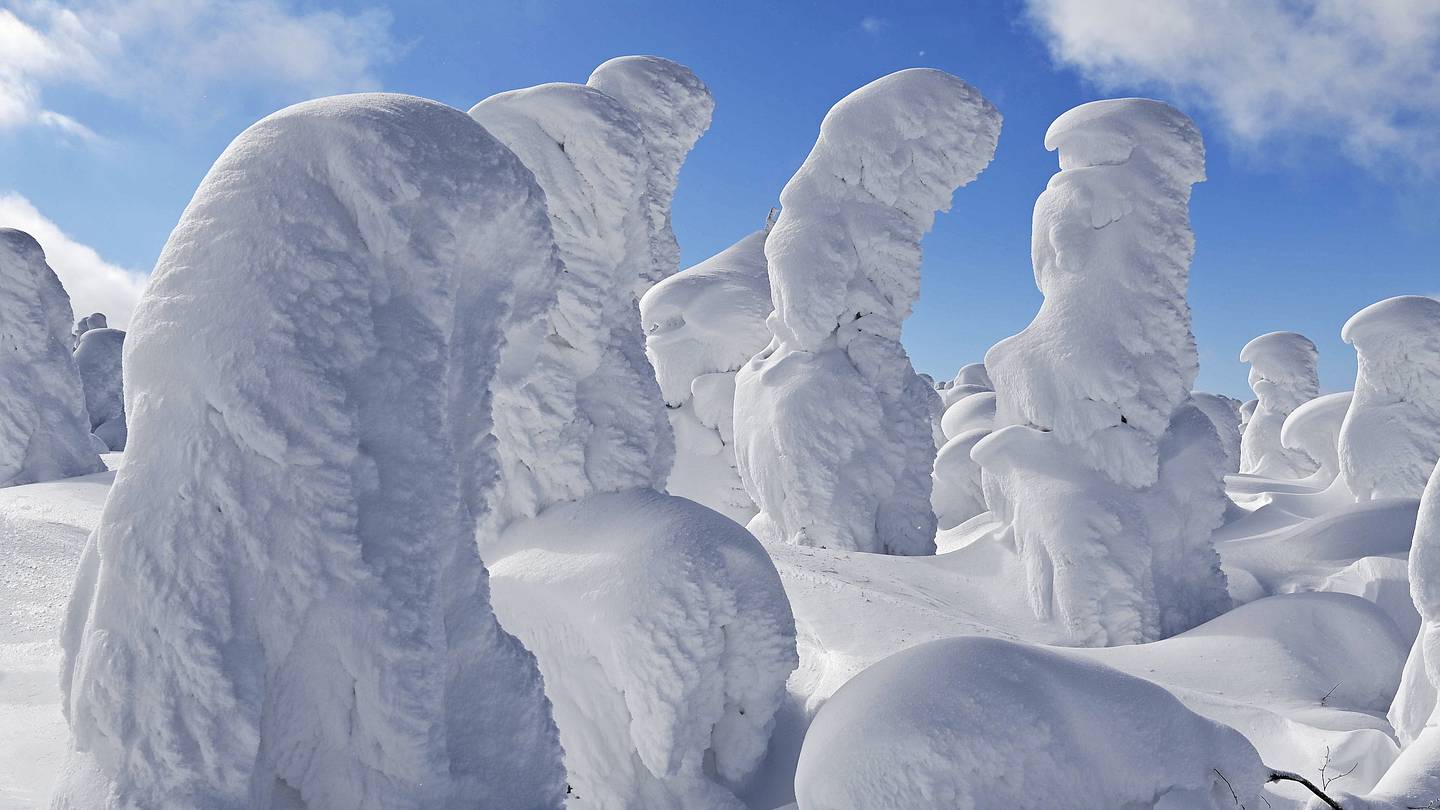
Winter has a reputation for making everything look quiet, clean, and slightly inconvenient. Yet under the right conditions, snow and ice become anything but ordinary. Wind rolls snow into hollow cylinders. Sunlight carves frozen fields into forests of blades. Rivers manufacture giant spinning records, while polar oceans grow icy tubes that descend toward the seafloor like something from a science-fiction movie.
These strange snow and ice formations are not random decorations added by an overenthusiastic weather department. Each one is produced by a precise combination of temperature, moisture, wind, sunlight, salinity, water movement, and timing. Change one ingredient, and the entire show may be canceled.
Here are six of nature’s weirdest winter creations, how they form, where they appear, and why seeing one often feels like discovering that Earth has been keeping a few magic tricks to itself.
Why Does Ice Form So Many Unusual Shapes?
Water is a remarkably creative substance. It expands when it freezes, changes directly between solid and vapor under certain conditions, and forms crystals whose growth depends on temperature and humidity. Snow and ice are also constantly being reshaped by moving air, flowing water, waves, sunlight, gravity, and changes in pressure.
That means frozen landscapes are rarely as motionless as they appear. A snowfield can lose material through sublimation, in which ice changes directly into water vapor. Sea ice can reject salt and create dense brine. A river current can rotate a sheet of ice for hours, slowly grinding it into a near-perfect circle.
In other words, winter is not sleeping. It is running a very cold sculpture studio.
1. Snow Rollers: Nature’s Self-Rolling Snowballs
“`
Snow rollers look as though someone started building a snowman, became distracted, and abandoned dozens of giant white rolls across a field. Also called snow donuts, snow bales, or wind snowballs, these formations are cylindrical and often hollow in the center.
How Snow Rollers Form
A snow roller requires an unusually picky set of weather conditions. A thin surface layer of moist, loose snow must rest on top of a smoother layer that does not easily stick to it. That lower surface may be crusted snow, ice, or hard ground. Temperatures are usually near the freezing point, making the upper snow sticky enough to cling together without becoming heavy slush.
Then the wind must cooperate. A strong gust lifts or curls an edge of the surface snow and begins pushing it along. As it travels, the moving piece gathers additional snow, much like a person rolling a snowball across a yard. Gravity can assist when the process occurs on a gentle slope.
The wind must be strong enough to move the snow but not so violent that it tears the roll apart. That is a fairly narrow operating window, which explains why snow rollers are rare. Apparently, even nature has trouble following a complicated recipe.
Why Are They Hollow?
The first snow collected at the center is often thin and fragile. It may collapse or blow away as the roller grows, leaving a hollow tube. Some rollers remain only a few inches wide, while exceptional examples become much larger and leave visible trails behind them.
Open fields, broad hillsides, and exposed mountain areas are good settings because the wind needs room to push the snow without colliding with trees, rocks, fences, or someone’s badly parked snowmobile.
“`
2. Penitentes: Forests of Sun-Carved Ice Blades
“`
Penitentes are tall, narrow blades of hardened snow or ice found in high, dry mountain environments, especially in the Andes. A large field of them can resemble a silent crowd of pointed figures or an army of frozen hooded monks. Their name comes from that resemblance to religious penitents.
Sunlight, Not Wind, Is the Master Sculptor
Although their sharp edges might suggest wind erosion, penitentes are primarily shaped by intense sunlight and sublimation. At high elevations, the air is cold, thin, and dry. Under these conditions, snow can change directly into vapor without first becoming liquid water.
Tiny hollows in a snow surface trap and reflect sunlight. The concentrated energy causes those depressions to deepen faster than the surrounding peaks. As the troughs grow, the surviving ridges become increasingly narrow and blade-like. Melting may also help remove snow in the warmer, more humid hollows, while exposed peaks remain colder and lose material more slowly through sublimation.
The blades tend to align with the sun’s path and may lean toward the position of the midday sun. Some are modest enough to step around. Others grow several feet high and turn an otherwise ordinary snowfield into an icy maze.
More Than a Visual Curiosity
Penitentes can make travel across high mountain snowfields difficult. Their steep sides and irregular spacing create obstacles for climbers and researchers. They also change how the surface reflects and absorbs sunlight, which can influence the rate at which a snowfield loses mass.
Similar blade-shaped terrain has even been studied on Pluto, where enormous ridges may have been carved from methane ice by a related sublimation process. Earth’s penitentes are therefore not just strange mountain scenery; they are a useful model for understanding frozen landscapes elsewhere in the solar system.
“`
3. Frost Flowers: Delicate Crystal Gardens on New Ice
“`
Frost flowers look like miniature ferns, feathers, petals, or tiny white coral reefs growing across a frozen surface. They often appear on newly formed sea ice, although related structures can develop on freshwater ice under suitable conditions.
Despite the name, frost flowers are neither plants nor frozen blossoms that fell from the sky. They are clusters of ice crystals created when moisture enters extremely cold air immediately above young ice.
The Recipe for an Ice Garden
Frost flowers generally require very cold air, relatively warm new ice, high humidity near the surface, and little wind. The temperature difference between the ice and atmosphere supplies moisture to a shallow layer of air. As that moist air cools, it becomes supersaturated, allowing water vapor to deposit directly as ice on small surface irregularities.
The crystals branch outward as they grow, producing elaborate shapes that may cover a wide area. Strong wind can disrupt the moist layer or destroy the delicate structures, so the best displays usually form during calm conditions.
Beautiful, Salty, and Surprisingly Lively
On sea ice, frost flowers can become highly saline. As seawater freezes, most of its salt is excluded from the developing ice crystals and becomes concentrated in brine. That brine may move upward through pores in the young ice and enter the frost flowers.
The resulting formations are chemically different from ordinary frost and can influence exchanges between the ocean, ice, and atmosphere. Researchers have also found active microorganisms associated with frost flowers, meaning these delicate crystal gardens may serve as temporary habitats in one of Earth’s harshest environments.
They look like fragile decorations. Scientifically, however, they are busy little neighborhoods.
“`
4. Pancake Ice: A Floating Polar Breakfast
“`
Pancake ice consists of round or oval disks floating on cold water. Each piece usually has a raised rim, making a field of them resemble thousands of pale pancakes crowded together in a skillet large enough to concern the Coast Guard.
From Ice Crystals to Frozen Disks
The process often begins with frazil ice, a loose collection of tiny ice crystals that forms in supercooled, turbulent water. The crystals gather into a slushy mixture sometimes called grease ice because of its smooth, oily appearance.
In rough water, waves and currents push the slush into separate circular masses. The pieces repeatedly collide, rounding their edges and forcing slush upward around their perimeters. That repeated bumping creates the characteristic raised rims.
Pancake ice can range from small plates to disks several feet across. Official ice classifications describe pieces that may reach roughly 10 feet in diameter, although dimensions vary with local conditions. Continued freezing can join the pancakes into larger sheets, while strong waves may cause them to overlap, fracture, or pile against one another.
Where Pancake Ice Appears
It is common in polar seas and marginal ice zones, where cold air meets moving water. It can also appear on large freshwater bodies, including the Great Lakes, during sufficiently cold and turbulent weather.
Pancake ice is more than a photogenic curiosity. Its presence reveals information about wave conditions, early sea-ice development, and exchanges of energy between the ocean and atmosphere. For scientists and mariners, those floating circles are part of a larger story about how an open body of water transforms into winter ice cover.
“`
5. Ice Circles: Giant Frozen Records That Spin in Rivers
“`
Ice circles, also called ice disks, are round sheets of ice that rotate slowly in rivers or streams. Some are only a few feet across. Others are enormous. A famous disk observed in Westbrook, Maine, in 2019 measured about 300 feet across and carried ducks on what was probably the slowest amusement-park ride in New England.
How Does a River Make a Circle?
Ice disks usually form where part of a river current begins rotating in an eddy. Small pieces of ice collect within the slower circular flow and gradually freeze together. As the growing sheet rotates, its edges rub against surrounding ice, the riverbank, or other obstacles.
This repeated contact works like a natural lathe, grinding away irregular edges and producing an increasingly round disk. The result can be surprisingly symmetrical even though no person measured, cut, or polished it.
Researchers have also demonstrated that melting may help sustain rotation. When slightly warmer water melts the edge of a disk, the cooled meltwater can sink and contribute to circulation beneath it. River flow, temperature differences, and abrasion may therefore work together.
Rare but Entirely Natural
Large ice disks regularly inspire theories involving machinery, hoaxes, or visiting spacecraft with an unusual interest in municipal waterways. The real explanation is less dramatic but more satisfying: moving water can organize loose ice, rotate it, and shape it with impressive precision.
Because the balance of current, temperature, and ice supply is temporary, the circles may break apart, become trapped, or melt soon after forming. Their brief existence is part of the appeal. A river might display one for several days and then return to looking completely ordinary, as though nothing peculiar happened.
“`
6. Brinicles: Underwater Icicles From a Frozen World
“`
Of all the strange natural ice formations, the brinicle may be the most alien-looking. It grows downward beneath sea ice as a hollow tube, resembling an underwater icicle or an icy stalactite. Brinicles occur in polar oceans, where freezing seawater creates a flow of extremely cold, salty brine.
Why Brine Sinks Through Sea Ice
When seawater freezes, the developing ice crystals contain much less salt than the original water. Much of the salt is pushed into pockets and channels of concentrated brine within the porous sea ice.
This brine remains liquid at temperatures that would freeze fresher seawater because its high salt concentration lowers its freezing point. It is also denser than the surrounding ocean water. When it escapes through the underside of the ice, it sinks in a narrow plume.
The descending brine is cold enough to freeze some of the seawater it touches. A thin shell of ice develops around the plume, creating a hollow tube that grows toward the seafloor. The brine continues flowing through the center, extending the structure downward.
The Famous “Finger of Death”
Brinicles are sometimes nicknamed ice fingers of death because a tube that reaches the bottom can spread a layer of ice across the seafloor. Small, slow-moving marine animals may become trapped by the advancing freeze.
The nickname is theatrical, but a brinicle is not a predatory ice monster. It is a physical consequence of salt rejection, temperature differences, gravity, and the unusual structure of young sea ice.
Scientists study brinicles because they help explain the movement of salt and heat through sea ice. Their channels may also create chemically rich environments of interest to researchers investigating how life survives in extreme conditionsand how similar systems might exist beneath the icy shells of distant ocean worlds.
“`
What These Frozen Oddities Teach Us
These six formations look completely different, yet they share a common lesson: ice is dynamic. It rolls, grows, rotates, fractures, sublimates, rejects salt, absorbs sunlight, and interacts with living organisms.
Snow rollers demonstrate the delicate balance between wind, moisture, and friction. Penitentes reveal the sculpting power of sunlight and dry air. Frost flowers connect the atmosphere to young sea ice. Pancake ice shows how waves organize freezing crystals. Ice circles expose the geometry hidden in flowing rivers. Brinicles reveal the complicated chemistry beneath polar ice.
None of them needs a supernatural explanation. The physics is already weird enough.
Experiencing Strange Snow and Ice Formations in the Wild
Seeing one of these formations in person can briefly change the way a winter landscape feels. A familiar field, river, lake, or coastline suddenly looks like a place governed by different rules. The experience is not simply about identifying a scientific phenomenon. It is about realizing how much activity can occur while the world appears quiet.
Walking Into a Field of Snow Rollers
Imagine arriving at an open field shortly after sunrise and finding dozens of white cylinders scattered across it. At first, the obvious assumption is that someone made them. Then the tracks become visible: narrow paths showing where each roll traveled under the force of the wind.
Some formations may look like rolled blankets, while others resemble hollow pastries dusted with fresh snow. The most interesting detail is often their fragility. A large roller may collapse when touched because its appearance suggests far more strength than it actually possesses. The best experience comes from observing without rearranging the scene. Low morning light reveals the curves, hollow centers, and trails far better than a boot-print-filled close-up.
Standing Before Penitentes
A field of penitentes creates a completely different sensation. Instead of a playful collection of snow sculptures, it presents a barrier. The blades may be hard, sharply ridged, and packed closely together. Moving through them can be slow and awkward, especially at high elevation where thin air already makes every step feel like a negotiation.
Their alignment becomes easier to appreciate when viewed across a broad slope. Hundreds of points lean in a similar direction, recording the influence of the sun in their shape. The landscape can look organized from a distance and chaotic from inside ita frozen crowd in which every member is facing the same speaker.
Watching Ice Move
Pancake ice and river ice disks are best experienced through motion. A photograph can show their shape, but it cannot fully communicate the soft clattering of pancake ice as waves push the pieces together. The disks bump, separate, overlap, and turn, producing a subdued rhythm that sounds surprisingly mechanical.
A rotating river disk is quieter and more hypnotic. Fixed objects along the bank make its movement easier to notice. Cracks, snow patches, and darker areas on the surface slowly shift position, confirming that the entire sheet is turning. Birds may stand on it without appearing impressed, which is typical bird behavior around internationally famous natural phenomena.
Finding Frost Flowers
Frost flowers reward careful observation. From a distance, they can look like a pale coating on fresh ice. Up close, each cluster contains branching crystals and sharp geometric details. Their beauty is extremely temporary. Sunlight, warming air, falling snow, or a rising breeze can erase the display.
They also require restraint from observers. New ice may be dangerously thin, and no photograph justifies stepping onto an unfamiliar frozen surface. A telephoto lens, shoreline viewpoint, or guided scientific excursion provides a much safer encounter.
Experiencing Brinicles Indirectly
Very few people will see a brinicle in person. Reaching one requires polar conditions, diving expertise, specialized equipment, and professional support. For most readers, research footage offers the safest and clearest experience.
That distance does not make the phenomenon less powerful. Watching an ice tube grow beneath a frozen ocean challenges the everyday idea that icicles must hang in open air. It reveals an environment where saltwater remains liquid below ice, dense brine flows downward, and freezing can spread across the seafloor.
The most memorable encounters with strange snow and ice often begin with disbelief: “That cannot be natural.” A closer look produces the better response: “It is naturaland the process that made it is even stranger than the object itself.”
Conclusion
Nature does not need complicated machinery to make extraordinary winter art. It uses wind to roll snow, sunlight to sharpen mountain ice, vapor to grow crystal flowers, waves to build frozen pancakes, currents to turn river ice, and salt to create underwater stalactites.
These formations are rare because their environmental requirements are so exact. That rarity makes them valuable reminders to pay attention. A windy field, a young layer of sea ice, or a slow river bend may be hosting a process most people will never notice.
Safety note: Snow and ice formations should always be observed from stable ground or with qualified guides. New ice, river ice, sea ice, and frozen shorelines can be dangerously thin or unstable, regardless of how solid they appear.