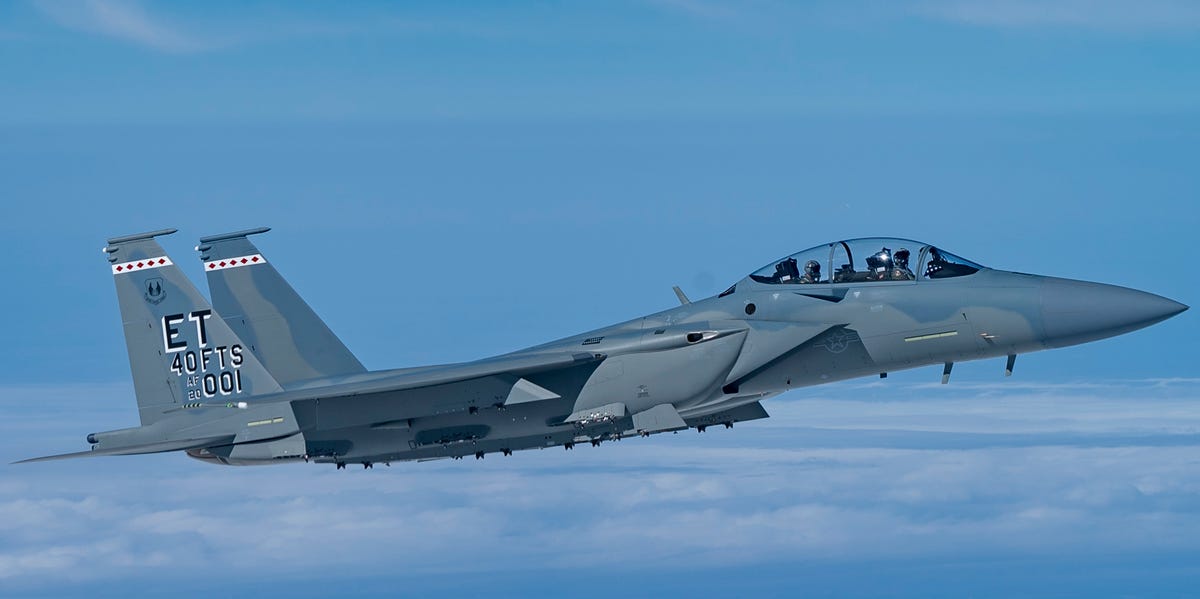
The United States Air Force finally receiving its first F-15EX was not just another “new jet lands, photographers rejoice, aviation Twitter explodes” moment. It marked the return of a familiar name with a very modern personality. The F-15 family has been around long enough to have stories, scars, fan clubs, and probably a favorite coffee order. But the F-15EX Eagle II is not a museum piece wearing fresh paint. It is a redesigned, digitally upgraded, heavy-lifting fighter built to keep the Eagle line relevant in a world of stealth aircraft, advanced sensors, networked warfare, and budgets that behave like they were written by raccoons with calculators.
The first F-15EX was officially accepted by the Air Force in March 2021 and sent to Eglin Air Force Base in Florida for combined developmental and operational testing. That mattered because the Air Force was not simply buying a faster version of an old airplane. It was introducing a platform designed to replace aging F-15C/D aircraft, support homeland defense missions, carry a large payload, and plug into a modern battlespace where data can matter as much as raw speed.
So, what exactly makes the F-15EX different from earlier Eagles? Why did the Air Force invest in a fourth-generation-plus fighter while also flying fifth-generation aircraft like the F-35 and F-22? And what do the new F-15 specs actually tell us about the future of American airpower? Let’s climb into the detailsfiguratively, of course. No one is handing us the keys, and honestly, that is probably best for everyone.
What Is the F-15EX Eagle II?
The F-15EX Eagle II is the newest production version of the legendary F-15 fighter family, manufactured by Boeing. It is based on the advanced F-15 design lineage that includes modern export variants, but it is configured for U.S. Air Force requirements. At a glance, it still looks unmistakably like an Eagle: twin tails, twin engines, broad shoulders, and the aerodynamic confidence of an aircraft that has never been accused of being shy.
Under the skin, however, the F-15EX is a very different aircraft from the older F-15C/D fighters it is meant to replace. It features fly-by-wire flight controls, a digital cockpit, advanced avionics, modern electronic warfare systems, open mission systems architecture, and improved mission computing. In plain English, the Eagle II takes the proven F-15 airframe concept and gives it the kind of digital nervous system expected in a modern combat aircraft.
The “EX” is also a two-seat aircraft, although it can be operated by a single pilot depending on the mission. That flexibility is important. A second crew station can support complex mission management, training, electronic systems workload, or future roles involving networked aircraft and unmanned systems. Think of it less as “extra chair included” and more as “future-proofing with a canopy.”
Why the Air Force Wanted a New F-15
The simplest answer is age. The F-15C/D fleet had been flying for decades, and many of those aircraft were becoming increasingly expensive and difficult to maintain. Airframes do not get younger, no matter how many inspirational hangar posters are taped nearby. The Air Force needed a replacement that could arrive quickly, use existing F-15 infrastructure, and require a shorter transition period for units already familiar with the Eagle ecosystem.
The F-15EX offered a practical solution. Because it shares many characteristics with the broader F-15 family, existing bases, maintainers, pilots, and support systems could adapt faster than they could with a totally new aircraft. That matters in real-world defense planning. A fighter that looks great in a brochure but takes forever to field is like a fire extinguisher arriving after the barbecue has become modern art.
The Air Force also wanted capacity. Stealth fighters are essential, but they are not the only answer to every mission. The F-15EX brings range, payload, speed, and endurance to the mix. It can serve as a powerful complement to fifth-generation aircraft, especially in missions where large weapons carriage, long-range patrol, homeland defense, or rapid availability are key priorities.
First Delivery: The Moment the Eagle II Arrived
The Air Force officially accepted its first F-15EX from Boeing in St. Louis on March 10, 2021. The aircraft arrived at Eglin Air Force Base on March 11, 2021, where it began testing with the 40th Flight Test Squadron and the 85th Test and Evaluation Squadron. That combined test approach was notable because the Air Force wanted to move quickly while still carefully evaluating the aircraft before broader fielding.
Eglin was the right place for that job. The base has deep testing experience and a long history of evaluating aircraft, weapons systems, sensors, and software. For the F-15EX, the goal was not simply to prove that the jet could fly. Boeing had already handled that part. The bigger goal was to evaluate how the aircraft performed as a complete system: avionics, radar, cockpit, electronic warfare, flight controls, software, maintainability, and operational integration.
In June 2024, the first operational F-15EX arrived at Portland Air National Guard Base in Oregon, making the 142nd Wing the first operational unit to receive the Eagle II. That was a major milestone because it moved the aircraft from the test world into front-line service. The Oregon Air National Guard has long played an important role in air defense over the Pacific Northwest, so receiving the first operational F-15EX was both symbolic and practical.
F-15EX Specs: The Big Numbers
Publicly available F-15EX specifications show why the aircraft has attracted so much attention. It is a twin-engine, all-weather, multirole fighter designed for air superiority, defensive counter-air, offensive counter-air, and other missions requiring speed, payload, and endurance.
Basic Public Specs
- Manufacturer: Boeing Defense, Space & Security
- Role: Multirole fighter with emphasis on air superiority and large payload capacity
- Crew: One or two, depending on mission needs
- Engines: Two high-performance turbofan engines
- Flight controls: Digital fly-by-wire system
- Cockpit: Large-area digital displays and modern controls
- Radar: Advanced electronically scanned array radar
- Electronic warfare: Eagle Passive/Active Warning and Survivability System, commonly called EPAWSS
- Payload: Public sources commonly describe the F-15EX as having a maximum external payload of about 29,500 pounds
- Speed: Often described as capable of more than Mach 2
- Architecture: Open mission systems designed to support faster upgrades
Those numbers matter because the F-15EX is not trying to be the stealthiest aircraft in the Air Force inventory. Its value is different. It is built around carrying capacity, speed, range, digital growth, and the ability to be fielded quickly by units that already understand the F-15 family.
Digital Cockpit: Goodbye, Button Jungle
One of the most visible upgrades in the F-15EX is the modern cockpit. Older fighter cockpits can look like a committee of switches had a disagreement and invited more switches. The Eagle II replaces much of that old-school clutter with large digital displays and improved human-machine interfaces.
This matters because modern pilots manage enormous amounts of information. Radar, sensors, communications, navigation, identification systems, electronic warfare data, and mission updates all compete for attention. A cleaner digital cockpit helps organize that information so the pilot can make faster, better decisions.
The cockpit is also tied to broader software modernization. The F-15EX’s open mission systems architecture is designed to make future upgrades easier than they were on legacy aircraft. In an age when software can age faster than a smartphone battery, that matters a lot. The Air Force wants aircraft that can adapt without needing an expensive technological archaeology dig every time a new system is added.
Fly-By-Wire Flight Controls
The F-15EX includes digital fly-by-wire flight controls, replacing older mechanical-style control logic with computerized flight control management. Fly-by-wire systems can improve handling, stability, efficiency, and safety. They also help support changes to the aircraft’s configuration and enable more precise control of a powerful airframe.
For an aircraft like the F-15EX, fly-by-wire is not just a convenience. It is part of what allows the Eagle II to combine the proven performance of the F-15 design with modern mission demands. The result is a fighter that preserves the Eagle’s reputation for speed and climb performance while adding digital refinement.
EPAWSS: The New Electronic Warfare Backbone
The Eagle Passive/Active Warning and Survivability System, or EPAWSS, is one of the most important upgrades on the F-15EX. It is designed to improve the aircraft’s ability to detect, identify, and respond to threats in complex electromagnetic environments. In less technical terms, it helps the aircraft understand what is happening around it and improves survivability.
Modern air combat is not only about what pilots can see through the canopy. It is also about radar signals, electronic emissions, jamming, sensors, and data. EPAWSS gives the F-15EX a much more modern defensive electronics suite than older Eagle models. That upgrade is a key reason the aircraft is considered a serious modernization rather than just a production restart.
Open Mission Systems: The Upgrade-Friendly Eagle
Open mission systems architecture is one of those phrases that sounds like it was invented in a conference room with too many lanyards. But the idea is simple and important: make the aircraft easier to upgrade. Instead of locking every future improvement behind slow, expensive integration work, open systems aim to allow new hardware and software to be added more efficiently.
This is critical because threats change. Sensors evolve. Communications standards improve. New weapons, defensive systems, and mission tools emerge. A fighter that cannot be upgraded quickly risks becoming outdated even if its airframe still has years of service life left. The F-15EX is designed to reduce that problem by giving the Air Force a more flexible digital foundation.
Payload and Range: Why the Eagle II Gets Attention
The F-15EX is often discussed as a high-payload fighter. That is one of its biggest selling points. Public descriptions emphasize its ability to carry a large external load, which gives commanders flexibility in mission planning. While stealth aircraft focus heavily on low observability and internal carriage, the F-15EX leans into capacity, persistence, and raw performance.
This does not mean the Eagle II replaces stealth fighters. It means it complements them. In a mixed force, different aircraft can do different jobs. Some may operate closer to heavily defended areas. Others may carry larger loads, patrol wide areas, support homeland defense, or act as part of a broader networked force. The F-15EX fits into that second category: a powerful, visible, fast, heavily capable aircraft that adds mass and flexibility.
F-15EX vs. Older F-15 Models
The F-15EX is related to earlier Eagles, but it is not simply an F-15C with a software update and a motivational speech. Compared with older F-15C/D aircraft, the Eagle II brings a modern cockpit, fly-by-wire controls, advanced mission computers, updated sensors, and a much more capable electronic warfare suite.
Compared with the F-15E Strike Eagle, the F-15EX shares the two-seat design heritage and multirole DNA, but it incorporates newer production-line improvements and digital systems. The Air Force initially focused the EX on replacing aging F-15C/D aircraft, but later planning has also discussed the aircraft in the broader context of refreshing the fighter fleet.
The key difference is modernization. The F-15EX takes the strong points of the Eagle familyspeed, range, payload, twin-engine performance, and proven maintainabilityand adds digital architecture for today’s missions. It is less a nostalgia project and more a practical answer to a fleet management problem.
Why Not Just Buy More F-35s?
This is the question that appears every time the F-15EX is discussed. If the F-35 is stealthy and modern, why buy a new F-15 at all? The answer is that air forces do not operate with one tool. They operate with a toolbox.
The F-35 brings stealth, advanced sensors, and deep integration. The F-15EX brings speed, payload, range, and easier transition for legacy F-15 units. It can use existing infrastructure and can be fielded relatively quickly compared with introducing a completely new platform. In defense planning, the best aircraft is not always the one with the flashiest feature list. Sometimes it is the one that fills a specific gap at the right time, at the right scale, with fewer transition headaches.
A useful analogy is trucks and sports cars. A sports car may be more advanced, but if you need to haul a refrigerator, you will suddenly become very interested in the truck. The F-15EX is not trying to be an F-35. It is trying to be the best modern Eagle it can be.
Testing and Production Status
After the first aircraft arrived at Eglin, the F-15EX entered a combined test process designed to evaluate performance, software, sensors, electronic warfare systems, and operational suitability. Public reports show that the aircraft moved through developmental and operational testing, with continued follow-on evaluation planned as the Air Force adds capabilities and refines the platform.
The program has also evolved in size. Early plans discussed larger fleet numbers, later plans reduced the total, and more recent budget discussions have again increased interest in buying additional F-15EX aircraft. This back-and-forth is not unusual in military acquisition. Aircraft programs live in the real world, where budgets, strategy, industrial capacity, aging fleets, and congressional priorities all wrestle for the steering wheel.
What is clear is that the F-15EX has moved beyond the “interesting idea” stage. It has flown, tested, entered operational service, and become a real part of the Air Force fighter modernization conversation.
What the F-15EX Means for the Air National Guard
The Air National Guard plays a major role in homeland defense, including quick-reaction alert missions and air sovereignty operations. For Guard units flying older F-15C/D aircraft, the Eagle II offers a path to modernization without abandoning the F-15 mission culture entirely.
Portland’s 142nd Wing receiving the first operational F-15EX was especially meaningful because it showed that the Air National Guard was not simply waiting at the back of the line. The Guard’s mission requires readiness, speed, and reliability. A new Eagle with modern systems gives those units a stronger platform for the decades ahead.
For communities around Guard bases, the arrival of a new fighter also means training changes, maintenance updates, infrastructure work, and new career opportunities. Fighter modernization is not just about aircraft. It affects pilots, maintainers, logisticians, engineers, local economies, and the people who live near the runway and know the sound of freedom sometimes has a very aggressive volume setting.
Experience Section: What the F-15EX Story Teaches About Modern Airpower
Looking at the F-15EX from an aviation enthusiast’s perspective, the most interesting lesson is that “new” does not always mean “brand-new shape.” Sometimes the smartest move is taking a proven design and rebuilding it around modern electronics, software, and mission needs. The Eagle II shows how much of today’s military aviation is about systems integration. The airframe matters, but the sensors, displays, processors, electronic warfare tools, data links, and upgrade pathways may matter just as much.
Anyone who has followed aircraft over time knows that legendary platforms rarely stay frozen. The F-16, B-52, C-130, and F/A-18 have all gone through major upgrades. The F-15EX belongs to that same tradition. It proves that a strong design can remain relevant when engineers keep improving what is inside. It is like restoring a classic muscle car, except instead of adding Bluetooth and cup holders, you add digital flight controls, advanced radar, mission computers, and electronic warfare systems. Slightly more expensive. Slightly harder to parallel park.
The F-15EX also teaches a practical lesson about readiness. In public debates, people often talk as if one aircraft must “beat” another aircraft in a simple ranking. Real air forces do not work that way. They need aircraft available in sufficient numbers, with trained crews, maintainable systems, and mission flexibility. A fighter that can be integrated into existing F-15 units quickly has value because time is a real factor. The Air Force cannot pause global responsibilities while waiting for a perfect future fleet to arrive neatly wrapped with a bow.
From a maintenance and training viewpoint, the Eagle II’s commonality with earlier F-15s is a major advantage. Pilots and maintainers still need conversion training, but they are not starting from zero. That helps explain why the aircraft appealed to planners who needed to replace old F-15C/D fighters without creating unnecessary disruption. In aviation, familiarity can be powerful. The person turning wrenches at 2 a.m. does not want surprises. They want clear procedures, available parts, and systems that make sense.
The F-15EX story is also a reminder that modernization is usually messy. Fleet numbers change. Budgets shift. Program timelines move. Critics argue. Supporters argue back. Somewhere in the middle, engineers keep testing, pilots keep flying, and maintainers keep the whole operation honest. The result is rarely perfect, but it is often revealing. The Eagle II exists because the Air Force needed capacity, speed, payload, and a faster way to refresh aging fighter units.
For aviation fans, the emotional side is hard to ignore. The F-15 is one of the most recognizable fighters in the world. Seeing a new Eagle roll out decades after the original design first flew feels unusual, almost like watching a classic rock band release an album with modern production and somehow still sound loud enough to annoy the neighbors. But the F-15EX is not just nostalgia with afterburners. It is a serious attempt to blend proven aerodynamic performance with contemporary combat systems.
That may be the most important takeaway: the future of airpower is not only stealth, not only speed, not only payload, and not only software. It is the combination. The F-15EX adds another piece to that combination. It gives the Air Force a modernized Eagle that can carry a lot, fly fast, use upgraded sensors, and serve alongside newer stealth aircraft. For a jet with roots in the Cold War, that is quite a second act.
Conclusion: The Eagle Is Older, Smarter, and Still Very Loud
The arrival of the first F-15EX marked a major milestone for the Air Force because it brought the Eagle family into a new era. The aircraft keeps the classic strengths of the F-15speed, range, payload, and twin-engine performancewhile adding the digital systems needed for modern missions. Its cockpit, flight controls, radar, mission computers, electronic warfare suite, and open architecture all point toward a fighter designed to evolve rather than fade.
The F-15EX is not a replacement for stealth aircraft, and it is not pretending to be one. Its role is different. It provides capacity, flexibility, and a fast modernization path for units that need to retire aging F-15C/D aircraft. It also gives the Air Force another way to balance near-term readiness with long-term modernization.
In the end, the Eagle II proves that old names can still learn new tricks. The F-15EX is familiar enough to feel like part of aviation history, yet modern enough to matter in future force planning. That is a rare combination. And yes, it still looks like it was designed by people who believed subtlety was something other aircraft could worry about.
Note: This article is based on public, non-operational information from official and reputable defense reporting sources. It is written for general education, aviation interest, and SEO publishing purposes.