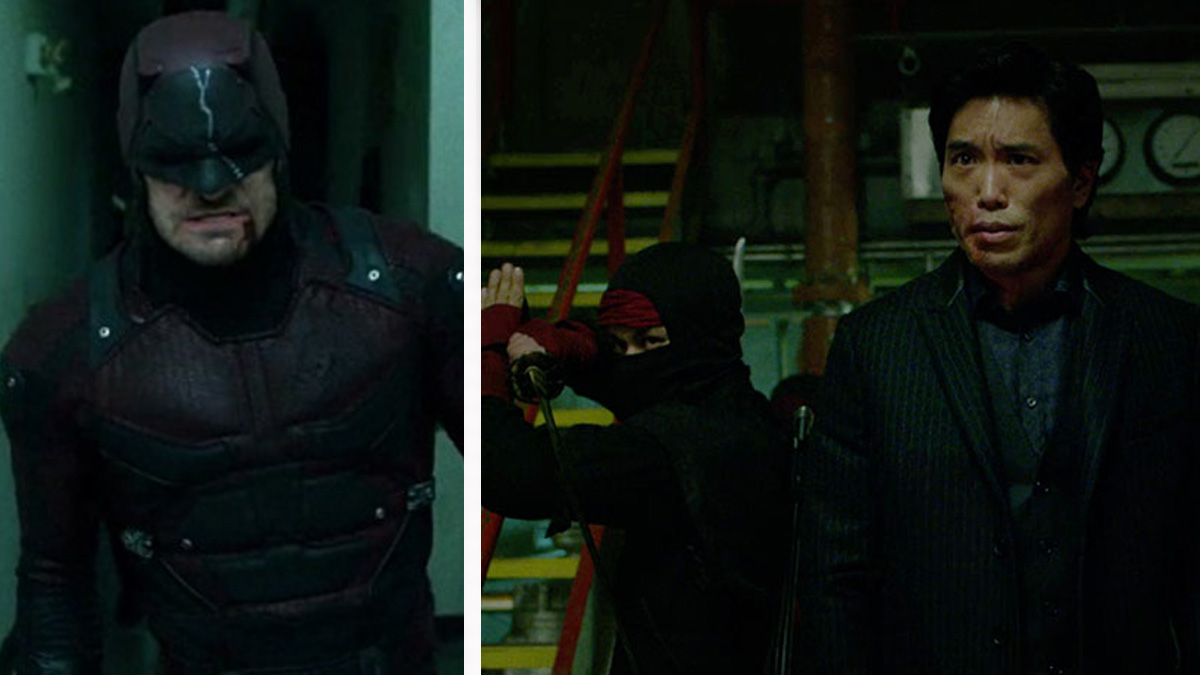
Marvel’s Daredevil has always been a show about what happens in the shadows. Matt Murdock fights in dark hallways, Wilson Fisk builds empires behind closed doors, and Hell’s Kitchen survives on secrets held together with duct tape, Catholic guilt, and an alarming number of broken ribs. But one alleged behind-the-scenes story from the Netflix era of Daredevil may be darker than anything Nobu ever tried to pull with The Hand.
In 2020, actor Peter Shinkoda, who played Nobu Yoshioka in Marvel’s Netflix series, alleged that former Marvel Television head Jeph Loeb discouraged the writers from developing storylines for Nobu and Madame Gao. According to Shinkoda, Loeb allegedly told the writers room that “nobody cares about Chinese people and Asian people.” The comment, as Shinkoda described it during a fan event, reportedly led to story material being dropped for two Asian characters who could have added far more depth to the show’s criminal underworld.
The allegation landed hard because Daredevil was not a forgotten side project. It was one of Marvel Television’s strongest critical successes: gritty, stylish, violent, morally complicated, and packed with performances that made superhero TV feel like prestige crime drama with better costumes. That is exactly why the claim matters. When a strong series sidelines characters because someone in power allegedly assumes audiences will not care, the issue is not just one lost subplot. It is a reminder that representation can disappear in the edit bay long before viewers even know what they missed.
What Peter Shinkoda Alleged About the Cut Daredevil Storylines
Peter Shinkoda said during the virtual #SaveDaredevilCon event that the show originally had more material planned for Nobu and Madame Gao, played by Wai Ching Ho. According to his account, those storylines were not abandoned because they were weak, too expensive, or impossible to fit into the season. Instead, he alleged that Loeb told the writers not to write for those characters because audiences did not care about Chinese and Asian people.
Shinkoda described the proposed Nobu story as involving a deeper personal angle, including a plot connected to a medical transplant and international travel. That detail matters because it suggests the writers were not simply adding extra villain dialogue. They were trying to build motive, history, and emotional stakes. In other words, the kind of material that turns a mysterious antagonist from “cool sword guy in a suit” into an actual person.
Madame Gao also stood to benefit from deeper writing. In the series, she is one of the most intriguing figures in Hell’s Kitchen: calm, strategic, dangerous, and somehow more terrifying when she is sipping tea than most villains are while swinging weapons. Her presence hinted at a wider world beyond Wilson Fisk’s crime network. Yet the show often left her in the realm of mystique rather than fully explored character drama.
Why the Alleged Comment Sparked Backlash
The alleged phrase “nobody cares about Chinese people and Asian people” was not just offensive because of its wording. It was offensive because it described a gatekeeping mindset that has shaped Hollywood for decades. When executives assume that certain audiences, cultures, or characters are not “marketable,” those assumptions can become self-fulfilling. Characters receive less screen time, fewer emotional arcs, and fewer chances to become fan favorites. Then decision-makers point to the lack of audience attachment as proof that the characters never mattered. Congratulations, the snake has eaten its own tail, and somehow the snake also got a development deal.
Fans reacted strongly because Daredevil had already shown that audiences cared deeply about layered supporting characters. Viewers cared about Ben Urich, Father Lantom, Karen Page, Foggy Nelson, Melvin Potter, and even side criminals who looked like they had been punched by Matt Murdock before breakfast. The show’s power came from treating Hell’s Kitchen like a lived-in ecosystem. So the idea that Nobu and Gao were not worth exploring felt especially strange. If a series has time to make us emotionally invested in a tailor who builds armor for vigilantes, it probably has time to give Madame Gao a proper backstory.
Nobu, Madame Gao, and the Missed Opportunity
Nobu Was More Than a Disposable Villain
Nobu entered Daredevil as a sharply dressed, highly dangerous figure connected to organized crime and The Hand. His fight with Matt Murdock remains one of the show’s most memorable early confrontations. It is brutal, fiery, and staged with the kind of intensity that makes viewers question whether Matt’s actual superpower is “surviving things that would turn other people into soup.”
Yet Nobu’s deeper motivations were only lightly explored. His connection to The Hand gave the show a supernatural and international dimension, but he often functioned as a weapon pointed at the hero rather than a fully developed antagonist. More backstory could have clarified his loyalties, his philosophy, his relationship to The Hand, and his personal stakes in the conflict. Instead, he remained fascinating but underwritten.
Madame Gao Deserved More Than Mystery
Madame Gao was one of the smartest characters in the Netflix Marvel universe. She projected power without raising her voice. She understood people, pressure, and survival. Every time she appeared, the show seemed to whisper, “There is a much bigger story here,” and then politely refused to tell it.
That restraint sometimes worked. Mystery can be useful. But mystery becomes frustrating when it replaces character development entirely. A richer Gao storyline could have expanded the world of Daredevil, connected crime, culture, migration, power, and age, and given Wai Ching Ho more room to turn a compelling supporting role into something unforgettable.
The Larger Problem: Asian Characters as Atmosphere
The controversy hit a nerve because Asian characters in American action stories have too often been used as atmosphere rather than people. They are the secret society, the martial arts temple, the silent assassin, the old mystic, the faceless gang, the tattooed henchman, or the person who exists mainly to make the white protagonist’s journey look more exotic. It is the narrative equivalent of using an entire culture as wallpaper, then acting surprised when people notice the room feels fake.
Daredevil was not alone in wrestling with this problem. Marvel’s Netflix era also faced criticism around Iron Fist, a series built around Danny Rand, a white martial arts hero whose story draws heavily from Asian-coded mythology and kung fu traditions. Those debates were not simply about one casting decision. They were about a long pattern in which Asian culture appears on screen while Asian characters are pushed to the margins.
That is why Shinkoda’s allegation mattered beyond one TV show. If the people controlling the story believe Asian characters are less interesting, the final product will reflect that belief. It may not always look like open hostility. Sometimes it looks like missing backstory. Sometimes it looks like fewer lines. Sometimes it looks like a character who enters with enormous potential and exits as a plot device wearing a nice coat.
Why Representation Behind the Camera Matters
Good representation is not only about who appears on screen. It is also about who has power in the room where stories are shaped. Writers, producers, showrunners, casting directors, executives, and editors all influence which characters receive complexity and which characters are reduced to shorthand.
When Asian characters are written without meaningful input from Asian creatives, even well-intentioned stories can slide into old habits. The result may not always be cartoonishly offensive, but it can still feel thin. A character may speak in vague wisdom, practice unexplained martial arts, or exist primarily as a threat from a mysterious “East.” The audience may get style, but not substance.
By contrast, when underrepresented creatives have real authority, stories often become more specific, more surprising, and more emotionally honest. Specificity is not a niche weakness; it is the secret sauce. The more grounded a character’s background feels, the more universal their emotions become. Nobody watches a great story and says, “I wish this had fewer details and more generic fog.”
Marvel Has Changed, But the Conversation Is Not Over
Since the Netflix Daredevil era, Marvel’s television structure has changed significantly. The original Marvel Television division was folded into Marvel Studios, and the franchise has since moved into a new Disney+ era. Daredevil: Born Again brought Charlie Cox and Vincent D’Onofrio back into the spotlight, reconnecting modern Marvel television with the legacy of the Netflix series.
Marvel has also had major successes with Asian-led or Asian-centered projects, most notably Shang-Chi and the Legend of the Ten Rings. That film proved, with the subtlety of a dragon crashing through a third act, that audiences absolutely do care about Asian heroes, Asian families, Asian mythology, and Asian-led action storytelling when those stories are treated as event-level entertainment.
Still, progress in Hollywood is rarely a straight line. One successful film or series does not erase decades of sidelining. The industry can celebrate diversity in press releases while still making cautious decisions behind closed doors. That is why Shinkoda’s allegation remains relevant. It points to the difference between symbolic inclusion and actual narrative investment.
What Daredevil Fans Lost
When storylines are cut, fans do not just lose minutes of screen time. They lose emotional architecture. A better-developed Nobu could have made The Hand more compelling. A deeper Madame Gao arc could have connected street-level crime to global power in a richer way. Their relationship could have clarified the politics of the criminal world around Hell’s Kitchen and given Matt Murdock enemies whose motives were not simply “be mysterious and do crime.”
The Netflix Daredevil series was at its best when villains believed they were heroes of their own stories. Wilson Fisk was terrifying because he had a worldview. Frank Castle was compelling because his violence came from grief and moral absolutism. Benjamin Poindexter became chilling because viewers watched his instability being shaped and weaponized. Nobu and Gao could have benefited from that same depth.
Instead, the Asian characters connected to The Hand often carried the burden of plot mechanics. They brought danger, ritual, and escalation, but not always the emotional weight that made Fisk or Castle so gripping. That imbalance is exactly what fans and critics noticed. It was not that Nobu and Gao lacked potential. It was that the show seemed to leave their potential locked in a storage unit somewhere under Midland Circle.
How This Controversy Fits Into Hollywood’s Bigger Pattern
Hollywood has a long history of treating Asian representation as optional, risky, or secondary. Asian characters have been erased, stereotyped, whitewashed, exoticized, and used as silent visual shorthand. Even when Asian culture influences major franchises, Asian characters themselves often receive less interiority than their white counterparts.
Research from media inclusion groups has repeatedly shown that Asian and Pacific Islander representation has lagged behind, especially in leading roles and meaningful speaking parts. This is not merely a numbers issue. It affects what kinds of stories audiences are taught to expect. If viewers rarely see Asian characters as complex leads, studios may wrongly assume there is no demand. But the demand has always been there. The supply has often been the problem.
The success of projects such as Crazy Rich Asians, Minari, Everything Everywhere All at Once, and Shang-Chi challenged the outdated belief that Asian-centered stories are too narrow. These works succeeded because they were specific, emotional, funny, strange, stylish, and human. In other words, they succeeded for the same reasons any good story succeeds.
Why the Word “Allegedly” Matters
It is important to describe the Daredevil controversy carefully. Shinkoda made a public allegation about what he says happened behind the scenes. Reports covered his comments widely, but the public conversation is still based largely on his account. That is why responsible writing should avoid presenting every detail as a court-established fact. Words like “alleged,” “claimed,” and “according to Shinkoda” are not legal decorations. They are accuracy tools.
At the same time, careful wording should not soften the seriousness of the issue. Whether someone reads the allegation as one actor’s painful account or as part of a larger Hollywood pattern, the concern remains clear: Asian characters deserve the same narrative care, complexity, and screen value as anyone else. They should not have to prove that audiences care before writers are allowed to care first.
Lessons for Modern TV Writers and Producers
Do Not Treat Supporting Characters as Disposable
Supporting characters are often where great shows build texture. A world feels real when even minor characters appear to have lives beyond the frame. Cutting depth from specific groups repeatedly sends a message, even if no one says that message out loud.
Let Culture Be Specific, Not Decorative
Culture should not be sprinkled onto characters like seasoning on a plot sandwich. It should shape worldview, relationships, humor, conflict, and choices. Specificity makes characters stronger, not harder to understand.
Hire People Who Can Challenge Lazy Assumptions
A diverse writers room is not a magic spell, but it helps. When more people with different lived experiences have creative authority, weak assumptions are more likely to be questioned before they become finished episodes.
Experiences Related to the Daredevil Controversy
For many viewers, the Shinkoda allegation felt painfully familiar. Anyone who has watched enough genre television has seen the pattern: an Asian character appears with a striking design, a mysterious past, and a fighting style that screams “important,” only for the story to move on before giving that character a real emotional center. The audience is left doing unpaid detective work, trying to assemble a personality from costume details, fight choreography, and three ominous lines about destiny.
That experience can be especially frustrating for Asian and Asian American viewers. Representation is not only about seeing someone who looks like you on screen. It is about seeing that person treated as narratively valuable. A character can be present and still feel invisible if the story refuses to ask what they want, what they fear, who they love, or why they make the choices they make.
Imagine watching Daredevil and being fascinated by Nobu. He has presence. He has menace. His fight scenes are electric. He clearly belongs to a larger mythology. Then imagine waiting for the show to open that door, only to find out years later that, according to the actor, the door may have been deliberately shut. That does not just disappoint fans of one villain. It reinforces the feeling that certain characters are allowed to look cool but not allowed to matter.
The same applies to Madame Gao. Viewers responded to her because she was not loud, obvious, or predictable. She had the kind of quiet authority that makes a room nervous. She suggested history without needing a flashback every five minutes. But mystery works best when it eventually rewards attention. Without deeper development, mystery can start to feel like avoidance wearing elegant gloves.
For writers and editors, the lesson is practical. If a character catches audience attention, feed that interest. Do not assume viewers only care about the hero. Fans of serialized television often fall in love with the edges of the story: the side villain, the strange alliance, the older mentor, the morally complicated crime boss, the person who appears for five minutes and somehow steals the episode. Great television notices when sparks appear and gives them oxygen.
For producers, the lesson is even simpler: never confuse your own blind spot with audience preference. “Nobody cares” is one of the most dangerous phrases in entertainment because it often means “I have not bothered to imagine who might care.” Audiences are curious. They care about good writing, strong performances, and characters with stakes. Give them a reason, and they will care about a blind lawyer, a crime lord in a white suit, a grieving vigilante with a skull vest, or a terrifying older woman running an empire from the shadows.
The Daredevil controversy also shows why fans keep revisiting old production stories. Behind-the-scenes decisions shape what becomes canon. They determine which characters become icons and which characters become trivia. When those decisions appear to be influenced by bias, fans are right to ask what stories were lost. The missing material matters because absence has consequences. A cut storyline can become a cut opportunity, a cut career moment, and a cut connection with viewers who were ready to care.
In the end, this topic is not only about Marvel, Jeph Loeb, Peter Shinkoda, Nobu, or Madame Gao. It is about a basic storytelling principle: every character deserves to be considered as a human being before being used as a function. When a show remembers that, even its villains become unforgettable. When it forgets, even a great series can leave shadows where richer stories should have been.
Conclusion
The allegation that Daredevil cut Asian character storylines because a producer allegedly believed “nobody cares about Chinese people and Asian people” remains one of the most troubling behind-the-scenes stories attached to Marvel’s Netflix era. It matters because the series had the talent, tone, and audience trust to make Nobu and Madame Gao far more than mysterious threats. It could have turned them into layered figures with motives, histories, and emotional stakes equal to the show’s best villains.
The larger lesson is clear: audiences do care. They care when characters are written well. They care when cultures are treated with specificity rather than used as decoration. They care when supporting characters are given enough depth to surprise them. Hollywood’s old assumptions about what viewers will accept have been proven wrong again and again. The only real question is whether decision-makers are willing to stop underestimating both the characters and the audience.