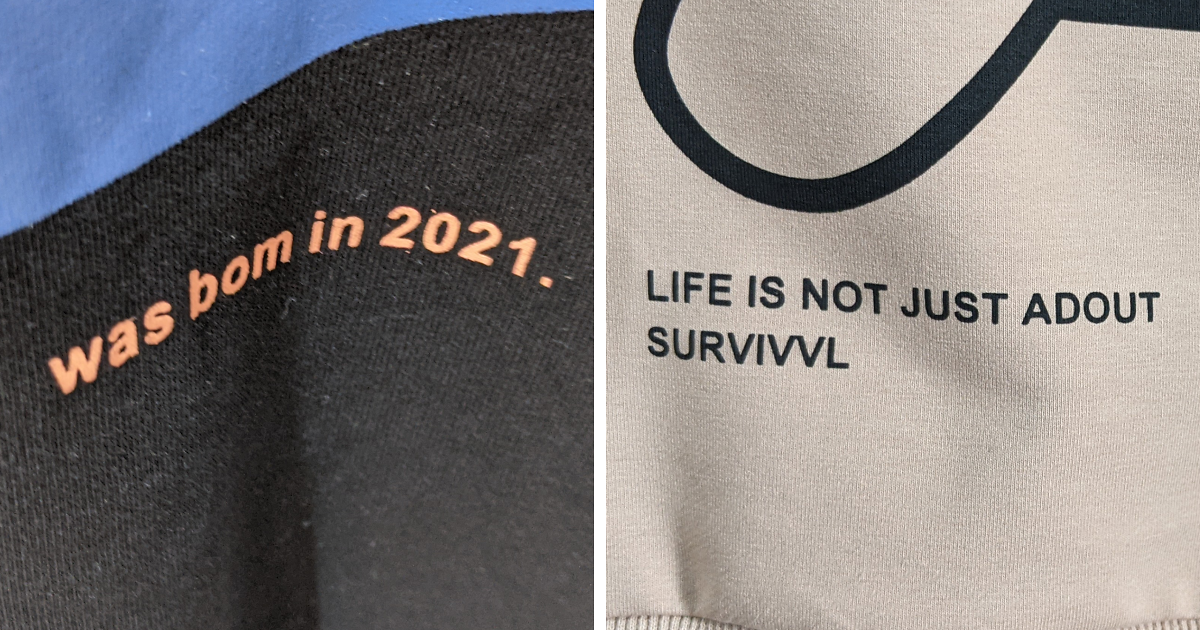
Note: This article body is ready to publish on the web and is written in a fun, reader-friendly style.
There are two kinds of shopping trips. The first kind ends with a new jacket. The second ends with 28 photos of gloriously confusing English slogans printed on hoodies, tees, sweaters, tags, mirrors, sale boards, and random display cards that absolutely did not survive the journey from one language to another. This article is about the second kind.
Walking through clothing stores in Taiwan can feel like stepping into a parallel universe where fashion copy has been written by a sleep-deprived poet, a brave translation app, and one extremely enthusiastic intern who believes commas are optional and grammar is more of a suggestion than a rule. The result is comedy gold. Not mean comedy. Not “look at these people” comedy. More like “language is hard, branding is weird, and somehow this sweatshirt now says something that sounds like a breakup text from a robot” comedy.
That is exactly why funny writing errors in Taiwan clothing stores are so memorable. They sit at the intersection of style, translation, pop culture, and pure accidental chaos. One shirt tries to sound deep and lands in existential fog. Another wants to sound cool and ends up threatening the customer. A third appears to have been assembled from leftover English words found in a washing machine. And somehow, all of it is still stylish enough that you almost want to buy it anyway.
Why Clothing Store English Goes Off the Rails So Beautifully
The funny part is not that English appears in Taiwanese fashion retail. That makes perfect sense. English has long been used around the world as a visual style marker in fashion, especially in streetwear, fast fashion, and youth branding. Sometimes the words are there for meaning. Sometimes they are there for mood. Sometimes they are there because “midnight urban premium soul” simply looks cooler on a sweatshirt than a plain old product code.
Problems start when words are chosen for aesthetic value but never fully checked for tone, grammar, or idiomatic meaning. A phrase that sounds sleek in one language can become hilariously awkward in another. Literal translation makes things worse. Slang behaves badly. Idioms refuse to cooperate. And once a designer starts mixing “dream,” “future,” “legend,” “street,” “classic,” and “freedom” in the same sentence, the odds of producing accidental nonsense rise dramatically.
That is how you end up staring at a shirt that seems to say, “Enjoy the difficult youth with honesty explosion.” You do not know what it means. You do know it has power.
What Makes These 28 Pics So Funny?
The humor usually comes from one of a few classic writing mistakes. Once you see the patterns, you start spotting them everywhere. That is when the shopping trip turns into a photo safari.
1. Direct Translation That Ignores Real English Usage
This is the king of clothing-store comedy. A phrase may be translated word-for-word and remain technically understandable, yet still sound strange to a native reader. The sentence is not fully broken, but it feels like it was assembled in a grammar lab. You can sense the intended meaning hiding inside it, waving for help.
2. Cool Words With Zero Relationship to Each Other
Fashion loves mood words. Unfortunately, mood words are not always friends. So a store sign may combine “vintage,” “future,” “romantic,” “sport,” and “authority” into one line and expect the customer to nod respectfully. Instead, the result reads like a playlist generated by a microwave.
3. Tiny Grammar Mistakes That Change Everything
A missing article, a confused tense, or the wrong preposition can turn a harmless phrase into something weirdly dramatic. “Born in style” becomes “Borned for style.” “Made with love” becomes “Make by love.” “For women” becomes “To woman.” One tiny error, and suddenly the shirt sounds haunted.
4. Accidental Aggression
Some slogans aim for confidence but overshoot into menace. What was supposed to sound bold or empowering comes out sounding like a legal threat. The shirt wants to inspire you. Instead, it feels like it wants your lunch money.
5. Inspirational Quotes That Lose the Plot
Motivational fashion copy is already risky in perfect English. Add weak translation and things get wonderfully unhinged. You begin with a noble message about dreams and end with a sentence that sounds like a refrigerator trying to become your life coach.
The Real Charm Behind the Mistakes
Here is the part worth saying clearly: these errors are funny, but they are also oddly charming. They remind us that language is alive, messy, and deeply human. Not every store is trying to write polished editorial copy. Sometimes the goal is simply to create a vibe, catch the eye, or borrow the prestige of English as a global design language. Meaning matters, but visual impact matters too.
That is why so many people smile instead of sneer when they see these mistakes. The charm lies in the mismatch between intention and result. The brand wants cool. The sentence delivers confusion. Yet the energy still comes through. You can still feel the ambition. You can still see the style. And often, that makes the item more memorable than flawless copy ever would.
Honestly, perfect grammar has never sold every outfit. Fashion has always flirted with the absurd. If a jacket can be called “oversized cloud utility core,” then a mistranslated slogan hardly feels like the biggest crime in the room.
What These Errors Reveal About Global Fashion
Funny writing errors in Taiwan clothing stores are not really just about Taiwan. They are about what happens when global fashion moves faster than careful language review. A design might be sketched in one place, edited in another, printed somewhere else, and sold in a market with different expectations. Every step adds room for a phrase to drift a little farther from what the writer meant.
Fashion also tends to reward speed. New drops arrive fast. Trends mutate weekly. A slogan only has to look trendy long enough to make it onto fabric. That does not leave much room for thoughtful editing, native-speaker review, or the deeply underrated act of asking, “Hey, does this sentence sound normal?”
And yet these mishaps are useful. They show that translation is not just swapping words. It is tone, context, rhythm, audience, and culture. A phrase can be grammatically close but emotionally wrong. It can be literal but not natural. It can be stylish in appearance while accidentally ridiculous in meaning. That gap is where the comedy lives.
Breaking Down the 28-Pic Experience
If you looked through 28 photos of funny writing errors from clothing stores in Taiwan, you would probably notice a progression.
At first, there is surprise. You see one odd slogan and laugh.
Then comes pattern recognition. By photo five, you realize the same types of mistakes keep returning: missing verbs, strange plurals, dramatic nouns, and motivational phrases that have clearly been through several emotional breakdowns.
By photo twelve, you are no longer just laughing. You are analyzing. Why do so many slogans rely on random abstract nouns? Why is “youth” always in danger? Why is “future” apparently made of denim?
By photo twenty, you have reached enlightenment. You stop judging the grammar and begin appreciating the art form. The shirt no longer needs to make sense. It only needs to make you stop, stare, and whisper, “Absolutely incredible.”
By photo twenty-eight, you are ready to frame one.
Common Types of Writing Errors You Might Spot
Awkward Word Order
This is a classic. All the right words are present, but they have chosen the wrong seating arrangement. The sentence sounds like it got dressed in the dark.
Incorrect Plurals
English plural forms are notorious little troublemakers. Add an “s” where it does not belong, forget it where it does, and suddenly your luxury cardigan is advertising “elegance spirites.” That is not a typo. That is performance art.
False Friends and Near Meanings
Some words look like good choices but carry the wrong tone. “Sensual” instead of “sensitive.” “Mature” instead of “grown.” “Liberty” where “casual” was probably intended. The sentence remains legal English, technically speaking, but emotionally it is doing backflips.
Overloaded Slogans
When one phrase tries to sound premium, sporty, emotional, rebellious, minimalist, and poetic all at once, the result can be gloriously impossible to decode. It is less of a slogan and more of a linguistic buffet plate.
Why People Keep Sharing These Photos Online
The answer is simple: they are relatable. Anyone who has ever studied another language knows the feeling of confidently writing something and later discovering it means “horse battery elegance mountain.” These clothing-store slogans are funny because they expose a universal truth. Language is hard. Style is subjective. And every one of us is one bad translation away from accidental comedy.
There is also a visual element. Fashion text is not hidden in a paragraph. It is huge. It is front and center. It is printed across the chest like a public announcement. That makes every mistake louder, funnier, and far more photogenic.
Social media loves that combination. A weird sign can be amusing. A weird sign on a fashionable hoodie under perfect store lighting? That is premium internet material.
How Brands Could Avoid Becoming the Next Viral Screenshot
The easy answer is proofreading, but the real answer is localization. Not just translation. Localization. That means checking whether the phrase sounds natural to the specific audience, fits the brand voice, and communicates the intended tone. A slogan should not merely be understandable. It should feel native, stylish, and emotionally right.
Stores also benefit from simplicity. Short, clear phrases age better than complicated pseudo-poetry. If your shirt can say one good thing, let it say one good thing. It does not need to say seven mysterious things and one accidental threat.
And yes, having a real human review the copy is still one of the smartest steps in the process. Machines can translate words. Humans catch the moment when “urban dream resistance of memory” should maybe not be printed on 500 sweatshirts.
Why I Secretly Love These Errors Anyway
Here is my confession: I do not want this phenomenon to disappear completely. I want fewer embarrassing mistakes for brands, sure. But I also want the world to keep producing these delightful little language accidents. They are funny without needing to be cruel. They turn ordinary errands into stories. They make retail spaces feel unexpectedly human.
In a world full of polished marketing, optimized messaging, and aggressively focus-grouped copy, a strange shirt slogan can feel weirdly refreshing. It is imperfect. It is unfiltered. It is memorable. And sometimes it is much more fun than the bland, predictable slogan a perfectly edited campaign would have produced.
Extra Reflections: My Experience With Funny Clothing Store Writing Errors
What always gets me about these clothing-store English mistakes is that they create an entirely different shopping rhythm. You are not just browsing anymore. You are reading. You are decoding. You are pausing mid-step because a sweater has just informed you to “keep silent passion with modern attack,” and now you need a minute.
I have had moments where I looked at a rack of otherwise normal shirts and felt like I was reading fragments from a lost science-fiction novel. One top seemed determined to inspire me, but the wording sounded like a weather warning. Another piece was probably aiming for a soft, romantic mood, yet the sentence felt more like a court testimony. I did not leave with the clothes, but I absolutely left with a story.
That is part of the joy. These errors turn retail into entertainment. They create accidental mini-performances in public spaces. Friends gather around a display and try to figure out what the slogan was supposed to mean. Someone offers a theory. Someone else makes it worse. A third person decides the broken version is actually better than the original. Suddenly, shopping for socks has become a group language workshop with lighting and sale tags.
They also make me think about how often English is treated as a design texture rather than a strict communication tool. In fashion, words are not always there to be read carefully. Sometimes they are there to suggest mood: urban, bold, elite, dreamy, sporty, rebellious, nostalgic. That is why even native English speakers can write slogans that sound silly. Fashion copy in general has a long history of taking itself very seriously while saying almost nothing. Translation errors simply push that habit into a more visible and more hilarious form.
Another reason these mistakes stay with me is that they are oddly democratic. You do not need to be a linguist to enjoy them. You just need enough English to know that something has gone charmingly sideways. They invite everyone into the joke, including people who have made their own language mistakes before. That matters, because the best reaction is not mockery. It is recognition. We have all been there in some form, trying to sound polished and ending up memorable for unexpected reasons.
And if I am being completely honest, there is a tiny part of me that admires the confidence of these garments. A shirt with a broken slogan still hangs there boldly, asking for your money as if nothing is wrong. That level of self-belief is inspirational. I have seen tops say things no polished marketing team would ever approve, and yet they still looked fabulous. Maybe that is the secret lesson hidden inside all 28 imaginary photos: confidence can carry a sentence surprisingly far.
So yes, I laugh when I see funny writing errors in some clothing stores in Taiwan. But I also appreciate them. They are snapshots of globalization in action, style in motion, and language doing cartwheels in public. They remind me that communication is messy, creativity is unpredictable, and sometimes the most unforgettable fashion statement is the one that makes absolutely no sense at all.
Conclusion
Funny writing errors in Taiwan clothing stores are more than quick laughs. They are tiny case studies in branding, translation, globalization, and the strange magic of fashion language. The 28 pics may be hilarious, but they also show how words travel, how meanings wobble, and how style can survive even when grammar taps out early. Whether you see them as design fails, accidental poetry, or wearable comedy, one thing is clear: these mistakes are unforgettable. And honestly, that might make them more effective than half the “perfect” slogans in the mall.