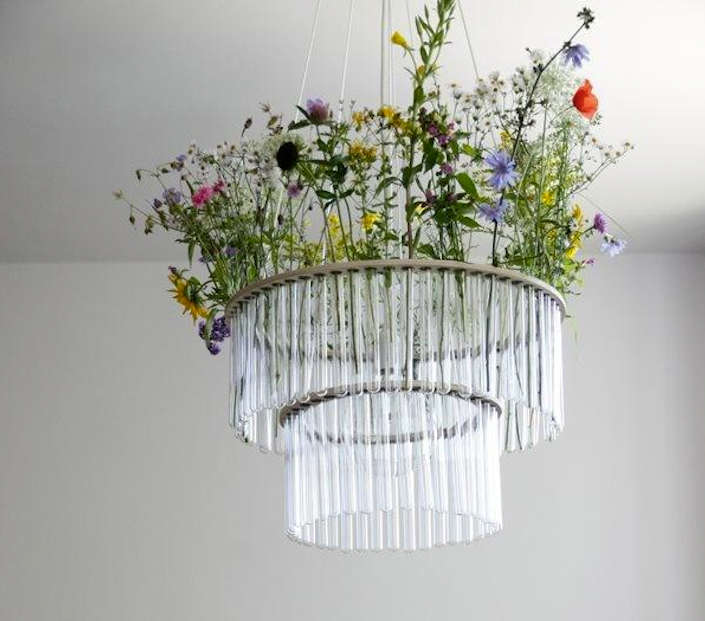
Some lighting fixtures brighten a room. Others steal the whole scene, sip espresso in the corner, and quietly become the reason guests start asking questions. That is the magic of the Polish test tube chandelier often described as a true “garden in the sky.” Equal parts light fixture, floral display, conversation starter, and tiny science lab with better manners, it takes a familiar chandelier shape and swaps crystal drops for glass laboratory tubes.
At the center of the fascination is Maria S.C., a design by Polish artist and designer Magda Jurek of Pani Jurek. The piece has been admired for years by design editors, plant lovers, and anyone who enjoys décor that refuses to sit quietly in the background. It looks refined at first glance, but the longer you stare, the more it reveals its playful side. One day it can hold single stems and trailing greenery. The next day it can glow beside clear glass tubes, tinted water, or a minimalist arrangement that says, “Yes, I do have taste, thanks for noticing.”
That mix of intelligence and whimsy is exactly why this chandelier still feels fresh. In a world full of predictable pendants and safe beige choices, a test tube chandelier from Poland lands like a stylish little rebellion. It combines indoor gardening, statement lighting, biophilic design, and a dash of art history in one object. Frankly, that is a lot of ambition for a ceiling fixture, but this one pulls it off.
What Exactly Is a Test Tube Chandelier?
The best-known version of this idea, Maria S.C., uses circular wooden bands fitted with removable laboratory glass tubes around a central light source. The result is a chandelier that behaves like a flower holder, a sculptural installation, and a customizable lighting feature all at once. Early coverage of the design highlighted versions with dozens of test tubes, including one widely cited model built with 96 tubes, which helps explain why the fixture can look lush, airy, dramatic, or almost architectural depending on how it is styled.
The design was created as a tribute to Maria Skłodowska-Curie, better known in the United States as Marie Curie. That connection matters. This is not random science-core décor tossed together for social media applause. The chandelier deliberately links chemistry, glass, experimentation, and beauty. It turns the language of the lab into something domestic and elegant, without losing the cheeky genius of using test tubes where people expect crystal or brass.
It also reflects one of the smartest ideas in contemporary home design: objects do not need to do just one thing anymore. A chandelier can provide light, yes, but it can also display seasonal stems, frame a dining table, soften a room with organic shapes, and let the homeowner change the mood without repainting a wall or dragging in new furniture. That is efficient, expressive decorating. Also, it is a lot more fun than arguing over swatches named things like “Misty Oat.”
Why This Polish Design Captured So Much Attention
1. It turns lighting into a living display
Plenty of homes have flowers. Plenty of homes have chandeliers. Very few combine them in a way that feels this intentional. The test tube chandelier does not merely hang above a room; it participates in it. Single stems become part of the silhouette. Leaves catch the light. Water adds sparkle. Empty tubes look crisp and modern, while filled ones create movement and softness. The fixture changes with the seasons, the room, and the person styling it.
2. It taps into the biophilic design movement
American design media has spent the last several years talking about biophilic interiors, and for good reason. People want homes that feel calming, alive, and connected to nature. Usually that means houseplants, natural materials, layered textures, and an emphasis on bringing the outdoors in. A chandelier that can literally hold bits of a garden overhead fits that desire beautifully. It is biophilic design without shouting, “Look at me, I bought seventeen monsteras and now I need a support group.”
3. It feels sculptural, not cluttered
One reason the fixture works so well is its restraint. The geometry stays clean. The tubes are repetitive and orderly. The frame is simple. That structure keeps the piece from tipping into chaos, even when it is styled with plants or color. The overall effect is more gallery installation than craft project. In design terms, that is a very hard balance to strike.
4. It invites customization
Many high-end fixtures are fixed compositions. They are beautiful, but they are finished. This one is more like a collaboration. You can style it with eucalyptus for a soft organic look, dried stems for something moodier, or a few bright blooms when the room needs a shot of happiness. Some owners lean into clear minimalism. Others use colored water for a more playful, almost art-school effect. The chandelier becomes personal without losing its original design identity.
The Design Language: Science, Art Deco, and a Wink of Surrealism
Part of the chandelier’s appeal is how many visual languages it speaks at once. The circular bands and repeated glass elements give it a refined rhythm that can read almost Art Deco. At the same time, the use of everyday laboratory glass has a ready-made quality that feels more conceptual and contemporary. It is elegant, but it also knows how weird it is. That self-awareness is part of the charm.
There is also something unmistakably European about its balance of seriousness and play. The tribute to Curie gives the design intellectual roots, but the execution never becomes stiff or museum-like. It stays usable. It stays warm. It stays just mischievous enough to make a dining room feel less formal and more alive. That combination is rare. Plenty of statement pieces are dramatic. Fewer are witty.
And because it comes from Poland, the fixture carries a sense of place that adds depth to the story. This is not décor generated by committee. It feels authored. The Polish origin matters not just geographically, but aesthetically: the design has craft, concept, and individuality. It feels made by a designer with an idea, not by an algorithm with a mood board.
How to Style a Garden in the Sky at Home
Choose the right room
A test tube chandelier works especially well over dining tables, breakfast nooks, kitchen islands, entry tables, or anywhere you want one vertical focal point to do heavy lifting. Dining areas are particularly natural because chandeliers already belong there. Add flowers overhead and the whole room feels hosted, even if dinner is just takeout and mild denial.
Keep the stems light and intentional
The prettiest arrangements usually are not the biggest. Think single blooms, airy cuttings, delicate herbs, slim branches, or a repeating type of foliage. A test tube is closer to a bud vase than a giant vessel, so the styling looks best when it respects that scale. Overcrowding the tubes is the fastest route to turning poetic Polish design into airborne chaos.
Mix empty and filled tubes
One of the smartest styling tricks is not filling every single tube. Leaving some empty gives the arrangement room to breathe and preserves the sculptural quality of the fixture. It also keeps the whole composition from looking too heavy. A little asymmetry can make the piece feel even more modern.
Use color carefully
Colored liquid can be gorgeous here, but it should be approached like hot sauce: enough to wake things up, not enough to become the entire personality of the room. Soft greens, pale amber tones, or subtle monochromatic palettes tend to age better than a full rainbow unless you are deliberately going for bold, art-forward energy.
Remember it is still a light fixture
As dreamy as the flowers are, lighting comes first. The chandelier should still suit the scale of the room and the surface below it. A dimmer switch is a very good idea. So is thinking about sightlines. You want drama, not a floral obstacle course hovering between you and your dinner guests.
What Makes It So Relevant Right Now?
Home design in the United States keeps circling back to a few major desires: more nature indoors, more personality, more sculptural lighting, and more objects that feel handcrafted rather than generic. This chandelier checks every one of those boxes. It supports the plant display trend without eating up floor space. It works with the appetite for statement lighting. It satisfies the ongoing love of unusual vessels, bud vases, and vertical greenery. Most of all, it feels human.
That last part matters. People are increasingly drawn to interiors that feel layered and personal instead of overly staged. A test tube chandelier changes with the seasons. It can hold a clipping from the yard, a few market stems, or a tiny arrangement tied to a birthday, dinner party, or random Tuesday when you wanted the room to feel less like a room and more like a tiny event. That flexibility gives it emotional range, not just visual appeal.
It also helps that the fixture blurs categories. Is it lighting? Floral design? Installation art? A vessel collection with delusions of grandeur? Yes. Beautifully yes. When an object escapes easy classification, it tends to linger in people’s minds. That is why design editors kept returning to it, and why the broader idea still resonates years after its debut.
Is It Practical, or Just Very Pretty?
Fortunately, it is both. The tubes are removable, which makes the piece adaptable and easier to restyle. You can live with it in a stripped-down form most days, then dress it up when you want more romance or color. That alone makes it more practical than many purely decorative art-light hybrids.
Of course, practicality has limits. Fresh flowers require maintenance. Water must be handled carefully. Not every stem belongs over a table, and not every homeowner wants to climb up and refresh an arrangement on a whim. But that is also the point: this is interactive design. It asks for participation. For some people, that sounds like a chore. For others, it sounds like exactly the kind of domestic ritual that makes a home feel loved.
If you adore styling, hosting, arranging, or experimenting, this chandelier is practically catnip. If you prefer décor that never changes and asks nothing of you, a regular pendant may be the more peaceful relationship. No judgment. Not every home needs a suspended botanical science poem.
The Bigger Lesson Behind the Chandelier
The real genius of “Garden in the Sky” is that it reminds us décor can be both useful and imaginative. Too much home content treats function and fantasy like divorced parents who cannot be in the same room. This fixture refuses that separation. It lights the room. It holds plants. It changes mood. It tells a story. It makes people smile. That is excellent design.
It also proves that floral display does not have to stay on the table. American design sources increasingly point upward and outward when talking about plants: walls, ceilings, hanging planters, mounted greenery, sculptural vessels. The modern home is becoming more vertical, more expressive, and more willing to let nature behave like décor without reducing it to background filler. In that context, the Polish test tube chandelier feels less like an oddball and more like a quiet pioneer.
Final Thoughts
Garden in the Sky: Test Tube Chandeliers from Poland is one of those design ideas that sounds mildly absurd until you see it. Then it suddenly makes perfect sense. Of course flowers can live in a chandelier. Of course a light fixture can nod to chemistry and still feel romantic. Of course a room can feel more alive when the thing overhead is not just glowing, but blooming.
That is why the piece endures. It is smart without being smug, elegant without being fragile, and playful without turning gimmicky. It invites people to decorate with curiosity. It makes a ceiling feel less like dead space and more like an opportunity. And in a decorating world crowded with copies of copies of copies, that kind of original thinking is worth celebrating.
If ever there were a fixture that could persuade a minimalist to buy flowers and a plant lover to care about lighting, this is probably it. A chandelier made of test tubes should not feel this poetic. And yet, hanging there like a little garden in midair, it absolutely does.
Living With a Garden in the Sky: The Experience
Imagine walking into a room early in the morning before anyone else is awake. The coffee is still doing its best work in the mug, the house is quiet, and above the table hangs this ring of glass catching the first pale light of the day. Some of the tubes are empty, some hold a few clipped stems, and a few have tiny leaves that seem to hover in place. The fixture is not loud, but it changes the entire mood of the room. Instead of feeling like a standard dining space, it feels curated, like a corner of a boutique hotel crossed with an artist’s studio and just a whisper of greenhouse.
That is the real experience of a test tube chandelier: it makes ordinary moments feel slightly ceremonial. Breakfast looks better under it. Evening takeout feels more intentional. A simple branch from the yard suddenly has a starring role. The overhead display changes with your mood and the season, so the room never feels static for very long. In spring, you might use delicate blooms and bright green cuttings. In fall, dried grasses and seed heads look dramatic and a little mysterious. Around the holidays, the chandelier can lean festive without becoming cheesy. That is a rare skill.
There is also a satisfying ritual to maintaining it. You do not just switch on the light and move on. You notice it. You interact with it. You swap stems, refresh water, step back, and decide whether the arrangement feels balanced. It turns decorating into something active and creative rather than purely consumptive. You are not simply buying a finished look. You are participating in one.
Guests usually respond the same way: first they look up, then they smile, then they ask, “Wait, are those test tubes?” That tiny moment of surprise is part of the fun. The chandelier has novelty, but it does not rely on novelty alone. After the double take, people usually start noticing the elegance of the shape, the glow through the glass, the softness of the greenery, and the way the whole thing somehow makes sense. It is memorable without trying too hard, which is more than can be said for half the internet.
Perhaps the nicest part is that the piece encourages you to pay attention to small beauty. A single stem matters here. A clipping matters. A little color matters. You do not need giant bouquets or expensive arrangements for the chandelier to feel special. In fact, the modesty of the materials often makes it more charming. One leaf can be enough. One flower can be enough. One empty tube catching light can be enough. Living with a garden in the sky is not really about excess; it is about noticing how much delight can fit into a carefully designed object suspended above everyday life.