“`
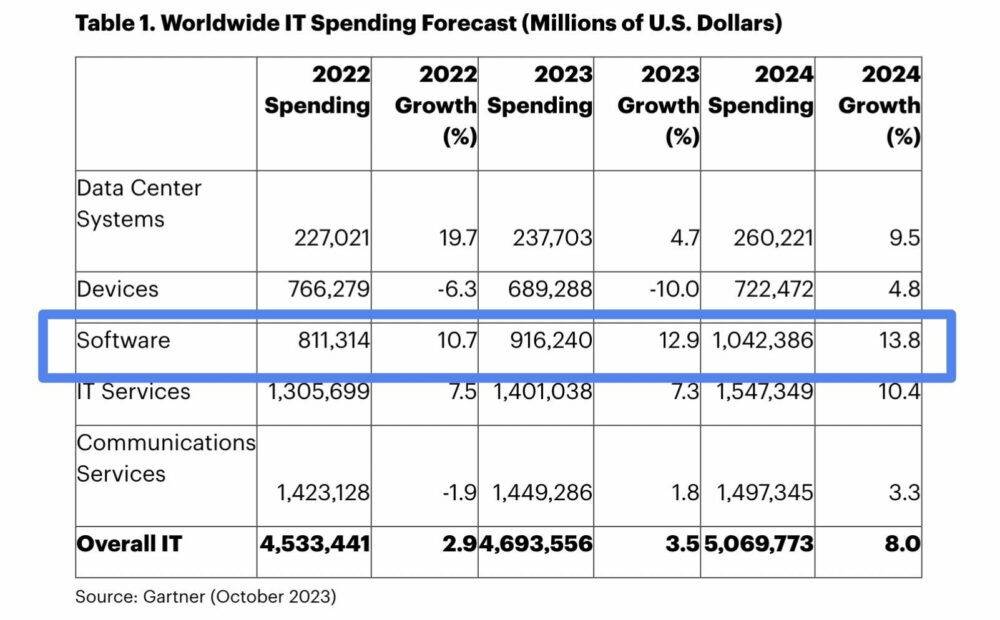
There are market milestones, and then there are moments when the business world collectively checks its credit card statement and whispers, “Wait, we spent how much?” Gartner’s forecast that global software spending would grow 13.8% in 2024 and cross the $1 trillion mark for the first time belongs firmly in the second category. It is a headline with fireworks, spreadsheets, and a small finance-team panic attack built in.
The number matters because it tells us something bigger than “companies like software.” We already knew that. The modern office runs on software the way a coffee shop runs on espresso and mild chaos. What Gartner’s projection shows is that software has moved from a useful business tool to the operating system of the global economy. Customer relationships, payroll, cybersecurity, logistics, analytics, collaboration, cloud infrastructure, artificial intelligence, compliance, billing, hiring, and even the humble meeting invite now depend on layers of applications.
Crossing $1 trillion is not just a vendor victory lap. It is a signal that enterprise software spending, SaaS budgets, cloud subscriptions, cybersecurity tools, data platforms, AI add-ons, and automation systems are becoming permanent budget pillars. The software market is no longer a side dish. It is the steak, the potatoes, and possibly the waiter recommending a premium upgrade.
What Gartner’s Software Spending Forecast Really Means
Gartner’s original forecast pointed to worldwide software spending reaching more than $1.04 trillion in 2024, up 13.8% from 2023. That was a striking jump because the 2023 market was already large, competitive, and under pressure from economic uncertainty. Later updates from Gartner continued to show software spending above the trillion-dollar line, with the July 2024 forecast placing software spending at nearly $1.1 trillion for the year.
So, the headline is not merely about a single percentage point. It is about direction. Even when CIOs complained about change fatigue, inflation, tighter approvals, and vendor consolidation, software kept growing. Businesses did not stop buying software; they became more selective, more skeptical, and more obsessed with value. In plain English: the wallet stayed open, but it started asking tougher questions.
Why Software Spending Is Still Growing So Fast
The easiest answer is that companies need software to function. The better answer is that businesses are now built around digital workflows. A retailer without inventory software is guessing. A hospital without secure systems is in trouble. A bank without analytics and compliance tools is inviting regulators to bring a folding chair. A sales team without CRM might as well communicate by carrier pigeon.
1. Cloud Adoption Keeps Pulling Budgets Forward
Cloud computing remains one of the biggest engines behind software spending growth. Public cloud services, SaaS platforms, and cloud-based infrastructure software allow companies to scale faster without buying and maintaining every server themselves. This shift sounds efficient, and often it is. But it also changes spending from occasional capital purchases into recurring subscription commitments.
That recurring model is great for vendors and convenient for customers, until the invoice grows legs and starts jogging. Usage-based pricing, storage fees, API calls, premium support, security add-ons, and AI-powered features can all expand cloud bills. Many organizations entered the cloud era expecting flexibility. They got it, but they also received a new hobby: explaining cloud costs in budget meetings.
2. Cybersecurity Is No Longer Optional
Cybersecurity spending continues to drive software budgets because threats are multiplying faster than unread Slack messages. Ransomware, phishing, identity attacks, supply-chain vulnerabilities, and AI-assisted fraud have pushed security software from “important” to “board-level urgent.” Companies are investing in endpoint protection, zero trust architecture, identity management, cloud security, threat detection, compliance monitoring, and incident response platforms.
This is not just fear-based spending. It is operational protection. A serious cyber incident can interrupt business, damage reputation, create legal exposure, and trigger regulatory consequences. In that context, security software is less like an optional subscription and more like locking the front door before going on vacation.
3. AI Is Changing the Software Budget Conversation
Generative AI did not instantly transform every IT budget in 2024, but it absolutely changed the conversation. Gartner’s analysis suggested that many organizations were still in the planning phase: evaluating use cases, preparing data, testing copilots, and figuring out governance. At the same time, technology providers were already embedding AI into existing products.
That matters because AI features often arrive as paid add-ons, premium tiers, usage tokens, or new modules. A company may not buy an entirely new AI system, but it may pay more for AI inside the software it already uses. That is how AI becomes a quiet budget multiplier. It is not always a giant new line item. Sometimes it is a modest upgrade across 20 platforms, each one saying, “Just a little more.” Famous last words, meet procurement.
The Trillion-Dollar Software Market Is Not Equal for Everyone
A growing software market does not mean every software company is suddenly swimming through gold coins like a cartoon duck. Gartner’s forecast came with an important caveat: more money is flowing into software, but much of it is going to established vendors, cloud platforms, security providers, and tools already embedded inside enterprise workflows.
That creates a split market. Incumbent vendors benefit from renewals, price increases, seat expansion, and bundled AI capabilities. New vendors face longer sales cycles, tougher security reviews, deeper procurement scrutiny, and buyers who are tired of adding yet another dashboard to the software lasagna.
What This Means for SaaS Startups
For SaaS startups, the Gartner forecast is both good news and mildly annoying news. The good news is obvious: software budgets are growing. Buyers are still investing. Digital transformation did not pack its bags and move to a cabin in the woods.
The annoying news is that buyers are harder to impress. A startup cannot simply say, “We have AI,” and expect a CIO to throw confetti. Companies want measurable ROI, faster implementation, stronger security documentation, integration with existing systems, and proof that the product will not become shelfware by next quarter.
Winning in this environment requires sharper positioning. Vendors need to solve painful problems, not vague ones. “We improve productivity” is nice. “We reduce invoice processing time by 42% while integrating with your ERP in three weeks” is much better. Specificity sells. Fluff gets forwarded to nobody.
Why Buyers Are Scrutinizing Software More Closely
Even as spending grows, buyers are not casually adopting tools the way people download weather apps before a vacation. Leadership teams are asking for consolidation, governance, cost control, and stronger proof of value. Many organizations have discovered that years of rapid SaaS adoption created overlapping subscriptions, unused licenses, shadow IT, duplicate tools, and renewal surprises hiding in the budget like raccoons in an attic.
This explains the rise of SaaS management, software asset management, FinOps, and cloud cost optimization. Companies want visibility into what they own, who uses it, what it costs, and whether it still deserves a seat at the budget table. The trillion-dollar software market is not just about buying more. It is also about managing better.
Software Consolidation Is Becoming a Strategy
One practical example is the consolidation of collaboration tools. A company may have separate platforms for chat, video meetings, documentation, project management, file sharing, whiteboarding, and employee recognition. Each tool may be useful, but together they can create a maze where productivity goes to stretch its legs and never returns.
In 2024, more IT teams began asking whether fewer platforms could handle more workflows. This does not mean best-of-breed software is dead. It means every tool must justify its existence. The new procurement mood is not anti-software. It is anti-waste.
The Role of IT Services in the Software Boom
Software spending does not happen in isolation. Companies also need consultants, implementation partners, managed service providers, system integrators, and internal teams to make software work. Gartner’s 2024 forecasts showed strong growth in IT services, driven by digital optimization, cloud migration, AI planning, and talent shortages.
This is important because buying software is the easy part. Using it well is the hard part. Anyone can purchase a powerful analytics platform. Turning messy business data into trusted dashboards that executives actually use is another adventure entirely. It involves architecture, governance, training, change management, security, and usually at least one meeting where someone says, “Can we define what we mean by customer?”
Generative AI: Investment, Tax, or Both?
One of the more interesting ideas from Gartner’s 2024 commentary was that generative AI can behave like a “tax” inside software spending. That sounds dramatic, but the point is practical. When software vendors add AI features, they may rely on underlying model providers or cloud infrastructure partners. The vendor charges the customer, but part of that revenue flows to the AI infrastructure stack.
For customers, this means AI features should be evaluated carefully. Some will be transformative. Some will save time, improve decision-making, or automate repetitive work. Others will be shiny buttons with premium pricing and suspiciously vague benefits. The difference matters. In a trillion-dollar software market, the winners will not be the companies that buy the most AI. The winners will be the companies that connect AI spending to measurable business outcomes.
How Businesses Should Respond to the 2024 Software Spending Surge
Gartner’s forecast should not make executives panic, nor should it inspire them to approve every software request with a cheerful thumbs-up. The best response is discipline. Software is essential, but essential does not mean unlimited. Companies need a mature operating model for software investment.
Build a Real Software Inventory
First, companies should know what software they already have. This sounds basic, but many organizations cannot produce a clean inventory of active applications, owners, renewal dates, license counts, usage levels, and contract terms. Without that visibility, software spending becomes guesswork with invoices.
Measure Adoption, Not Just Purchase
Second, teams should track adoption. A tool with 1,000 paid seats and 130 active users is not a platform; it is a very expensive ghost town. Usage data should inform renewals, training, consolidation, and vendor negotiations.
Connect Software to Business Outcomes
Third, each major software investment should connect to a measurable goal. That goal might be faster sales cycles, reduced security risk, lower support volume, improved customer retention, shorter development timelines, better compliance, or higher employee productivity. The more specific the goal, the easier it is to defend the spend.
Negotiate Like Renewals Matter Because They Do
Finally, procurement teams should treat renewals as strategic moments. Many software costs rise not during the initial purchase but during expansion and renewal. Buyers should review usage, benchmark pricing, challenge unused modules, and avoid being surprised by automatic increases. A renewal calendar may not sound thrilling, but neither does overpaying for software no one opens.
What the Trillion-Dollar Milestone Says About the Future
The move beyond $1 trillion confirms that software is now core infrastructure for business. It also suggests that the next phase of competition will be about value density. Companies will not simply ask, “Which software can we buy?” They will ask, “Which software creates the most measurable value per dollar, per employee, per workflow, and per risk reduced?”
That is a healthier market. It rewards vendors that deliver outcomes, not just features. It rewards buyers who manage technology as a portfolio, not a pile. And it rewards IT leaders who can translate software investments into business language. The CIO of 2024 is not just a technology executive. The CIO is part strategist, part economist, part security guardian, part therapist for teams suffering from change fatigue.
Real-World Experience: Lessons From the Software Spending Boom
In practical business experience, the software spending surge feels less like a sudden explosion and more like a steady rising tide that keeps reaching new shelves in the finance department. A company starts with a CRM because sales needs structure. Then marketing adds automation. Customer support needs a help desk. Finance wants planning software. HR needs onboarding and payroll. Engineering needs DevOps tools. Security adds identity management, endpoint protection, and monitoring. Suddenly, the organization is not “using software.” It is living inside software.
One common experience is the discovery phase that happens when leadership asks a simple question: “How many SaaS tools do we have?” The room becomes quiet. Someone opens a spreadsheet. Someone else says, “Define tool.” That is when the real work begins. Teams often find duplicate project management apps, multiple survey tools, unused analytics licenses, and old subscriptions owned by employees who left two reorganizations ago. It is not negligence; it is the natural result of fast growth, decentralized buying, and teams trying to solve problems quickly.
Another experience is the renewal surprise. A department may love a platform, but when the renewal arrives, the price has increased because usage grew, premium features were added, or the vendor changed packaging. This is especially common with cloud and AI-enabled products. What began as predictable subscription pricing can become usage-based pricing, and usage-based pricing is wonderful until usage behaves like a teenager with the family data plan.
The best organizations respond by building stronger governance without crushing innovation. They do not force every software request through a nine-month approval tunnel guarded by paperwork dragons. Instead, they create clear rules: security review for sensitive data, business owner assigned before purchase, renewal date tracked, expected outcome documented, and usage reviewed regularly. This keeps teams agile while preventing software sprawl from becoming a budget monster.
There is also a people lesson. Software only delivers value when employees actually change how they work. Many companies underestimate training, communication, and workflow redesign. They buy a platform expecting transformation, then discover that employees are still using spreadsheets because the new system feels complicated or disconnected from daily tasks. Successful software adoption requires champions, practical onboarding, leadership support, and patience. The button may say “automate,” but the organization still has to do the human part.
Finally, the trillion-dollar software market teaches a simple lesson: software strategy is business strategy. Companies that manage software thoughtfully can move faster, serve customers better, secure data more effectively, and make smarter decisions. Companies that treat software as a random collection of subscriptions will spend more and get less. In 2024 and beyond, the winners will not necessarily be the biggest spenders. They will be the clearest thinkers.
Conclusion
Gartner’s forecast that software spending would grow 13.8% in 2024 and pass $1 trillion for the first time is more than a big-number headline. It reflects a permanent shift in how businesses operate, compete, secure themselves, and pursue growth. Cloud adoption, cybersecurity, AI planning, SaaS expansion, and digital transformation are pushing software deeper into every department.
But the lesson is not “buy everything.” The lesson is “buy intelligently.” A trillion-dollar market creates opportunity for vendors, but it also creates pressure for buyers to manage cost, reduce overlap, prove ROI, and align every platform with measurable business value. Software is no longer just technology. It is the machinery of modern business. And like all machinery, it works best when someone maintains it, measures it, and occasionally asks why three teams are paying for three tools that do the same thing.