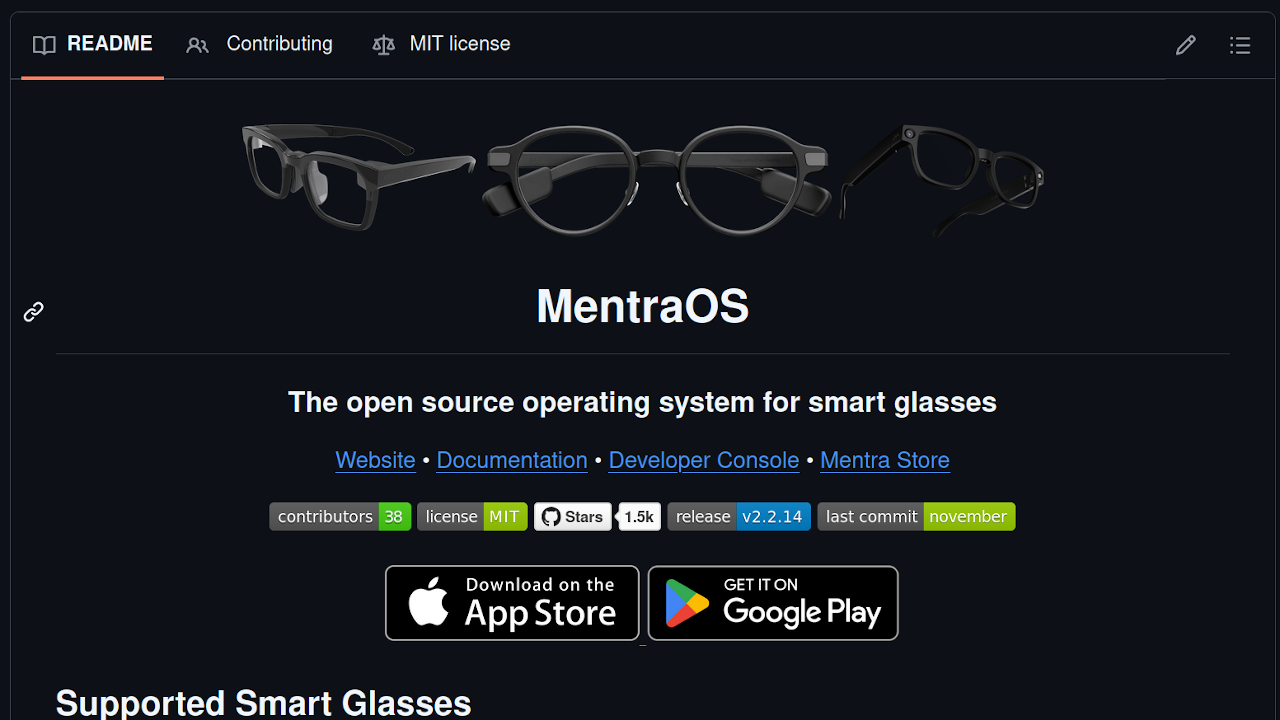
Smart glasses have spent years trying to answer one very awkward question: are they the next computer, or just sunglasses with a charging case and a self-esteem problem? Mentra is betting on the first answer, but with a twist. Instead of treating smart glasses like another closed gadget ecosystem, Mentra is pushing an open smart glasses OS that works across multiple hardware platforms.
That is the big idea behind MentraOS, an open-source operating system, SDK, app store, and development framework for wearable eyewear. The promise is simple but important: developers should be able to build smart glasses apps once and run them across compatible glasses, rather than rewriting the same idea for every pair of frames on the market. For users, that means more apps, more choice, and fewer “sorry, your expensive face computer is not supported” moments.
Mentra’s approach arrives at a lively time for AI wearables. Ray-Ban Meta glasses have helped normalize camera-and-audio glasses for everyday consumers. Google is bringing Android XR and Gemini deeper into headsets and future eyewear. Enterprise brands like Vuzix continue to focus on field work, logistics, and hands-free workflows. In the middle of all that, Mentra is trying to become the connective tissue: an open layer where smart glasses from different makers can share apps, tools, and developer momentum.
What Is MentraOS?
MentraOS is best understood as a platform for smart glasses rather than a traditional desktop-style operating system. It connects the glasses, the phone, cloud services, and third-party apps into one system. The glasses act as lightweight input and output devices. The phone becomes a bridge. Cloud services help coordinate heavier processing. Developers build mini apps that can use supported features such as audio, camera, captions, translation, AI prompts, and display output depending on the hardware.
That architecture matters because smart glasses are tiny. They do not have the thermal room of a laptop, the battery of a tablet, or the social forgiveness of a VR headset. People expect eyewear to be light, comfortable, and normal-looking. Nobody wants to wear a toaster oven on their face unless the toaster oven has excellent fashion sense.
MentraOS tries to solve that by letting the glasses remain simple while the software stack handles pairing, connection, data streaming, hardware access, and cross-device compatibility. In plain English: developers can focus on the app experience instead of wrestling every Bluetooth quirk, display limitation, and hardware-specific SDK monster hiding under the bed.
Why Cross-Compatibility Is the Big Deal
The phrase “cross-compatible smart glasses OS” may not sound exciting at first. It sounds like something a product manager says after three cold coffees. But it may be the most important part of Mentra’s strategy.
Early smart glasses have a fragmentation problem. One model may have a display but no camera. Another may have a camera and microphones but no display. Some glasses are built for consumers, some for enterprise, and some for developers who think weekend debugging is a personality trait. Without a shared platform, every new device risks becoming its own island.
MentraOS currently supports multiple smart glasses families, including Mentra Live, Vuzix Z100, and Even Realities models through its apps and documentation. That means a developer can target more than one device category, while users gain access to a broader ecosystem of apps. Some glasses are better for captions and glanceable text. Others are better for hands-free recording or livestreaming. Cross-compatibility lets the software follow the user’s needs instead of being trapped inside one frame design.
Mentra Live: Hardware Built Around an App Store
Mentra also sells its own smart glasses, Mentra Live. The company describes them as lightweight open-source smart glasses with a full SDK, camera, audio, and AI features. Mentra has promoted the glasses for field work, inspections, remote support, content capture, live captions, translation, and hands-free workflows.
The glasses weigh about 43 grams, which puts them in the category of wearable enough for daily use rather than “neck workout disguised as innovation.” Mentra Live includes a camera, microphones, speakers, phone connectivity, and app support through the Mentra ecosystem. Unlike display-focused glasses, Mentra Live is mainly camera-and-audio oriented, which makes it useful for point-of-view capture, AI vision prompts, calls, notes, and streaming use cases.
The key difference is not just the hardware. It is the app model. Mentra’s MiniApp Store gives users access to apps built for smart glasses, while the SDK lets developers create and deploy new experiences. That matters because smart glasses need more than one killer feature. They need a steady flow of small, useful tools: captions during a noisy conversation, a note-taker during a site visit, a translation helper in a restaurant, or a quick “what am I looking at?” assistant when your brain opens too many tabs.
Open Source as a Strategy, Not Just a Sticker
Plenty of tech products use “open” as a marketing word, the way snacks use “natural” after visiting a laboratory. Mentra’s stronger claim is that the core platform is open source and available through public repositories. The company’s GitHub presence includes MentraOS and example apps, and the project is associated with an MIT license. This gives developers more room to inspect, modify, contribute, and self-host parts of the stack.
For a smart glasses OS, openness is more than a philosophical bonus. It can reduce platform anxiety. Developers do not want to build the future of wearable computing on a black box that may change rules overnight. Manufacturers do not want to hand their customer relationship to a larger platform owner. Users, especially privacy-conscious users, want more control over where their data goes and what apps can access.
Open source does not automatically solve every problem. A project still needs documentation, reliable APIs, good governance, security reviews, and actual users. But it changes the default conversation. Instead of “trust us,” Mentra can say, “inspect it, build on it, and help improve it.” In a category involving cameras, microphones, AI assistants, and public spaces, that distinction is not tiny. It is the whole bowl of soup.
How Mentra Compares With Android XR and Meta’s Smart Glasses
Mentra is not competing in an empty room. Google’s Android XR is designed to extend Android into headsets and glasses, with Gemini playing a central role in contextual AI. Meta’s Ray-Ban smart glasses have already shown that regular-looking eyewear can attract mainstream attention when paired with cameras, audio, voice assistants, and social sharing.
The difference is positioning. Android XR is backed by Google’s platform power, developer base, AI infrastructure, and hardware partnerships. Meta’s glasses are consumer-friendly and deeply tied to Meta’s services. Mentra is smaller, but it is aiming at a different opening: an open smart glasses operating system that can support multiple hardware platforms without forcing everything through one mega-company’s ecosystem.
That is why Mentra’s “write once, run across glasses” pitch is interesting. If smart glasses become a major computing platform, developers will not want to maintain five versions of the same app for five similar devices. Hardware makers will not want to reinvent app distribution from scratch. Users will not want to lose their favorite tools every time they upgrade frames. Cross-compatible software is boring in the same way plumbing is boring: you only realize how important it is when it breaks.
Real Use Cases: Where Open Smart Glasses Could Shine
1. Live Captions and Accessibility
One of the most practical smart glasses applications is live captioning. For deaf and hard-of-hearing users, or anyone trying to understand speech in a noisy environment, captions can turn glasses into real-time subtitles for life. That is not a gimmick. That is a daily utility.
2. Translation in the Real World
Translation apps are another natural fit. Instead of pulling out a phone, users could see or hear translated language while traveling, attending meetings, or speaking with customers. It will not magically turn everyone into a United Nations interpreter, but it can reduce friction in everyday communication.
3. Field Work and Inspections
For technicians, medical staff, warehouse workers, construction teams, and inspectors, smart glasses can provide hands-free documentation and remote support. A worker can capture what they see, receive instructions, record notes, or check procedures without juggling a phone while standing next to equipment that looks expensive enough to have its own lawyer.
4. AI Assistants With Context
The most futuristic use case is contextual AI. A smart glasses assistant can respond to what the user sees and hears, not just what the user types. That could help with shopping, navigation, reminders, document reading, accessibility, education, and workflow automation. The challenge is making those features useful without making everyone around the wearer feel like they accidentally walked into a surveillance demo.
The Privacy Question Mentra Cannot Avoid
Any smart glasses platform must face the privacy issue directly. Cameras and microphones on eyewear are powerful because they are always near the user’s point of view. That same power makes bystanders uneasy. The industry has already seen concerns around camera glasses, cloud media processing, AI interpretation of real-world scenes, and facial recognition debates.
Mentra’s open-source positioning may help, but it does not eliminate the responsibility. Users need clear controls. Apps need strict permissions. Developers need guidelines. Bystanders need visible signals when recording is happening. Enterprises need policies around sensitive workplaces. The platform should make privacy a default design principle, not a settings-page scavenger hunt.
The smartest version of MentraOS would treat privacy as a product feature. Imagine per-app permission dashboards, local-first options where possible, visible recording indicators, easy data deletion, and transparent documentation for what flows through the phone, cloud, and glasses. That would not just reassure users. It would give Mentra a meaningful contrast against more closed ecosystems.
Why Developers May Pay Attention
Developers follow platforms where distribution, tooling, and user demand meet. Mentra is working on all three. Its SDK lowers the technical barrier. Its MiniApp Store gives apps a place to live. Its hardware support gives developers more possible users than a single-device experiment.
For indie developers, smart glasses apps could become the next playground for lightweight utilities. A meeting summarizer. A cycling glance assistant. A warehouse checklist. A chess coach. A hands-free recipe guide. A museum companion. A speech practice tool. A personal memory aid. The best apps will probably not look like phone apps floating on your nose. They will be tiny, context-aware helpers that appear at the right moment and disappear before becoming annoying.
That requires a different design mindset. Smart glasses apps must be fast, minimal, and respectful. Nobody wants pop-ups in their eyeballs while crossing the street. Developers who understand attention, accessibility, and voice-first design will have an advantage.
The Business Angle: Why Manufacturers Might Care
Mentra’s pitch to manufacturers is also important. Building hardware is hard enough. Building a developer ecosystem, app store, SDK, cloud layer, and consumer software experience is even harder. For smaller eyewear makers, a turnkey open OS can reduce time to market and make their devices more useful at launch.
This is similar to why Android mattered for smartphones. Not every phone company could build an operating system and developer ecosystem from scratch. Android gave manufacturers a shared software foundation. Mentra appears to be chasing a smart glasses version of that playbook, though on a much younger and more experimental playing field.
If it works, manufacturers could focus on optics, comfort, battery life, industrial design, and specialized hardware. MentraOS could handle the app platform. That division of labor may be exactly what smart glasses need to move from novelty to normal.
Challenges Ahead for MentraOS
The opportunity is real, but so are the obstacles. Smart glasses remain a difficult category. Battery life is limited. Displays are small. Cameras raise social concerns. Voice control can be awkward in public. App discovery is still early. Many consumers are curious, but not yet convinced they need smart glasses every day.
Mentra also needs to prove reliability. Cross-compatible platforms sound wonderful until users hit inconsistent hardware behavior. An app that works beautifully on one pair of glasses may feel clumsy on another with different sensors, display capabilities, or battery limits. Mentra will need strong compatibility layers, careful app labeling, and honest expectations.
There is also the ecosystem chicken-and-egg problem. Developers want users. Users want apps. Hardware makers want both. Mentra’s $8 million seed funding and growing public platform give it a better shot, but execution will decide whether MentraOS becomes a serious layer in wearable computing or another interesting GitHub tab we all promised to revisit.
Why This Moment Matters
Smart glasses are moving from science-fiction accessory to practical AI interface. The market is being pulled by several trends at once: lighter hardware, better edge AI, improved microphones, more capable phone chips, cloud AI services, and consumer familiarity with voice assistants. At the same time, people are tired of staring down at phones for every tiny task.
Mentra’s open smart glasses OS fits neatly into that shift. It says the future of eyewear should not belong only to one closed ecosystem. It should allow different hardware, different AI services, different app ideas, and different communities to participate. That is ambitious. It is also refreshing.
Experience Section: What Using an Open Smart Glasses OS Could Feel Like
Imagine starting your morning with smart glasses that do not feel like a prototype from a secret lab, but like ordinary eyewear with a few helpful superpowers. You put them on, connect through the Mentra app, and choose which mini apps you want active for the day. Live captions for the commute? On. Meeting notes for work? On. Random app that tells you whether your houseplant looks emotionally disappointed? Maybe later.
The first thing you would notice is that smart glasses work best when they are quiet. The magic is not constant noise. It is timing. During a conversation, captions appear only when needed. During a walk, navigation cues arrive without demanding your full attention. During a work task, a checklist appears at the right step. Good smart glasses should feel like a helpful assistant, not a tiny manager living on your face.
Cross-compatibility would make that experience more flexible. Suppose you use display glasses for work because you need glanceable text. Later, you switch to camera glasses for field documentation. In a closed ecosystem, that might mean starting over. With an open platform like MentraOS, the ideal experience is that your apps, preferences, and workflows follow you across compatible devices.
For developers, the experience could be equally refreshing. Instead of buying three different smart glasses models and learning three different SDKs just to test one idea, a developer could build around MentraOS and target multiple supported devices. That lowers the barrier for experimentation. And experimentation is exactly what this category needs. Nobody fully knows what the “killer app” for smart glasses will be yet. The best answer may come from a small developer who builds something oddly specific, wildly useful, and impossible to predict in a boardroom.
For businesses, MentraOS could turn smart glasses from a flashy pilot project into a practical deployment tool. A logistics team might use glasses for barcode workflows and voice notes. A repair team might use them for remote expert support. A healthcare training team might use them for step-by-step guidance, with strict privacy rules. A school or museum might create guided learning apps. The point is not that one app solves everything. The point is that an open OS makes it easier to create many small solutions.
There will still be awkward moments. Someone will forget they are wearing camera glasses and wonder why people are staring. Someone will try voice commands in a quiet elevator and immediately regret every life choice. Someone will drain the battery by running too many features at once. That is normal for new platforms. Early smartphones had terrible battery life, weird apps, and keyboards that looked like they were designed by a committee of thumbs. Over time, the good ideas survived.
The most promising part of Mentra’s strategy is that it invites more people into the process. Users can choose. Developers can build. Manufacturers can adopt. Communities can inspect and contribute. That open loop is exactly what smart glasses need if they are going to become more than expensive camera frames.
If MentraOS succeeds, it may not be because it makes smart glasses flashy. It may succeed because it makes them useful, flexible, and less trapped. In a market full of polished hardware and walled gardens, that is a surprisingly bold move. The future of smart glasses may not be one pair to rule them all. It may be many pairs, many apps, and one open layer helping them speak the same language.
Conclusion
Mentra brings an important idea to the smart glasses market: openness should arrive before the category becomes locked down. MentraOS offers an open-source platform, SDK, app store, and cross-compatible framework for smart glasses at a time when AI eyewear is gaining real momentum. By supporting multiple hardware platforms and encouraging developers to build portable apps, Mentra is trying to solve one of wearable computing’s biggest early problems: fragmentation.
The company still has plenty to prove. It must build trust, expand device support, improve reliability, attract developers, and handle privacy with unusual seriousness. But the direction is compelling. If smart glasses are going to become the next everyday computer, they need more than stylish frames. They need an ecosystem. Mentra’s open approach may be one of the most interesting attempts to build that ecosystem before the walls go up.