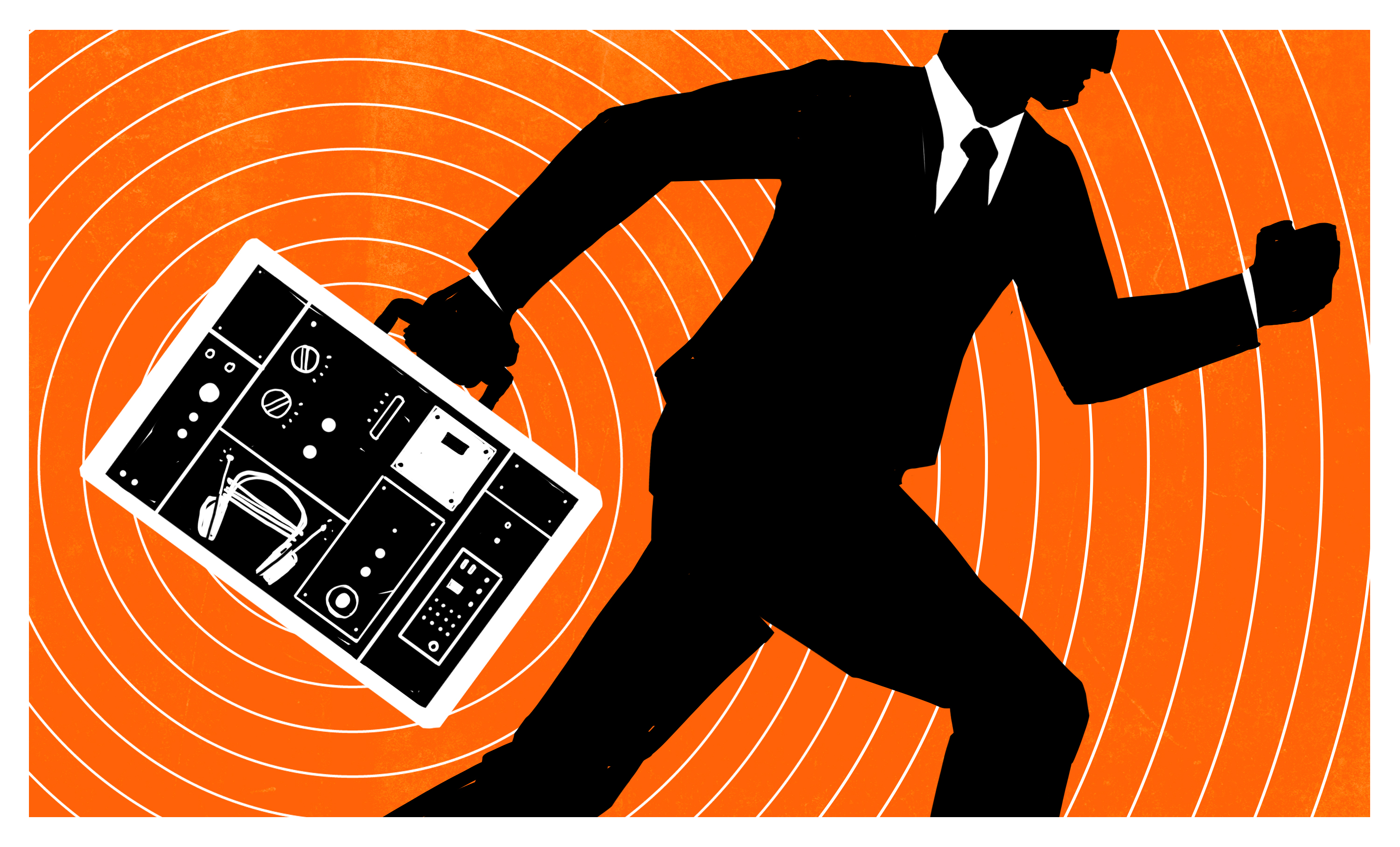
There are hacks you do for fun, hacks you do because the printer has betrayed you again, and hacks you do because history has decided to place you in a farmhouse in occupied France with a suitcase full of vacuum tubes and a very serious deadline. Spy radios belong to that last category. They were not “hacking” in the modern hoodie-and-keyboard stereotype. They were hacking in the older, grittier sense: solving impossible problems with limited tools, high stakes, and zero room for drama.
During World War II and the early Cold War, clandestine radio communication became one of the most important tools in espionage. A good spy radio could connect resistance fighters, intelligence officers, coastwatchers, aircraft crews, and headquarters across borders. A bad radio, or a careless operator, could invite radio direction-finding vans, armed patrols, and a very unpleasant knock at the door. In other words, spy radios were tiny machines with enormous consequences.
This is the story of how clandestine radio equipment changed intelligence work, why suitcase radios mattered, how famous systems such as the British S-Phone and American Joan-Eleanor worked in the field, and what modern readers can learn from these beautifully stressful pieces of technology.
Why Spy Radios Mattered
World War II is often called an “electronic war” because radio, radar, signals intelligence, and cryptography reshaped how armies fought and how governments gathered information. Commanders needed faster communication. Resistance groups needed contact with Allied handlers. Intelligence agencies needed ways to receive reports from people living under enemy occupation. The radio spectrum became a battlefield that most civilians could not see, but everyone eventually felt.
Before reliable clandestine radio, an agent might depend on couriers, dead drops, coded letters, or risky face-to-face meetings. Those methods could work, but they were slow and fragile. A radio changed the rhythm. An operator could send a report about troop movements, request an airdrop, confirm a landing zone, or receive instructions without waiting weeks for a courier to cross borders. That speed could save missions. It could also save lives.
Of course, radio had one awkward habit: it announced itself. A transmitter sends energy into the world, and the world does not promise to keep secrets. Enemy listening posts could intercept signals. Direction-finding teams could triangulate a source. Security services could compare schedules, call signs, message lengths, and operator habits. The spy radio was therefore not just a gadget. It was part of a larger discipline involving timing, encryption, concealment, cover stories, and nerves sturdy enough to support a bridge.
The Office of Strategic Services and the Birth of American Spycraft
The U.S. Office of Strategic Services, better known as the OSS, was created during World War II to gather intelligence, support resistance movements, run special operations, and experiment with new tools for unconventional warfare. It was short-lived, but its influence was long. The OSS became a foundation for later American intelligence and special operations culture, and its wartime work showed how science, fieldcraft, language skills, courage, and improvisation could be thrown into the same backpack.
The OSS did not treat communication as a boring administrative function. It understood that a mission behind enemy lines was only useful if information could travel back. A sabotage team without communication could become isolated. A resistance network without radio contact could miss supply drops. A brilliant observation about enemy troop movements meant little if it stayed trapped in someone’s notebook until after the battle had moved on.
That is why clandestine radio operators were among the most valuable and vulnerable people in the field. They needed technical skill, discipline, and calm. They also needed to work fast. A long transmission might feel satisfying to the sender, but to enemy direction finders it was basically a dinner bell.
Suitcase Radios: The Original Portable Workstations
One of the most iconic spy radio designs was the suitcase radio. The name sounds charming, as if James Bond packed for a weekend trip and accidentally brought a small electronics lab. In practice, a suitcase radio was a compact transmitter-receiver hidden inside luggage or another ordinary-looking container. It could be carried into an apartment, farmhouse, attic, hotel room, or safehouse and set up for secret communication.
These sets were compact for their era, but “portable” is a relative word. Modern readers may think portable means “fits in a hoodie pocket.” Wartime portable often meant “you can carry it if you are motivated, frightened, and possibly being chased.” Vacuum tubes, batteries, power supplies, headphones, keys, crystals, cables, and antennas all took space. Even so, compared with earlier radio gear, suitcase sets were revolutionary.
The suitcase mattered because it made the radio less suspicious. If a room was searched quickly, luggage might not attract immediate attention. A good disguise bought time. And in spy work, time is not money; time is survival.
Virginia Hall and the Radio That Refused to Be Romantic
Virginia Hall remains one of the most remarkable figures in Allied intelligence. An American who worked first with the British Special Operations Executive and later with the OSS, she operated in occupied France despite intense danger and a prosthetic leg she famously nicknamed “Cuthbert.” The Gestapo reportedly considered her one of the most dangerous Allied spies in France. That is quite a résumé line, though not one you would want printed on business cards.
Hall’s radio work shows the unglamorous truth behind clandestine communication. The International Spy Museum preserves a Type 111 MKII radio associated with her wartime OSS service. It included headphones and Morse code materials, and the museum notes that powering the set could involve a bicycle frame connected to a car battery. Imagine sending intelligence while someone pedals for electricity. It is heroic, yes, but also deeply inconvenientlike a spy thriller written by a gym instructor.
Her story reminds us that spy radios were not magical devices. They depended on logistics: batteries, antennas, schedules, trained operators, secure codes, and safe locations. If any one of those failed, the entire communication chain could collapse.
Dr. René Joyeuse and the Mark IV Radio
Another powerful example comes from Dr. René Joyeuse, an OSS operative involved in Operation Sussex before D-Day. He parachuted into France to gather information on German installations, troop movements, supply depots, and military manufacturing facilities. His original Mark IV radio was damaged during the parachute drop and became inoperable. Instead of becoming just another lost artifact of war, it was hidden in a French home for decades before being donated to the CIA Museum.
That damaged radio is a perfect symbol of clandestine operations. Planning may be meticulous, but gravity does not read mission briefs. Equipment can break. Containers can land badly. Weather can scatter teams. A radio that works perfectly in training can become a very expensive brick after a rough landing. Field technology must therefore be rugged, repairable, and supported by backup plans.
S-Phone: Quiet by Design
Not every spy radio was built for long Morse transmissions. Some were designed for short-range air-to-ground voice contact. The British S-Phone, developed for Special Operations Executive work, used unusually high frequencies for the time and low power to reduce the chance of enemy detection. Its purpose was practical: help agents and resistance members communicate with aircraft without lighting up the radio horizon like a Christmas tree with poor operational security.
The S-Phone’s design reveals a key principle of clandestine technology: the strongest signal is not always the best signal. In ordinary radio, range is a virtue. In espionage, range can be a liability. If the intended aircraft can hear you but the enemy listening post over the hill cannot, that is a win. A spy radio is not trying to impress the ionosphere. It is trying to whisper to the right person.
This is where engineering becomes tradecraft. Antenna direction, output power, frequency choice, and operating time all become part of the security system. The technology and the human procedure are inseparable.
Joan-Eleanor: The OSS Goes High Frequency
The American Joan-Eleanor system took the air-to-ground concept further. Developed for the OSS with help from wireless pioneer Al Gross and engineers working in the RCA orbit, Joan-Eleanor paired a small field unit carried by an agent with an aircraft-mounted receiver system. The field unit, “Joan,” allowed an operator on the ground to speak to “Eleanor” in an aircraft overhead.
For its time, the system was impressively compact and specialized. It used very high frequencies that were less common in wartime monitoring, and it was designed for brief, direct communication between agents and aircraft. The goal was not to broadcast across continents. The goal was to create a narrow, timely lifeline between people hiding on the ground and friendly crews in the sky.
Joan-Eleanor shows how “hacking when it counts” often means redefining the problem. Instead of asking, “How do we make the biggest transmitter?” engineers asked, “How do we make a transmitter that is small, quick, hard to notice, and useful only to the people who need it?” That is elegant design under pressure.
Morse Code, One-Time Pads, and the Human Factor
Many clandestine radio messages were sent in Morse code because continuous wave transmission could be efficient, reliable, and compact. A skilled operator could send information with minimal bandwidth and relatively simple equipment. But skill mattered. Every operator had a “fist,” a distinctive rhythm in sending Morse. To trained listeners, that rhythm could become a fingerprint.
Encryption was another essential layer. One-time pads, code groups, and cipher procedures helped protect the content of messages even if the signal was intercepted. Yet encryption did not solve every problem. A perfectly encrypted message still reveals that someone transmitted from somewhere at some time. Traffic analysis could be dangerous. So could sloppy procedure, reused keys, long transmissions, or predictable schedules.
The lesson is still modern: security is not one tool. It is a system. A strong cipher cannot rescue a careless process. A brilliant radio cannot save an operator who transmits too long from the same location. And a clever hiding place cannot help if the equipment fails at the worst moment.
The Hunters: Radio Direction Finding and Counterespionage
Every spy radio story has a shadow story: the people trying to find it. Radio direction finding, sometimes compared to “fox hunting” in amateur radio, was used to locate clandestine transmitters. Teams could use directional antennas and monitoring stations to narrow down a signal source. In wartime, this was not a friendly weekend contest. It was counterespionage with consequences.
The United States also had its own radio intelligence efforts. The Federal Communications Commission’s Radio Intelligence Division played a significant role in monitoring suspicious transmissions and supporting wartime security. Meanwhile, FBI and Allied code-breaking efforts used intercepted messages to identify enemy networks. The airwaves were crowded with invisible moves and countermoves.
This cat-and-mouse dynamic shaped spy radio design. Shorter transmissions reduced exposure. Higher or less common frequencies complicated interception. Directional antennas narrowed the signal path. Portable sets allowed operators to change locations. Every technical choice answered a threat.
Cold War Echoes and Numbers Stations
After World War II, spy radios did not vanish. They evolved. Cold War intelligence agencies used shortwave broadcasts, burst transmitters, miniature receivers, concealed antennas, and numbers stations. A numbers station could broadcast strings of spoken digits over shortwave radio. To casual listeners, it sounded like a haunted accountant trapped in a refrigerator. To an agent with the correct one-time pad, it could carry instructions.
The appeal was simple. Shortwave radio could cross borders. A receiver was easier to explain than a transmitter. A broadcast did not need to know exactly where the listener was. Again, the central idea was not glamour. It was practicality.
Modern secure communication has moved into satellites, encrypted messaging, digital networks, and cyber operations. Yet the logic of spy radios still matters. Limit exposure. Reduce signatures. Protect content. Protect patterns. Design for failure. Train the human. Do not assume the enemy is asleep, because history suggests the enemy has coffee.
What Spy Radios Teach About Real Innovation
Spy radios are fascinating because they sit at the intersection of engineering and fear. They had to be small but powerful enough, simple but secure enough, rugged but concealable, and useful to people who might be tired, hungry, hunted, or operating in a language that was not their own. That is a brutal design brief.
The best systems did not chase technical perfection in isolation. They served a mission. A radio that was theoretically impressive but too heavy for a parachute drop was a failure. A secure system that required weeks of training might be useless to a resistance fighter needed tomorrow. A transmitter with wonderful range could become a beacon for the enemy. Context decided quality.
This is why spy radios deserve attention beyond military history. They are case studies in user-centered design before the phrase became a boardroom decoration. The “user” might be an OSS agent hiding in a barn. The “customer journey” might involve parachutes, forged documents, batteries, and a patrol outside. The “conversion goal” might be surviving long enough to transmit one accurate report. Suddenly, modern product meetings seem less dramatic.
Experiences and Reflections: Learning from Spy Radios Today
Spending time with the history of spy radios changes the way you look at technology. At first, the machines seem charmingly old-fashioned: knobs, tubes, crystals, Morse keys, canvas bags, and metal cases with the personality of a lunchbox. Then the reality sinks in. These were not collector toys. They were lifelines. A suitcase radio in a safehouse could decide whether a bridge was bombed, whether supplies reached a resistance group, or whether an agent remained connected to the outside world.
One experience many radio hobbyists describe is the strange intimacy of tuning across shortwave bands at night. Static rolls in like weather. Signals fade and return. A distant voice appears, then dissolves. Even without secret content, radio feels alive because it is affected by distance, atmosphere, equipment, and timing. Now imagine doing that under occupation, with curtains drawn and a schedule measured in minutes. The romance disappears quickly, replaced by respect.
The first practical lesson is humility. Modern devices hide complexity behind glass screens and cheerful icons. Spy radios did not hide much. The operator had to understand power, antennas, tuning, procedure, and message discipline. If something failed, there was no help desk ticket. There was only a screwdriver, training, and perhaps a deeply unhelpful sense of panic. That kind of technology demanded competence from the user.
The second lesson is that constraints can create better design. The most interesting spy radios were not built by asking, “What features can we add?” They were built by asking, “What can we remove without killing the mission?” Weight, heat, operating time, suspicious parts, complex controls, unnecessary rangeeverything was questioned. Today, when software and hardware often swell with features nobody requested, spy radios offer a stern little lecture from history: simpler can be smarter.
The third lesson is operational awareness. A radio operator had to think beyond the device. Where is the antenna? How long has the set been transmitting? Who might be listening? What happens if the batteries fail? What if the drop container breaks? What if the operator is captured? These questions are not just historical. Modern cybersecurity has similar concerns. Tools matter, but patterns matter too. Metadata matters. Human behavior matters. A secure channel used carelessly can become an insecure system.
The fourth lesson is resilience. Many clandestine networks survived because people improvised. They repaired equipment, changed locations, adapted schedules, concealed gear, and worked around failures. This was not the glossy improvisation of movie spies who solve everything with a smirk. It was patient, practical problem-solving under pressure. The kind that looks boring until you realize boring kept someone alive.
Finally, spy radios remind us that communication is power. Not noisy communication. Not endless communication. Useful communication. A short, accurate message at the right time can matter more than a flood of information. That may be the most modern lesson of all. In an age of constant alerts, feeds, posts, pings, and inbox confetti, the old clandestine radio operator offers a surprisingly wise rule: know what must be said, say it clearly, say it securely, and then get off the air.
Conclusion
Spy radios were more than clever gadgets hidden in suitcases. They were survival tools, intelligence pipelines, and engineering answers to terrifying field problems. From Virginia Hall’s Morse transmissions to Dr. René Joyeuse’s damaged Mark IV radio, from the S-Phone’s quiet air-to-ground design to the OSS Joan-Eleanor system, clandestine radios show how technology becomes historic when it meets urgency.
The phrase “hacking when it counts” fits because these devices were built around necessity. They solved real problems with limited size, limited power, limited time, and unlimited danger. They remind us that innovation is not always shiny. Sometimes it hums softly in a suitcase, waits for the right minute, and sends a message that changes what happens next.