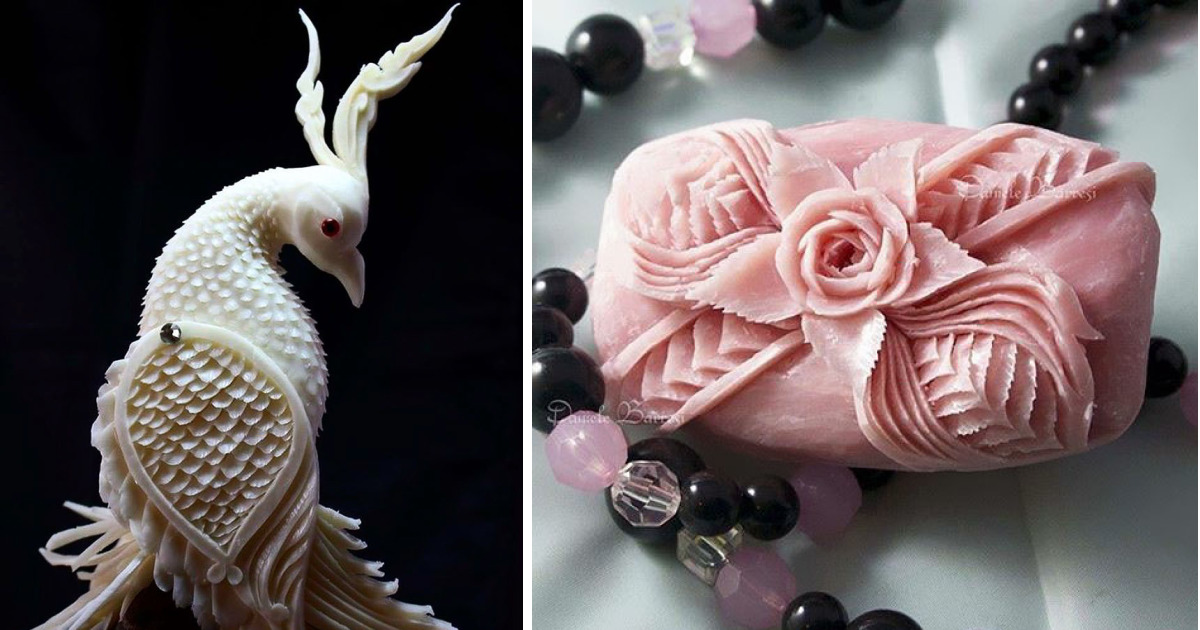
Some people look at a bar of soap and think, “Excellent, my hands are about to smell like lavender.” I look at it and think, “There is probably a dragon, a peony, or an absurdly fancy little cathedral hiding in there.” That is the strange, delightful problem with soap carving: once you start seeing ordinary objects as raw material, the bathroom shelf becomes an art supply store with better fragrance.
Creating intricate pieces of carved art from soap is part sculpture, part meditation, and part comedy show starring tiny flakes of soap that somehow travel farther than glitter. The medium is soft enough to welcome beginners, but detailed enough to challenge patient artists. A plain white block can become a rose with curling petals, a miniature animal, a geometric relief, a lace-like ornament, or a decorative piece that looks far too elegant to have once lived near a sink.
Soap carving art has a long, wonderfully odd history. In the United States, soap sculpture became popular in the early 20th century through national carving contests and educational art programs. In Thailand and other craft traditions, carved soap often connects with fruit and vegetable carving, where artists transform delicate surfaces into flowers, leaves, and ceremonial designs. Today, handmade soap art lives everywhere from classrooms and museums to Instagram feeds, craft fairs, and the quiet corners of homes where patient people sit with a towel, a soft bar, and a dangerously optimistic sketch.
Why Soap Became My Favorite Canvas
Soap is humble. It does not arrive with the dramatic authority of marble or bronze. Nobody unveils a bar of soap under velvet ropes while a string quartet plays in the background. And yet, that is exactly what makes it fascinating. Soap is familiar, inexpensive, fragrant, and surprisingly expressive. It allows an artist to practice form, depth, texture, and negative space without needing a full studio or a heroic budget.
The softness of soap gives it a forgiving personality. If wood carving feels like negotiating with a stubborn tree, soap carving feels like having a polite conversation with a very scented cloud. The surface responds quickly. A shallow groove can become a vein in a leaf. A curved scrape can turn into a petal. A carefully shaped edge can suggest motion, shadow, or softness. Even the mistakes have charm. A broken corner may become a feather. A crack may become a branch. A lopsided oval may become a fish, because sometimes art is just confidence wearing fins.
For me, the magic begins before the first mark. I hold the bar, turn it in my hand, and study its shape. Rectangular soap suggests architectural designs, framed reliefs, and symmetrical patterns. Oval soap wants to become flowers, shells, or animals. Colored soap adds another layer of drama, especially when the shade supports the design: pale pink for roses, green for leaves, blue for waves, cream for classical ornaments. The best hand-carved soap pieces feel as if they were always inside the bar, waiting for someone patient enough to remove everything that did not belong.
The Beauty of Intricate Soap Sculpture
Intricate soap sculpture depends on small decisions. The final artwork may look dramatic, but it is built from tiny choices: how deep to make a groove, where to leave a raised line, which areas should remain smooth, and which details should be textured. A carved soap flower, for example, is not just “a flower.” It is a hundred little negotiations between curve and shadow.
Flowers, Leaves, and Lace-Like Patterns
Floral soap carving is one of the most beloved styles because soap naturally suits delicate forms. Petals can be layered from the center outward, giving the piece a blooming effect. Leaves can be shaped with soft ridges and tapered ends. The result is decorative, elegant, and just a tiny bit ridiculous in the best way: a rose that smells like rose, carved from something that might otherwise be used after chopping onions.
Lace-like designs are more challenging. They require patience, clean spacing, and a strong understanding of what to remove and what to preserve. The empty spaces matter as much as the raised parts. Too much carving and the design collapses visually. Too little carving and it looks flat. The secret is rhythm: repeating curves, balanced holes, fine borders, and gentle shadows that make the soap look lighter than it is.
Animals, Symbols, and Miniature Scenes
Animals give soap carving a playful personality. A fish can be shaped from an oval bar with flowing fins. A bird can emerge from a simple silhouette with carved wings and a small beak. A cat, rabbit, turtle, or owl can be simplified into soft sculptural forms. The goal is not always hyperrealism. Sometimes the best carved soap art captures the attitude of the subject rather than every anatomical detail. A tiny owl with oversized eyes can be more memorable than a perfectly measured owl that looks like it has tax problems.
Symbolic designs also work beautifully: hearts, stars, mandalas, initials, waves, suns, moons, and abstract patterns. These pieces are especially popular as gifts because they feel personal without being too fragile or formal. A hand-carved soap gift says, “I made this for you,” while also saying, “Please do not drop it in the shower unless you enjoy emotional consequences.”
How I Think About Design Before Carving
Every detailed soap carving starts with planning. Not complicated planning. I am not drafting blueprints for a skyscraper. But I do like to sketch the main shape and decide where the highest and lowest areas will be. Soap carving is a subtractive art form, which means the artist creates by removing material. That simple fact changes everything. You cannot add the same piece back once it has crumbled away, unless your artistic philosophy includes “strategic denial.”
I usually think in layers. First comes the silhouette: the outer shape that tells the viewer what the piece is. Then comes the main relief: the larger raised areas that create depth. Finally, I focus on surface details: petal veins, feather lines, borders, dots, scales, curls, and tiny decorative cuts. Working from large to small keeps the piece balanced. It also prevents the classic beginner tragedy of spending 40 minutes perfecting one tiny corner before realizing the whole design is slightly sideways.
Good soap carving also requires restraint. The temptation to add “just one more detail” is powerful. Unfortunately, soap has limits. It can hold a surprising amount of detail, but overcrowding makes the design muddy. A clean curve often looks more sophisticated than ten nervous scratches. Negative space gives the eye a place to rest. Smooth areas make textured areas more impressive. In other words, a carved soap piece needs breathing room, even though it technically cannot breathe and would be terrible at yoga.
The Tools and Materials That Make the Difference
The best soap for carving is usually firm enough to hold detail but soft enough to shape without crumbling. Many artists prefer simple, smooth bars without heavy exfoliants, embedded bits, or overly oily surfaces. A fresh bar can be too soft, while a very old bar may crack. The sweet spot is a bar that feels steady in the hand and shaves away in thin, controlled pieces.
For safety and accessibility, many beginner projects use simple, blunt craft materials such as plastic utensils, wooden sticks, pencils, paper clips, or dedicated safety carving tools. Experienced artists may use more specialized carving tools, but the principle stays the same: controlled pressure, patience, and respect for the material. Soap is gentle, but careless carving can still lead to broken designs, messy surfaces, or minor injuries. A towel under the soap helps catch shavings and keeps the work area from looking like a snow globe had a nervous breakdown.
Lighting matters more than people expect. Shadows reveal depth. When I carve under strong side lighting, I can see which ridges are too high and which grooves need smoothing. A rotating surface also helps because a design that looks perfect from the front may look suspiciously like a potato from the side. Checking the piece from multiple angles keeps the sculpture balanced.
Why Soap Carving Feels So Satisfying
Soap carving is deeply satisfying because progress is visible. In painting, the early stages can look chaotic. In writing, the first draft can resemble a raccoon walking across a keyboard. But with soap carving, every small removal reveals form. You can watch the idea appear in real time. The process is quiet, tactile, and calming. The soft scraping sound, the scent of the soap, and the slow emergence of a shape all create a peaceful rhythm.
That rhythm is why soap carving has become more than a craft for many people. It is a way to practice patience. It trains the eye to notice proportions and details. It teaches the hands to slow down. It reminds the brain that not everything has to happen at the speed of a notification. In a world built on scrolling, soap carving is refreshingly unscrollable. You cannot rush a petal. You cannot swipe past a mistake. You have to sit with the object and work with what is in front of you.
There is also a charming impermanence to carved soap. Unlike marble, soap is not pretending to last forever. It is delicate. It can soften, fade, chip, or eventually be used. That temporary nature makes the art feel more intimate. A carved soap piece exists in the strange space between sculpture and everyday object. It can be displayed, gifted, photographed, or treasured for a season. Its beauty comes partly from the fact that it was made from something ordinary and vulnerable.
What Makes a Carved Soap Piece Look Professional?
A professional-looking soap carving is not necessarily the most complicated one. It is the one with clear intention. The design should have balance, clean edges, controlled depth, and a pleasing relationship between smooth and textured areas. If it is a flower, the petals should feel layered rather than randomly stacked. If it is an animal, the basic form should read clearly before the details begin. If it is abstract, the pattern should feel rhythmic rather than accidental.
Clean Edges
Clean edges are the difference between “handmade charm” and “I fought this soap and the soap won.” Edges do not have to be razor sharp, but they should be deliberate. Soft rounding can look elegant when it is consistent. Sharp contrast can look dramatic when it is controlled. The key is to avoid hesitant marks that make the piece look unfinished.
Layered Depth
Depth gives soap carving its sculptural power. A flat scratched drawing on soap can be pretty, but raised layers create shadows and dimension. Even a simple leaf becomes more interesting when the center vein rises slightly above the surrounding surface. A flower feels alive when the inner petals sit higher than the outer ones. Relief carving turns a plain bar into a miniature landscape.
A Strong Focal Point
Every intricate piece needs a focal point. This might be the center of a flower, the eye of an animal, the top of a spiral, or the brightest smooth area in a pattern. Without a focal point, the viewer’s eye wanders around politely, unsure where to park. With one, the entire design feels intentional.
My 500-Word Experience: What Soap Carving Has Taught Me
The most important lesson I have learned from creating intricate pieces of carved art from soap is that patience is not a personality trait; it is a practice. I did not begin with perfect flowers, balanced ornaments, or elegant relief sculptures. I began with crooked shapes, broken corners, and several bars of soap that looked as if they had been emotionally betrayed. At first, I wanted every line to obey me immediately. Soap, being soap, had other plans.
Over time, I learned to listen to the material. That may sound dramatic, like something an artist says while staring out a rainy window, but it is true. Each bar behaves differently. Some soaps cut smoothly and hold detail beautifully. Others crumble when pushed too hard. Some are too soft and smear at the edges. Others are dry and need gentler pressure. The more I carved, the more I realized that technique is not about forcing the material to obey. It is about understanding what the material is willing to become.
I also learned that the best designs often come from limits. A small bar forces me to simplify. A crack forces me to adjust the composition. A mistake forces me to invent a new detail. There have been times when a planned rose became a shell, a shell became a leaf, and a leaf became something abstract enough to be called “contemporary.” That flexibility is part of the joy. Soap carving rewards people who can adapt without panicking.
One of my favorite experiences is the moment when a piece suddenly “appears.” For the first part of the process, the soap looks awkward. The shape is rough, the details are missing, and the whole thing feels uncertain. Then, after enough careful refining, one curve catches the light correctly. A petal lifts. A feather line becomes clear. The sculpture begins to make sense. That moment feels tiny and enormous at the same time. It is the craft version of hearing a song finally find its melody.
Sharing carved soap art with other people has taught me something else: ordinary materials invite curiosity. When people see a carved wooden sculpture, they admire it. When they see a carved bar of soap, they lean closer and ask questions. “Is that really soap?” “How long did it take?” “Can you still use it?” “Does it smell good?” Soap lowers the wall between art and audience. It makes sculpture feel friendly, reachable, and a little funny. That is powerful.
The experience has also changed how I see everyday objects. A plain bar of soap is no longer plain. It is potential. It is a small block of possibility. Soap carving has taught me to slow down, observe carefully, accept mistakes, and find beauty in modest materials. It reminds me that art does not always need expensive supplies or grand declarations. Sometimes it needs a quiet table, a simple bar, steady hands, and the willingness to believe that something beautiful is hiding in the most ordinary place.
Why This Tiny Art Form Still Matters
In a culture obsessed with bigger, faster, and louder, soap carving is wonderfully small. That smallness is its strength. It proves that creativity does not have to be expensive or intimidating. It can begin with something already sitting in your home. It can fit in your palm. It can smell like clean linen or citrus. It can make a mess that is, at least theoretically, self-cleaning.
Intricate soap carving also reminds us that craftsmanship is not defined by the price of the material. A masterpiece can be made from marble, clay, paper, fabric, ice, sugar, fruit, or soap. What matters is the artist’s attention. Soap may be temporary, but the skill is real. The patience is real. The imagination is real. The final piece may be delicate, but the act of making it is strong.
Conclusion
I create intricate pieces of carved art from soap because the medium keeps surprising me. It is soft but demanding, simple but expressive, ordinary but full of possibility. Every carved bar is a reminder that beauty does not always arrive in dramatic materials. Sometimes it sits quietly beside the sink, waiting for someone to notice the flower, animal, ornament, or dream hidden inside.
Soap carving art is more than a charming craft. It is a study in patience, texture, balance, and imagination. It is proof that handmade art can be accessible without being simple-minded, delicate without being weak, and playful without losing depth. And if the final sculpture smells amazing? Well, that is just the universe adding a bonus feature.
Note: This article is original, publish-ready content inspired by real soap-carving traditions, contemporary handmade art practices, and safe craft education references. It does not duplicate source text.