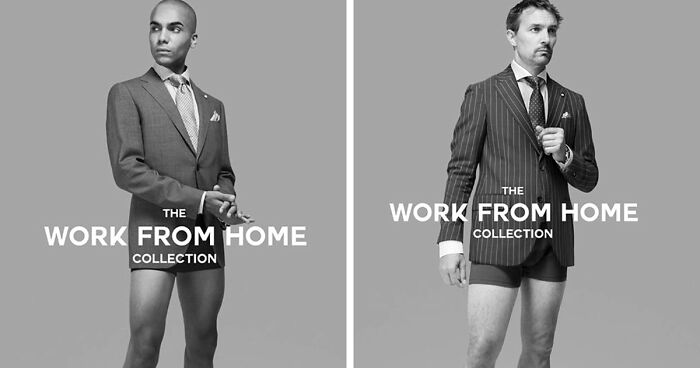
Because in 2020, “business casual” somehow became “business on top, blanket burrito below.”
The Pandemic Changed Office Fashion Overnight
Before the COVID-19 pandemic, office fashion had a fairly predictable rhythm. Monday meant a button-down shirt. Tuesday meant slacks that had seen things. Wednesday was the day everyone quietly wondered whether clean sneakers counted as professional. Then 2020 arrived, shut down commutes, moved meetings into kitchens, and introduced the world to a new corporate dress code: camera-ready from the shoulders up, deeply unserious from the waist down.
That strange new reality created one of the funniest and sharpest fashion moments of the pandemic: Canadian menswear brand Henri Vézina released a playful “Work From Home Collection,” a campaign that leaned directly into the absurdity of remote work style. The idea was simple, smart, and very 2020: why dress the whole body when video calls only show half of it?
The campaign featured men wearing polished business pieces on topsuit jackets, dress shirts, ties, and the familiar armor of office lifepaired with ultra-casual bottoms such as underwear, socks, or flip-flops. It was not just a joke. It was a mirror. Millions of workers were suddenly performing professionalism through a webcam while their lower halves lived in a separate, more emotionally honest universe.
Meet Henri Vézina: The Canadian Clothing Brand Behind the Joke
Henri Vézina is a Montreal-based menswear retailer known for suits, dress shirts, formalwear, and polished business clothing. In normal times, that kind of brand helps men look ready for boardrooms, weddings, interviews, and other places where “I ironed this” is considered a personality trait.
But the pandemic was not normal times. Offices closed, conferences became video calls, and people who had once debated tie width were suddenly asking whether pajama pants were visible on Zoom. Instead of pretending nothing had changed, Henri Vézina did something more memorable: it laughed with the customer.
The “Work From Home Collection,” created with Dentsu McGarryBowen Montreal, worked because it understood the cultural moment. It did not try to sell fantasy. It sold recognition. The campaign basically said, “We know what you are doing, and honestly, same.” That honesty made the ads feel less like a hard sales pitch and more like a perfectly timed wink from a brand that knew businesswear had entered its awkward teenage years.
Why the Work From Home Collection Worked So Well
1. It Turned a Shared Problem Into a Shared Laugh
Good pandemic marketing did not ignore the situation. Great pandemic marketing found a way to be useful, human, and slightly ridiculous without being insensitive. Henri Vézina’s campaign hit that balance by focusing on a harmless but universal detail of lockdown life: what do you wear when your office is your living room?
Everyone who worked remotely had their own version of the “Zoom outfit.” Maybe it was a blazer over a T-shirt. Maybe it was a button-down shirt paired with gym shorts. Maybe it was a respectable sweater above and fuzzy slippers below, because capitalism can have the torso but not the toes. The campaign exaggerated that behavior just enough to make people laugh, but not so much that it felt fake.
2. It Understood the New Visual Rules of Work
Remote work made the screen the new office doorway. In a physical workplace, your full outfit moved through space. In a video meeting, your outfit became a cropped portrait. That changed the logic of dressing. Suddenly, collars mattered more than shoes. Texture near the face mattered more than trouser breaks. A good shirt could carry an entire performance review.
Henri Vézina’s “Work From Home Collection” made that visual reality obvious. The joke was not simply that men were not wearing pants. The sharper idea was that remote work had rewritten what counted as “dressed.” A tie still communicated professionalism. A jacket still framed the shoulders. The bottom half, meanwhile, quietly resigned from public life.
3. It Refreshed Formalwear Without Abandoning It
The campaign also did something clever for a menswear brand: it kept suits relevant at a time when many people had no reason to wear one. Instead of fighting the comfort trend, Henri Vézina adapted to it. The message was not “dress exactly like you did in 2019.” The message was closer to “keep the part that still matters, and feel free to let your knees enjoy freedom.”
That made the brand feel flexible. Formalwear did not disappear during the pandemic, but it needed a new role. It became less about full-body ceremony and more about moments: the client pitch, the online interview, the investor update, the virtual wedding toast, the important call where everyone pretends not to notice the laundry mountain in the background.
Remote Work Created a New Fashion Category
The COVID-19 pandemic did not invent comfortable clothing, but it pushed comfort from weekend mode into weekday survival gear. Loungewear, athleisure, knitwear, soft tailoring, house dresses, elevated sweats, and stretch fabrics all gained new importance because people were dressing for a life that had collapsed into one room.
Before 2020, many wardrobes were divided into categories: work clothes, going-out clothes, gym clothes, and the mysterious pile known as “clothes I may need someday.” Remote work blurred those lines. A person might answer emails, make lunch, attend a budget meeting, stretch on the floor, and help a child with homework without changing outfits. Naturally, fashion had to respond.
That is why pandemic fashion was not just about laziness. It was about adaptation. People needed clothing that could support concentration, comfort, and quick transitions. A soft blazer, a clean knit polo, a wrinkle-resistant shirt, or a pair of tailored joggers suddenly made more sense than stiff pieces designed for long commutes and conference-room chairs.
The Rise of “Business on Top” Style
The phrase “business on top” became a comic shorthand for remote-work dressing. It described the split-screen life of pandemic professionals: polished in the frame, chaotic outside it. Henri Vézina’s campaign turned that phrase into a fashion concept.
At its funniest, the look was a suit jacket with boxers. At its most practical, it was a dress shirt with comfortable pants. Either way, it showed how people were rethinking effort. Workers still wanted to look capable, but they were no longer willing to suffer through uncomfortable clothing just to sit ten feet from the refrigerator.
This shift also changed how brands talked about style. Instead of selling “office outfits,” retailers began promoting “work from anywhere” clothing. The best pieces were versatile, comfortable, and presentable. They had to survive a video call, a school pickup, a grocery run, and possibly an emotional staring contest with a sourdough starter.
What Pandemic Fashion Revealed About Work Culture
The “Work From Home Collection” was funny because clothing is never just clothing. It carries expectations. A suit can signal authority. A tie can signal effort. Sweatpants can signal comfort, exhaustion, rebellion, or all three before noon.
When people stopped going to offices, they also started questioning which parts of office culture were truly necessary. Was the commute essential? Were back-to-back meetings productive? Did hard shoes improve quarterly results? The answer to that last one was especially suspicious.
Remote work showed that professionalism is not stored in a pair of dress pants. People could lead teams, close deals, teach classes, write reports, and solve problems from home. The outfit changed, but the work often continued. That realization pushed fashion toward practicality. Clothes had to earn their place in the closet.
From Loungewear to “Workleisure”
One of the biggest fashion lessons of the pandemic was that comfort and polish do not have to be enemies. The old choice was often framed as either “look professional” or “feel like a human.” Pandemic fashion asked why we could not have both.
That question helped popularize a middle category sometimes called workleisure: clothing with the softness of loungewear and the structure of workwear. Think knit blazers, drawstring trousers that do not look like gym pants, clean sneakers, stretch button-downs, breathable polos, and cardigans with enough dignity to join a meeting.
Henri Vézina’s campaign lived at the comic extreme of this idea, but the broader trend was serious. People wanted clothing that respected the body. After months of uncertainty, nobody wanted waistbands that behaved like tiny landlords.
Why the Campaign Still Feels Relevant
Although the original campaign was born in the early pandemic period, its message still feels relevant because remote and hybrid work did not vanish. Many companies brought employees back to offices, but the traditional five-day office routine did not return everywhere in the same way. Hybrid work made flexible dressing more important than ever.
Today, a modern work wardrobe often needs to perform across several settings. A person may work from home on Monday, go to the office on Tuesday, take a video call from a coffee shop on Wednesday, and attend an in-person meeting on Thursday. That schedule rewards clothing that travels well, layers easily, and looks intentional without requiring a personal assistant named Sebastian.
The Henri Vézina “Work From Home Collection” captured the beginning of that shift. It was a punchline, yes, but also a prediction: the future of workwear would be less rigid, more hybrid, and much more honest about comfort.
Style Lessons From the Work From Home Collection
Build Around the Camera Frame
For remote meetings, the upper body does the heavy lifting. Collars, necklines, clean knits, jackets, and color contrast matter because they shape how you appear on screen. A crisp shirt or structured layer can make you look alert even when your coffee has not yet signed in.
Choose Comfort That Still Looks Intentional
Comfort does not have to mean sloppy. The best work from home outfits use soft fabrics, flexible fits, and neat silhouettes. A plain sweater, a well-fitting T-shirt under a casual blazer, or a knit polo can look professional without making you feel trapped in your own outfit.
Keep One Emergency Outfit Ready
Every remote worker should have a “surprise meeting” outfit within reach. This is the shirt, jacket, or sweater you can throw on when a call suddenly becomes camera-on. It is the fashion equivalent of a fire extinguisher, but with buttons.
Do Not Forget the Psychological Side
Getting dressed can help create a boundary between work and rest. Even a small changeswitching from sleepwear into a comfortable daytime outfitcan tell your brain, “We are working now.” That matters when your desk, couch, lunch table, and existential crisis corner are all in the same apartment.
500-Word Experience Section: What the Work From Home Collection Reminds Us About Real Life
The funniest thing about the “Work From Home Collection” is that almost everyone who lived through remote work has a story that proves the campaign was not exaggerating by much. One person had a client presentation in a pressed shirt and basketball shorts. Another wore a blazer over a pajama top and prayed nobody asked them to stand up. Someone else definitely attended a meeting in slippers shaped like animals and still made excellent points about quarterly planning.
That was the strange beauty of pandemic workwear: it made people more aware of the performance of getting dressed. In an office, outfits often run on autopilot. You wear the accepted uniform because everyone else does. At home, with no lobby, no elevator, and no coworker silently judging your shoe choice, clothing became more personal. People started asking what actually helped them feel focused, calm, confident, or comfortable.
For some, dressing up became a lifeline. Putting on a real shirt, combing hair, and wearing something structured helped create normalcy in a time when normal had packed a suitcase and left no forwarding address. For others, the comfort revolution was overdue. They discovered they could do serious work without stiff collars, tight waistbands, or shoes designed by someone who apparently disliked feet.
The Henri Vézina campaign captured both sides. It respected the need to look professional while admitting that the old rules had become a little silly. The top half of the outfit represented continuity: work still mattered, meetings still happened, and people still wanted to be seen as capable. The bottom half represented reality: home was now part of the office, comfort mattered, and nobody was emotionally prepared to wear dress pants just to sit beside a houseplant.
In practical terms, the pandemic taught many people to build smarter wardrobes. Instead of buying clothes for one narrow situation, workers began looking for pieces that could do more. A soft jacket that works on video and at dinner. A knit shirt that feels relaxed but looks sharp. Pants with stretch that can survive a desk day and a walk around the block. The best pandemic-era clothing was not lazy; it was efficient.
The experience also made fashion more forgiving. Before COVID-19, office clothing could feel like a rulebook. During remote work, it became more like a conversation. People saw coworkers’ homes, pets, children, bookshelves, kitchen cabinets, and occasionally a confused family member wandering through the background. Clothing became part of a larger human picture. Perfect polish mattered less than presence, clarity, and warmth.
That may be the lasting charm of the Work From Home Collection. It reminds us that style works best when it responds to life instead of denying it. The pandemic was difficult, disruptive, and deeply serious, but this campaign found humor in one small, shared absurdity. It told the truth: sometimes the modern professional is a well-dressed rectangle on a screen, wearing confidence above the desk and comfort below it.
Conclusion: A Funny Campaign With a Serious Fashion Insight
Henri Vézina’s “Work From Home Collection” was more than a clever pandemic advertisement. It was a snapshot of a cultural turning point. The campaign understood that remote work changed not only where people worked, but how they presented themselves, how they thought about comfort, and how brands needed to speak to a customer living through unusual times.
The best part is that the joke still lands. We laugh because it is true. The pandemic made workwear less formal, more flexible, and more human. It pushed fashion brands to rethink the purpose of office clothing and encouraged workers to stop treating comfort like a guilty pleasure. Whether you call it remote work style, hybrid work fashion, workleisure, or simply “please let my waistband be kind,” the lesson remains the same: modern workwear must look good, feel good, and understand the life people are actually living.
In that sense, the Canadian clothing brand did what smart fashion always does. It noticed a change before everyone had the words for it, dressed it up, made it funny, and sent it into the world wearing a suit jacket and absolutely no shame.