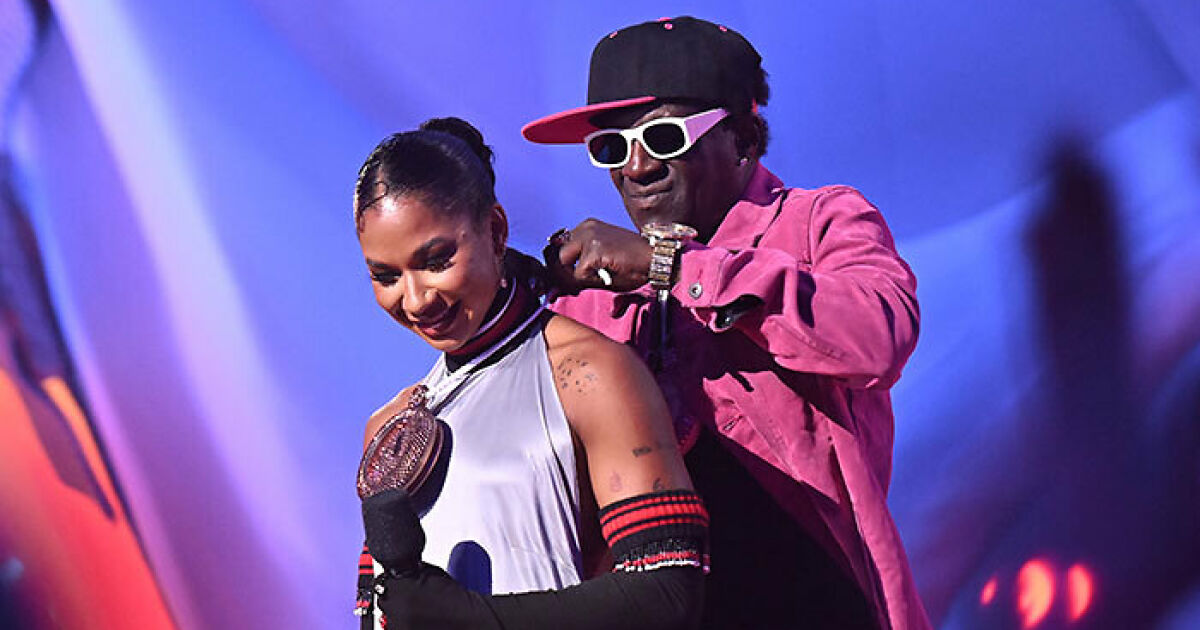
Some awards-show moments are planned down to the sparkle. Others arrive wearing a giant clock and somehow make the whole room feel softer. That is exactly what happened when Flavor Flav surprised Olympic gymnast Jordan Chiles with a custom bronze clock necklace at the 2024 MTV Video Music Awards. The gesture was playful, shiny, very Flavor Flav, and unexpectedly moving. In a night built for pop stars, camera flashes, and acceptance speeches, one of the most memorable moments belonged to an athlete who had been through an emotional Olympic storm.
Jordan Chiles, already beloved for her power, personality, and joy on the gymnastics floor, walked onto the VMAs stage with Flavor Flav as one of the evening’s presenters. The rapper, long famous for his oversized clock necklaces and larger-than-life energy, turned the appearance into what he called an Olympic moment. Then came the surprise: a bronze-colored clock chain made for Chiles after the controversy surrounding her Paris Olympics floor exercise bronze medal.
It was not just jewelry. It was a public hug with a chain attached. It said, in the loudest and kindest way possible, that achievement does not disappear because paperwork gets messy. It also reminded viewers why sports stories can hit harder than a power ballad: behind every score, appeal, and medal table is a human being trying to keep smiling under impossible pressure.
The VMAs Moment That Had Fans Reaching for Tissues
During the 2024 MTV VMAs, Flavor Flav stood beside Jordan Chiles and acknowledged what millions of Olympic viewers already knew: Chiles had lived through one of the most confusing and emotional medal disputes in recent gymnastics history. He told her he had something that could not be taken away, then presented the bronze clock necklace in front of the crowd.
Chiles appeared genuinely stunned. The smile, the pause, the emotion in her reaction all made the moment feel less like a celebrity stunt and more like a friend stepping in at exactly the right time. Flavor Flav also told her that he had her prize money covered, making the gesture both symbolic and practical. In classic Flav style, it was extra. In human terms, it was deeply thoughtful.
The line “You deserve everything” became the emotional center of the exchange. It worked because it was simple. No legal footnotes. No scoring chart. No dramatic monologue. Just recognition. And for an athlete who had been debated in headlines, discussed by arbitration panels, and pulled into a global sports controversy, recognition mattered.
Why a Bronze Clock Meant So Much
Flavor Flav’s clock necklace is not random branding. It is his signature, his superhero cape, his business card, and possibly the only accessory that can make a wall clock feel underdressed. By making a bronze version for Jordan Chiles, he turned his personal symbol into a message of support.
The bronze clock was clever because it echoed the medal without pretending to replace it. An Olympic medal is official history. A custom clock is not the same thing, and nobody serious would argue that it is. But it carried emotional weight because it was made for her, presented publicly, and designed around the exact color tied to the controversy.
In a world where athletes often hear praise only when they win cleanly, quickly, and without complication, the clock said something more generous: you are still worthy of celebration even when the system around you is complicated. That is why the moment traveled so quickly across entertainment and sports media. It had the ingredients the internet loves: a beloved athlete, a famous rapper, a shiny object, and an emotional payoff that did not require a 40-slide PowerPoint.
The Olympic Controversy Behind the Emotional Reaction
To understand why Jordan Chiles became emotional, it helps to revisit the Paris Olympics floor exercise final. Chiles initially received a score of 13.666. Her coach, Cecile Landi, submitted an inquiry about the difficulty score. The inquiry was accepted, raising Chiles’ score to 13.766 and moving her into third place behind Rebeca Andrade and Simone Biles.
That result created a historic podium: Andrade of Brazil with gold, Biles with silver, and Chiles with bronze. It was widely celebrated not only as a competitive result but also as a powerful image of three women of color sharing an Olympic podium in gymnastics. Then the situation changed.
Romania challenged the timing of the inquiry, arguing that the appeal was submitted after the one-minute deadline. The Court of Arbitration for Sport later ruled that the inquiry had been late, and the International Gymnastics Federation adjusted the standings. The International Olympic Committee then moved to reallocate the bronze medal to Romania’s Ana Bărbosu, placing Chiles fifth in the final results.
USA Gymnastics said it had time-stamped video evidence showing the inquiry was made within the required window, but CAS initially said its rules did not allow reconsideration of the award even with new evidence. The dispute continued beyond the Olympics, with Chiles and her team pursuing legal avenues through Switzerland’s highest court. In January 2026, USA Gymnastics said the Swiss Federal Supreme Court recognized flaws in the earlier process and allowed the case to be heard with relevant evidence considered.
Jordan Chiles: More Than One Medal
Jordan Chiles’ career cannot be reduced to a single disputed result. She is a two-time Olympian, a team silver medalist from Tokyo, a team gold medalist from Paris, a world champion, and a standout NCAA gymnast for UCLA. She has built a reputation for expressive floor routines, fearless performance quality, and the kind of confidence that makes a gymnastics arena feel like a concert venue.
At the Paris Olympics, Chiles helped Team USA win gold in the women’s team event. She competed with energy, precision, and visible pride. Her floor routine, often praised for its musicality and performance value, reflected the modern direction of elite gymnastics: power matters, but personality matters too. Chiles brings both.
That is part of why fans responded so strongly to the medal controversy. They were not just reacting to a score. They were reacting to the whiplash of watching an athlete celebrate, stand on a podium, receive flowers and applause, and then face the possibility that the result would be rewritten after the fact. Even people who cannot tell a switch leap from a sandwich understood the emotional unfairness of that experience.
Flavor Flav’s Surprising Role as Olympic Hype Man
Flavor Flav’s support for Jordan Chiles did not come out of nowhere. In 2024, he became one of the most visible celebrity supporters of American Olympic athletes, especially women athletes. He signed a five-year sponsorship deal with USA Water Polo as the official hype man for the women’s and men’s national teams. That phrase sounds like something invented by a marketing department after too much espresso, but in Flav’s case, it fit perfectly.
He showed up. He cheered. He used his platform to draw attention to athletes who often do not receive mainstream coverage outside Olympic years. He also became known for stepping in when individual athletes spoke publicly about financial challenges. His Olympic-era persona was not just “celebrity in the stands.” It was “celebrity with a megaphone, a clock, and apparently a very large heart.”
The Jordan Chiles bronze clock moment worked because it matched that pattern. It was not a brand trying to borrow an athlete’s pain for a quick headline. It felt like Flavor Flav doing what he had already been doing: using fame to make athletes feel seen.
Why the Moment Went Viral
The VMAs are designed for viral moments. That is the whole ecosystem: dramatic outfits, surprise appearances, celebrity reactions, and speeches clipped into bite-sized internet candy. But this moment had a different rhythm. It was not shocking in a scandalous way. It was touching in a sincere way, which is rarer and therefore more powerful.
Several factors made it spread. First, Chiles’ Olympic controversy was already widely known. Second, Flavor Flav’s clock necklace is instantly recognizable. Third, the gift connected pop culture and sports in a way that felt organic. Fourth, the emotional reaction was real. Audiences can usually spot when a public moment has been laminated in PR gloss. This one felt warm around the edges.
It also gave fans something positive to hold onto. The medal dispute had been heavy, full of legal language and institutional tension. The VMAs moment offered relief. It did not solve the case, but it gave Chiles a public celebration at a time when many fans felt she deserved one.
The Bigger Conversation: Athletes, Appeals, and Emotional Cost
Sports controversies often become technical very quickly. Who filed what? When did the clock start? Which federation had jurisdiction? What does the rulebook say? Those questions matter because fair competition depends on rules. But the Jordan Chiles case also showed how technical decisions can create emotional fallout that lands squarely on athletes.
Chiles did not create the scoring system. She did not design the inquiry process. She performed, waited for the judges, accepted the revised score, and stood on the podium based on the official result at that time. When the result changed later, the public debate placed her at the center of something far larger than one routine.
That is why the bronze clock mattered. It cut through the legal fog and returned attention to the person. Whether someone followed the case as a gymnastics expert, a casual Olympic viewer, or a VMAs fan who came for music and left emotionally invested in arbitration, the heart of the story was easy to understand: an athlete deserved compassion.
What Brands and Public Figures Can Learn From Flavor Flav
There is a useful lesson here for brands, celebrities, and anyone with a platform: support works best when it is specific. Flavor Flav did not simply post a generic “stay strong” message and move on. He made something connected to Chiles’ story, gave it to her in a meaningful setting, and used his own signature style to amplify the message.
That specificity made the gift memorable. A regular necklace might have been sweet. A bronze clock necklace was unmistakably personal. It connected to the medal, to Flav’s public identity, and to the idea of time itself. After all, the controversy hinged on seconds. Giving Chiles a clock was almost too perfect. Somewhere, a metaphor sat up straight and asked for a raise.
The moment also showed that public support does not have to be stiff or overly polished. It can be joyful. It can have humor. It can sparkle under stage lights. Serious care and playful presentation are not opposites. Sometimes the most healing gestures arrive with rhinestones.
Fan Reaction: Why People Felt Protective of Jordan Chiles
Fans rallied around Chiles because they saw more than a result change. They saw a young athlete placed under a microscope during what should have been one of the happiest chapters of her career. Many viewers also recognized the unique pressure placed on women athletes, especially Black women athletes, who are often expected to be graceful under scrutiny while carrying emotional burdens quietly.
Chiles has long been admired for her charisma and resilience. She performs with a visible sense of joy, and that joy makes fans feel connected to her. When someone known for radiance is hurt, the public response can be fierce. The bronze clock became a symbol for that protectiveness. It said what many fans had been saying online: Jordan Chiles is not defined by a panel’s confusion, a deadline dispute, or a medal table revision.
Importantly, support for Chiles does not require attacking Ana Bărbosu. The Romanian gymnast was also caught in an institutional mess she did not create. The fairest reading of the situation recognizes that multiple athletes were placed in painful positions by a process that left too much room for confusion. The best version of sports fandom can hold compassion for more than one person at a time. It is allowed. No referee whistle required.
Experience Perspective: Why This Story Feels So Personal
From a viewer’s perspective, the Jordan Chiles and Flavor Flav moment felt powerful because it resembled something many people experience on a smaller scale: working hard, doing the right thing, receiving recognition, and then watching circumstances beyond your control complicate the celebration. Most people will never wait for an Olympic score under arena lights, but plenty know what it feels like to have a win questioned, minimized, delayed, or buried under technicalities.
That is why public kindness can land so strongly. When someone has been discussed like a case file, a gesture that treats them like a person can feel enormous. The bronze clock was not valuable simply because it was custom or flashy. It was valuable because it restored a sense of ceremony. It gave Chiles a moment where the audience was not debating her; they were applauding her.
There is also something deeply relatable about receiving encouragement when you are trying to hold it together. Chiles’ reaction showed the emotional release that comes when support arrives unexpectedly. People often stay strong through the official process, the public comments, the headlines, and the pressure. Then one kind sentence breaks through. Suddenly, the feelings have somewhere to go.
The phrase “You deserve everything” worked because it was not complicated. In difficult moments, people rarely need a perfect speech. They need someone to say, “I see what happened, I see your effort, and I still believe you deserve celebration.” That is a message athletes need, but so do students, artists, workers, parents, and anyone who has ever had to keep smiling while life rearranged the furniture without asking.
The VMAs setting made the gesture even more interesting. Awards shows can be glamorous but emotionally distant. Everyone looks airbrushed, styled, and lightly allergic to ordinary problems. Yet here was a moment that felt grounded. A gymnast who had spent years training for fractions of points stood beside a rapper whose whole brand is joyful exaggeration, and together they created one of the night’s most human scenes.
For young athletes watching, the message was especially meaningful. It showed that even elite competitors face unfairness, confusion, and disappointment. It also showed that support can come from unexpected places. Not every person who cheers for you will be from your sport, your school, your workplace, or your inner circle. Sometimes your hype man arrives from hip-hop history wearing a clock big enough to alert three time zones.
The experience lesson is simple: recognition matters. It does not erase the hard part, but it helps people carry it. Flavor Flav did not fix the arbitration process on the VMAs stage. He did something smaller and, in that moment, more immediate. He made Jordan Chiles feel celebrated. In a culture that often rushes to analyze, judge, and move on, that kind of public affirmation is not silly. It is necessary.
Conclusion: A Clock, a Champion, and a Moment That Lasted
Jordan Chiles’ emotional reaction to Flavor Flav’s bronze clock at the VMAs became memorable because it blended sports, pop culture, humor, and genuine care. The gift was shiny, yes, but the message behind it was stronger than the sparkle. Chiles had already proven herself as an Olympic champion, a world-class gymnast, and a performer with rare charisma. The clock simply gave the public another way to say what many already believed: she deserved support, respect, and celebration.
The ongoing medal dispute remains a serious sports matter, involving rules, evidence, and institutional accountability. But the VMAs moment lives in a different emotional category. It reminds us that athletes are not only results on a scoreboard. They are people who feel every cheer, every headline, every unfair turn, and every act of kindness.
Flavor Flav’s gift did not replace an Olympic medal. It was never supposed to. Instead, it became a symbol of something harder to take away: public love. And for Jordan Chiles, in front of a cheering VMAs crowd, that love arrived right on time.
Note: This article is written in original language for web publication and is based on publicly reported facts about the 2024 VMAs, Jordan Chiles’ Olympic medal dispute, Flavor Flav’s athlete support, and later appeal developments.