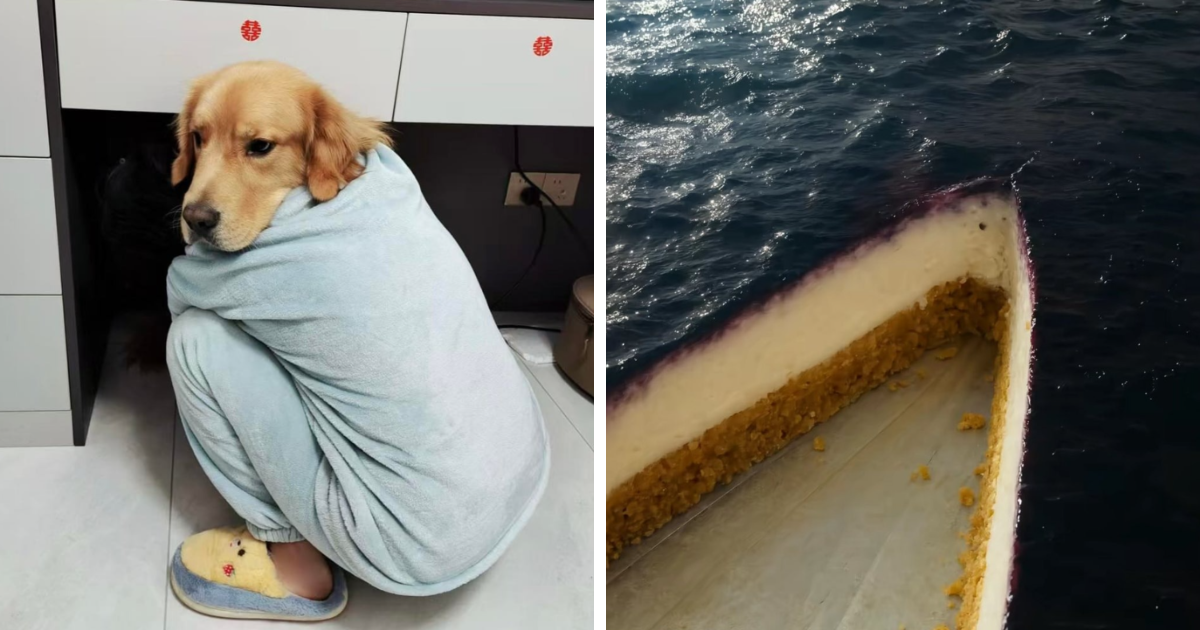
Some photos politely ask for a second look. Others grab your brain by the collar and say, “Explain this immediately.” A dog sits too upright and suddenly resembles a tired office worker trapped in a golden retriever costume. A shadow lands in the perfect place and turns a harmless chair into a tiny monster. A cat’s legs disappear behind a blanket and, for one glorious second, the internet believes it has discovered a furry loaf with eyes.
That is the magic behind confusing photos: they make everyday reality feel like it briefly forgot its own password. The title “Looks Like A Human In A Dog Suit”: 50 Confusing Photos That Mess With Your Sense Of Reality captures a very specific kind of online joythe moment when your eyes, brain, and common sense hold an emergency meeting and nobody brings snacks.
These strange images are not always edited, staged, or generated by artificial intelligence. Many are simple accidents of timing, perspective, lighting, posture, reflection, and our brain’s impressive talent for jumping to conclusions. The result is a gallery of visual riddles: dogs that look suspiciously human, objects that appear to float, people with “extra” limbs, faces hiding in furniture, and pets that seem to be auditioning for a low-budget science fiction film.
Why Confusing Photos Are So Addictive
Confusing photos work because they turn seeing into a tiny puzzle. Most of the time, vision feels effortless. You open your eyes, the world appears, and you move on with your day. But the brain is not just recording the world like a security camera. It is interpreting, predicting, filling gaps, and making fast guesses based on what usually happens.
That system is extremely useful. If you see a shape moving in the dark, your brain would rather alert you quickly than spend ten minutes preparing a peer-reviewed report. But the same shortcut can also make a sleeping dog look like a person in a fuzzy costume or turn a pile of laundry into a suspicious goblin with poor posture.
The Brain Loves Patterns
Humans are pattern-finding machines. We recognize faces, bodies, animals, and familiar shapes almost instantly. This helps us communicate, avoid danger, and understand social cues. It also means we see faces in clouds, electrical outlets, toast, tree bark, and sometimes in the front end of a very judgmental-looking car.
This tendency is called pareidolia, and it is one of the main reasons confusing photos spread online. A random shape becomes meaningful because the brain dislikes visual chaos. Give it two dots and a curved line, and it will happily announce, “Congratulations, that trash can is smiling at us.”
Perspective Can Betray Everyone
Forced perspective is another major culprit. When two objects line up just right, depth becomes hard to judge. A person standing far behind a dog may look as if they have tiny legs. A bird flying close to the camera may look as large as an airplane. A cat sitting near a cup can appear to be trapped inside it, which is both impossible and somehow emotionally believable.
Photography flattens a three-dimensional world into a two-dimensional image. Once depth is compressed, the brain has to guess what belongs in front, what belongs behind, and what belongs to the same body. This is where the comedy begins.
The “Human In A Dog Suit” Effect
The phrase “looks like a human in a dog suit” is funny because it points to an uncanny overlap between animal behavior and human body language. Dogs can sit in positions that resemble people lounging on a sofa after a long Monday. They can raise their eyebrows, tilt their heads, stare directly into the camera, and wear expressions that seem almost too emotionally specific.
Of course, dogs are not secretly paying rent and pretending not to understand taxes. But certain breeds, poses, and camera angles can make them look oddly human. A dog sitting upright with its front paws arranged like arms can trigger the same visual category we use for people. Add expressive eyes, relaxed lips, and a suspiciously wise stare, and suddenly the dog looks like it knows your Wi-Fi password.
Dog Expressions Feel Familiar
Dogs communicate through posture, facial movement, gaze, ears, tail position, and vocalizations. People often interpret these signals through a human lens. A relaxed open mouth may look like a smile. Raised eyebrows may look like concern. A tilted head may look like deep philosophical reflection, even if the dog is mostly thinking, “Did you say cheese?”
This familiarity is part of why dog photos dominate the “confusing but adorable” corner of the internet. When a dog accidentally resembles a person, the image becomes both funny and slightly unsettling. It is not scary exactly. It is more like your brain has walked into the wrong meeting room.
50 Types Of Confusing Photos That Mess With Reality
While every viral confusing photo has its own flavor of visual nonsense, most fall into a few recognizable categories. Think of this as a field guide for spotting reality glitches before your brain starts filing a complaint.
1. Pets That Look Like People
These are the crown jewels of confusing animal photos. A dog sits upright like a retired professor. A cat lounges with one paw over the couch arm like it is waiting for room service. A horse turns its head at the exact moment the camera catches an expression that says, “We need to talk about your life choices.”
2. Animals With Human-Looking Faces
Sometimes fur patterns, eye placement, and shadows combine to create a strangely human face. A dog’s muzzle may be partially hidden, making the eyes and brow stand out. A goat may stare with such intensity that it appears to have read your diary. A bird may angle its head in a way that gives it the energy of a tiny suspicious neighbor.
3. Extra Limbs That Are Not Actually Extra
One of the most common confusing photo tricks is the accidental extra arm, leg, paw, or tail. Two people stand close together, and suddenly one appears to have three hands. A dog lies beside another dog, and the viewer must conduct a full anatomy investigation to determine which leg belongs to which fluffball.
4. Floating Objects
Floating objects usually come from shadows, hidden supports, or perfect timing. A dog jumping in midair can look like it has mastered levitation. A cup on a glass table may appear suspended in space. A person sitting on a ledge may look like they are hovering, which is impressive until you spot the missing visual clue.
5. Tiny Giants And Giant Tiny Things
Forced perspective can make a small dog look larger than a house or a human hand look bigger than a person’s head. This trick is why tourists can “hold” the sun, “push” famous towers, or “eat” a mountain in vacation photos. It is also why your brain should never be allowed to make final decisions based on one image.
6. Reflections That Create New Worlds
Mirrors, windows, puddles, and shiny appliances love causing trouble. A reflection can place a face where no face should be. A window can merge indoor and outdoor scenes into one surreal image. A puddle can make a city street look like a portal, which is lovely until someone steps in it and ruins the fantasy with wet socks.
7. Shadows With Dramatic Ambitions
Shadows are professional pranksters. A harmless plant can cast a shadow that looks like a spider the size of a dinner plate. A dog’s shadow may look like a wolf. A person carrying bags may appear to have wings. Shadows simplify shapes, remove details, and leave the brain to guess the restwhich it does with the confidence of a toddler holding permanent markers.
8. Camouflage That Hides The Main Subject
Some confusing photos are basically visual hide-and-seek. A white dog sleeps on a white rug. A gray cat blends into a pile of blankets. A lizard disappears against bark. The subject is right there, but the colors and textures make it vanish until your eyes finally snap into focus.
9. Perfectly Timed Chaos
Timing can turn normal moments into absurd illusions. A bird flying behind a person may look like a strange hat. A dog shaking water off its fur may become a blurry sea creature. A person jumping at the right moment may look like they have no legs. Photography freezes motion, and frozen motion often looks like reality got paused during a sneeze.
10. Objects That Look Alive
Chairs, bags, lamps, and appliances can develop unexpected personalities when the lighting is right. A vacuum cleaner becomes a sad robot. A backpack becomes a curled-up animal. A mop becomes a ghost with low self-esteem. Once your brain sees the “face,” it becomes almost impossible to unsee it.
Why “Reality Glitch” Photos Spread So Fast Online
Confusing photos are perfect social media fuel because they invite participation. The viewer does not just consume the image; they solve it. People zoom in, rotate the phone, read the comments, and proudly announce the answer like they just cracked a museum heist.
They also create a shared laugh without needing a complicated setup. A dog that looks like a person is instantly understandable across cultures. A photo that appears to show a floating cat does not require a long caption. It simply arrives, causes mild brain static, and leaves everyone happier.
They Reward The Second Look
Online attention is quick, but confusing images slow people down. A normal photo gets a glance. A confusing photo gets a stare. Then another stare. Then the viewer sends it to a friend with a message like, “Please tell me what I’m looking at.” That extra attention is exactly why these images perform so well on social platforms.
They Make Us Feel Clever
There is a tiny burst of satisfaction when a confusing photo finally makes sense. The hidden dog appears. The “extra arm” is revealed to belong to someone behind the subject. The floating object is sitting on a transparent shelf. The brain loves completing the puzzle, even when the prize is simply realizing that the cat was not, in fact, melting.
Are Confusing Photos Edited?
Some are edited, of course. The internet is a big place, and not everyone treats reality with the respect it deserves. But many confusing photos do not need editing at all. Real life provides enough weirdness on its own.
The most convincing confusing images often come from ordinary scenes: pets on couches, people at parties, reflections in windows, shadows on walls, or family photos taken at exactly the wrong second. The charm lies in the accident. A heavily manipulated image may impress viewers, but an accidental illusion feels like catching reality with spinach in its teeth.
How To Tell If A Confusing Photo Might Be Real
Look for practical explanations before assuming digital magic. Ask where the light is coming from. Check whether a reflection is involved. Look for hidden edges, overlapping bodies, matching colors, or a missing shadow. If the confusing part depends on alignment, timing, or depth, it may be a real accidental illusion.
Also pay attention to image quality. Heavy blur, strange edges, mismatched lighting, or inconsistent shadows can suggest editing. But do not become too serious about it. Half the fun of these photos is letting your brain be briefly confused before logic walks in carrying a clipboard.
The Psychology Behind The Laugh
Confusing photos are funny because they create harmless uncertainty. Your brain expects the world to behave. When an image violates that expectation without threatening anything, the result is delight. A dog that looks like a human is not dangerous. It is just weird enough to make the mind wobble.
That wobble is where humor lives. The viewer recognizes two interpretations at once: “This is a dog” and “This appears to be a man wearing a dog suit.” The conflict is absurd, and the absurdity is enjoyable because the stakes are low. Nobody is harmed. Reality just does a pratfall.
The Uncanny Valley Of Pets
The uncanny valley usually describes things that look almost human but not quite. While dogs and cats are obviously animals, certain photos can create a mild pet version of that feeling. A dog’s posture may be too human. A cat’s stare may seem too knowing. A monkey may sit in a way that looks like someone waiting for a bus after receiving bad news.
That slight discomfort is part of the appeal. The image is not terrifying; it is delightfully wrong. It makes viewers laugh because the brain briefly considers an impossible explanation before correcting itself.
How Photographers Accidentally Create Confusing Images
Professional photographers understand composition, lighting, depth, and timing. Casual photographers often create illusions by accident because life moves faster than the shutter button. A pet jumps. A child runs through the background. A reflection appears. A shadow stretches. The photo is captured before anyone notices the visual trap.
Phone cameras add another layer. Wide-angle lenses can stretch subjects near the edge of the frame. Portrait mode can blur background details that might explain the scene. Low light can remove important information. A perfectly normal moment becomes confusing because the camera simplifies reality differently than human eyes do.
Examples Of Everyday Photo Confusion
Imagine a black dog sleeping on a black couch with only its eyes visible. At first glance, it looks like a pair of floating eyeballs. Or picture a person holding a puppy close to the camera while standing far from a friend in the background. The puppy appears enormous, like a soft villain preparing to conquer the suburbs.
Another classic example is the “missing body” illusion. Someone sits behind a table, and the table hides their torso. Their head appears to float above the surface like a polite ghost attending brunch. Add a pet in front of them, and suddenly the internet has a new mystery to solve.
Why Dogs Are Especially Good At Looking Accidentally Human
Dogs have lived closely with people for thousands of years, and they are unusually skilled at paying attention to human cues. They watch faces, gestures, tone, posture, and routines. Because humans also watch dogs closely, we become very good at reading personality into their expressions.
That connection makes dog photos emotionally rich. A dog looking guilty near a destroyed pillow seems like a tiny criminal awaiting sentencing. A dog sitting upright in a chair looks like a coworker about to ask why the meeting could not have been an email. A dog with one paw resting on another dog’s shoulder looks like it is offering relationship advice.
The Camera Loves A Dramatic Dog
Some dogs naturally have expressive faces. Wrinkled brows, round eyes, floppy ears, and long muzzles can create human-like emotional signals. A camera angle from slightly above can make the eyes seem larger and more soulful. A straight-on shot can make the face feel unusually direct. Add indoor lighting and a couch, and the dog becomes less “pet” and more “roommate who refuses to pay utilities.”
How To Enjoy Confusing Photos Without Falling For Fake Information
Confusing photos are fun, but the same visual weaknesses that create harmless illusions can also make people misread serious images. Online, a misleading crop, missing context, or unusual angle can change how a scene appears. That is why visual literacy matters.
Before believing a shocking image, check whether there is more context. Look for the original source, other angles, dates, captions, and credible reporting. A funny dog photo can be enjoyed instantly. A photo making a serious claim deserves more patience. The brain is fast, but fast is not always accurate.
Train Your Eye Like A Friendly Detective
Ask simple questions: What is hidden? What is reflected? What is cropped out? Where are the shadows? Could two separate things be overlapping? Is the scale realistic? Does the background explain the foreground? These questions turn confusion into curiosity instead of panic.
And yes, sometimes the answer is simply that a dog sat like a person and looked directly into the camera with the energy of a middle manager named Gary. Not every mystery needs a dramatic solution.
Experiences Related To Confusing Photos That Mess With Your Sense Of Reality
Anyone who has spent enough time around pets, kids, mirrors, or family group photos has probably created a confusing image without trying. The best ones usually happen in ordinary places. A living room becomes an illusion studio. A backyard becomes a stage for visual nonsense. A dog bed becomes the set of a mystery film called Where Did The Rest Of The Animal Go?
One of the most relatable experiences is the double-take pet photo. You take a quick picture of your dog sleeping, planning to capture a wholesome moment. Later, you open the image and realize the dog looks like a man in a fur coat taking a nap after a long shift. The front paws resemble hands. The posture resembles a person. The expression seems oddly tired, as if the dog has just reviewed quarterly reports. You know it is your pet, but for a second your brain whispers, “Are we completely sure?”
Another common experience happens with reflections. You photograph a window because the sunset looks pretty, but the glass catches the room behind you. Now the image shows trees, clouds, your couch, a lamp, and half of your own face floating in the sky like a confused weather spirit. It is not supernatural. It is just physics with a flair for drama.
Family photos are also experts at accidental chaos. Someone leans behind someone else. A hand appears near the wrong shoulder. A child runs through the background. A dog’s tail crosses the frame at exactly the wrong moment. Later, everyone studies the picture like a crime scene. “Whose arm is that?” becomes the main event, and the original reason for the photo is forgotten forever.
Travel photos create their own reality problems. Mountains, monuments, and skylines can play tricks with scale. A person standing far away may look tiny enough to fit in a hand. A statue may appear to be interacting with a tourist. A bird passing near the lens may look like a prehistoric creature invading the vacation album. The photo is technically honest, but emotionally it is a liar wearing sunglasses.
Then there are food and household objects. A burnt piece of toast appears to have a face. A sliced pepper looks shocked. A backpack on the floor looks like a sleeping animal. A coat hanging on a chair becomes a shadowy figure at 2 a.m., which is why nobody should investigate laundry in the dark unless they are emotionally prepared.
The most memorable confusing photos are not just strange; they are social. You show them to someone else because confusion is more fun when shared. One person sees the illusion immediately. Another cannot see it at all. A third person suddenly explains it, and everyone either feels smarter or slightly betrayed by their own eyeballs. That group reaction is the real charm. The image becomes a tiny event.
In a world full of polished content, confusing photos feel refreshingly accidental. They are messy, funny, and weirdly humaneven when the star is a dog who looks like it might ask for a cup of coffee. They remind us that reality is not always boring. Sometimes it simply lines up at the wrong angle and gives us a perfect little glitch.
Conclusion: Reality Is Fine, Your Brain Is Just Improvising
“Looks Like A Human In A Dog Suit”: 50 Confusing Photos That Mess With Your Sense Of Reality is more than a funny title. It describes a universal online experience: the joy of seeing something ordinary become wonderfully strange. These photos work because the brain is always predicting, completing, comparing, and interpreting. Most of the time, that system helps us navigate the world. Occasionally, it turns a dog on a sofa into a suspiciously human gentleman in a fur outfit.
Confusing photos remind us that seeing is not as simple as looking. Perspective, shadows, timing, reflections, camouflage, and familiar patterns can all transform reality into a visual riddle. And honestly, thank goodness. The internet has enough serious things. Sometimes we need a floating cat, a dramatic shadow, or a dog who appears to be one business casual outfit away from joining a video call.