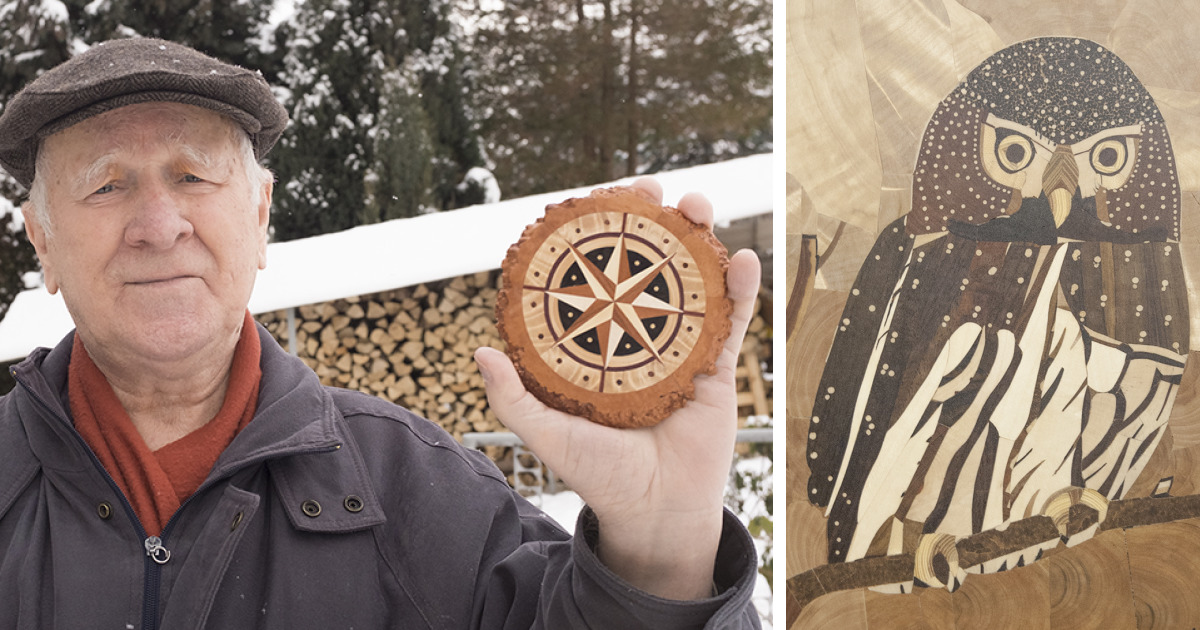
Some people spend a quiet afternoon making a birdhouse. My grandfather looked at a plain piece of wood and apparently thought, “Yes, I would like to disappear into this project for more than 100 hours and emerge with sawdust in places science has not yet named.” The result was not just a handmade wooden piece. It was a story carved, sanded, shaped, polished, and patiently coaxed into existenceone careful hour at a time.
Wood art has a strange kind of magic. It begins as something ordinary: a board, a stump, a slab, a scrap pulled from the corner of a workshop. Then a craftsperson studies the grain, feels the weight, notices the knots, and starts imagining what is hiding inside. Unlike plastic, metal, or digital design, wood has a personality before the artist even touches it. It has lines, scars, color changes, rings, pores, and surprises. Sometimes it behaves beautifully. Sometimes it argues like a tiny wooden lawyer.
This is why a piece that takes 100+ hours matters. It represents more than time. It represents skill, patience, family memory, and the stubborn belief that beauty is worth making slowly. In an age of fast shipping, instant downloads, and furniture that arrives with 42 screws and one mysterious extra peg, handmade wood art reminds us that craftsmanship still has a heartbeat.
The Beauty of Wood Art Begins Before the First Cut
Great wood art starts with observation. A skilled maker does not simply attack a board with tools and optimism. The first step is studying the wood itself. Grain direction, hardness, figure, color, moisture content, and defects all influence the final design. A dramatic swirl in the grain might become the center of a landscape. A knot might turn into the eye of an animal. A crack might be stabilized and transformed into a design feature rather than treated as a flaw.
That is one of the most fascinating things about wood carving and woodworking art: the material helps make creative decisions. Maple may offer a smooth, pale surface that is excellent for clean details. Walnut brings rich chocolate tones and elegant contrast. Oak has bold grain and open pores. Cherry deepens in color over time, almost like it is aging gracefully on purpose. Every species has its own visual language, and a good artist learns to listen.
In my grandfather’s case, the project began not with rushing, but with planning. He examined the board from different angles, traced possible shapes, and thought about where the eye should travel across the finished piece. That may sound dramatic, but anyone who has ever cut the wrong side of a board knows that woodworking teaches humility quickly. Wood does not have an undo button. It has “well, now we’re making something smaller.”
Why 100+ Hours Is Not as Excessive as It Sounds
To someone outside the workshop, 100 hours may sound like a lot. To a woodworker, it sounds like Tuesday through next month. A detailed handmade wood art piece involves many stages, and each one demands patience. The time is not spent only on carving. It includes sketching, measuring, cutting, rough shaping, refining, sanding, cleaning, filling, finishing, drying, inspecting, and fixing tiny imperfections that only the maker can see but cannot emotionally survive leaving alone.
The rough shaping stage removes excess material and establishes the main form. This may involve saws, chisels, gouges, carving knives, rasps, files, or rotary tools, depending on the design. After that comes refinement, where the piece begins to look intentional rather than like it lost a fight with a beaver. Details are carved in. Edges are softened. Shadows are created. Depth is added. Texture is introduced carefully so the surface feels alive.
Then comes sanding, the quiet marathon of woodworking. Sanding is not glamorous, but it is where many projects become either beautiful or “almost beautiful if viewed from across the room.” Proper sanding usually moves through progressively finer grits. The goal is to remove tool marks, scratches, rough patches, and uneven surfaces without flattening the character of the piece. Hand sanding around curves and small details can take hours by itself, especially when the artist wants the finished surface to feel smooth without losing crisp definition.
The Role of Grain, Texture, and Natural Character
One reason handmade wood art feels special is that no two pieces of wood are identical. Even two boards from the same tree can differ in grain pattern, density, color, and figure. Growth rings can create movement. Mineral streaks can add contrast. Curly, quilted, bird’s-eye, or fiddleback grain can turn a simple surface into something almost three-dimensional.
Rather than covering these features, many wood artists design around them. A flowing grain pattern can suggest water, wind, hair, feathers, clouds, or landscape lines. Darker areas can create natural shading. Lighter areas can become highlights. This is where woodworking becomes a partnership between human intention and nature’s own design department, which apparently has excellent taste and zero concern for making things easy.
Texture also matters. A piece of wood art may include smooth polished areas, carved grooves, stippled backgrounds, raised relief, scorched accents, or layered surfaces. These contrasts help the eye understand depth. They also invite touch. People instinctively want to run their fingers over wood art because the surface tells part of the story. Unlike a printed image, carved wood has physical presence. It throws shadows. It changes with light. It feels warm in a way few materials do.
Tools Used in Handmade Wood Art
Wood art can be made with simple hand tools or a full workshop of machines. The best tool depends on the artist’s style and the demands of the project. Traditional carving tools include gouges, chisels, knives, mallets, rasps, files, and scrapers. These tools give the maker direct control and allow subtle adjustments. Power tools such as band saws, scroll saws, rotary tools, sanders, and routers can speed up certain tasks, but they do not replace judgment.
Hand tools often leave a human signature in the work. A shallow gouge mark, a carefully chamfered edge, or a crisp carved line can show the maker’s touch. Power tools, on the other hand, can help with precision and heavy material removal. Many experienced wood artists combine both. They may rough out a shape with machinery, then finish the details by hand, allowing efficiency and craftsmanship to meet somewhere in the middle and shake dusty hands.
Common tools behind detailed wooden art
- Carving knives: Useful for shaping, trimming, and adding controlled details.
- Gouges: Curved cutting tools that remove wood in scooped shapes and create flowing lines.
- Chisels: Ideal for crisp cuts, edges, and geometric details.
- Rasps and files: Helpful for refining curves and smoothing rough transitions.
- Sandpaper and sanding blocks: Essential for preparing the surface before finishing.
- Scrapers: Excellent for smoothing difficult grain without excessive sanding.
- Clamps: The unsung heroes of woodworking, because every project secretly wants to move at the worst possible moment.
The Patient Science of Sanding and Finishing
If carving gives wood art its shape, finishing gives it its voice. A good finish protects the surface, enhances the grain, and determines how the final piece responds to light. Some finishes create a soft natural look. Others produce a glossy, glass-smooth surface. Oil finishes can deepen color and make the grain glow. Wax can add a gentle sheen and pleasant touch. Clear film finishes can provide more protection for display pieces that may be handled frequently.
Before finishing, the wood must be clean and properly prepared. Dust can ruin a finish faster than a cat can sit in an open box. Fine particles trapped under oil, varnish, shellac, lacquer, or polyurethane can create bumps and cloudy areas. This is why careful makers vacuum, wipe, inspect, and sometimes repeat the process several times before applying the first coat.
Finishing is rarely a one-step process. A coat may need to dry, cure, or be lightly sanded before the next layer. Raised grain may need attention. Open-grained woods may benefit from grain filling if the goal is a smooth reflective finish. Detailed carved areas require care so finish does not pool in corners or obscure delicate lines. It is slow work, but when done well, the finished piece seems to glow from within.
Why Handmade Wood Art Feels More Personal Than Factory Decor
Factory-made decor can be attractive, useful, and affordable. But handmade wood art carries something different: evidence of a person’s attention. When my grandfather spent more than 100 hours on one piece, those hours became part of the object. Every curve, edge, and polished surface held a decision. Every correction showed persistence. Every small detail suggested that someone cared enough to do it right, even when nobody else would have noticed the shortcut.
This is why handmade wooden art often becomes an heirloom. It is not just something to hang on a wall or place on a shelf. It becomes a family landmark. Visitors may admire the design, but relatives see more: the workshop light, the smell of sawdust, the coffee cup near the bench, the careful hands, the quiet concentration, and the familiar voice saying, “Don’t touch that yet, the finish is still wet.”
Wood art also ages beautifully. Over time, finishes mellow, colors deepen, and small signs of life may appear. Rather than making the piece less valuable, these changes often add warmth. A handmade wooden artwork can become connected to birthdays, holidays, moving days, family stories, and the simple passing of time.
The Emotional Value of a Grandfather’s Craftsmanship
There is something especially meaningful about art made by a grandparent. Grandfathers often carry practical knowledge that was learned by doing: how to sharpen a blade, how to judge a board, how to fix a mistake without announcing it to the entire neighborhood, and how to keep working when the project becomes more complicated than expected.
A 100-hour wood art project says, “I had time, and I chose to spend it creating something lasting.” That is a powerful message. In many families, handmade objects become a kind of love language. They may not come with dramatic speeches. They may come with a simple, “I made this,” followed by a shrug, as if creating a beautiful piece of art from raw wood were no more impressive than making toast.
But it is impressive. It is deeply impressive. The hours matter because they represent devotion. The patience matters because it reflects character. The finished art matters because it turns memory into something visible.
Lessons Hidden in 100+ Hours of Woodworking
Watching someone create wood art over many hours teaches lessons that reach far beyond the workshop. The first lesson is patience. Good work cannot always be rushed. Some steps take as long as they take. Glue must dry. Finish must cure. Sanding must be repeated. Details must be refined slowly. The project sets the pace, and the maker learns to respect it.
The second lesson is problem-solving. Wood moves, chips, splits, dents, and surprises you. A knot may interrupt a carved line. A tool may slip. A finish may dry unevenly. Skilled woodworkers do not avoid every problem; they learn how to respond. Sometimes a flaw becomes a feature. Sometimes the design changes. Sometimes the artist mutters something educational under their breath and keeps going.
The third lesson is humility. Woodworking rewards confidence but punishes arrogance. Measuring carefully, testing finishes on scrap, sharpening tools, and planning cuts all matter. Even experienced makers continue learning because wood is never exactly the same twice.
Why This Amazing Wood Art Deserves Attention
In a world filled with mass-produced objects, a handmade wood art piece created over 100+ hours deserves attention because it represents the opposite of disposable culture. It is slow, intentional, physical, and personal. It asks us to look closer. It reminds us that beauty is not always loud. Sometimes it is quiet, polished, and sitting in the grain of a board.
This kind of artwork also supports the broader appreciation of traditional craft. Woodworking combines design, engineering, material science, patience, and artistic instinct. A successful piece must be visually pleasing, structurally stable, carefully finished, and respectful of the wood’s natural behavior. That is no small achievement. It is not just “making something from wood.” It is understanding how wood wants to be shaped and how to guide it without fighting it too much.
My grandfather’s project stands as a reminder that handmade art carries a human pulse. It contains decisions, mistakes, corrections, quiet victories, and a whole lot of sanding. Especially the sanding. Always the sanding.
How to Appreciate Handmade Wood Art Like a Pro
You do not need to be a woodworker to appreciate wood art. Start by looking at the grain. Notice whether it flows with the design or contrasts with it. Look at the edges and transitions. Are they crisp, soft, rounded, or textured? Observe the finish. Does it look natural and warm, glossy and refined, or rustic and tactile? Then consider the time involved. A simple-looking curve may have required careful tool control. A smooth surface may have taken multiple rounds of sanding and finishing.
Also, look for restraint. Great wood art does not always show off with unnecessary details. Sometimes the most elegant choice is knowing when to stop. That may be the hardest part of all, especially for makers who keep seeing “one more tiny thing” to improve. Perfectionism lives rent-free in many workshops.
Experiences Related to “My Grandfather Spent 100+ Hours To Craft This Amazing Wood Art”
The most memorable part of watching my grandfather create this wood art was not a single dramatic moment. There was no movie-style scene where the final chip fell away and everyone applauded while golden sunlight entered the workshop at exactly the right angle. Real craftsmanship is quieter than that. It is built from small, repeated rituals: sharpening a tool, brushing away dust, checking the grain, leaning back to study the shape, then returning to the bench for another careful pass.
At first, the project looked almost impossible to understand. To me, it was just wood with pencil marks on it. To him, it was already becoming something. He could see balance where I saw lines. He could imagine depth where I saw a flat surface. He would tilt the piece under the light and explain how the grain might help create movement. I nodded wisely, pretending I understood all of it, while secretly thinking the board still looked like it needed a sandwich and a nap.
As the hours added up, the artwork slowly changed. The rough outline became a form. The form gained details. The details gained shadows. The shadows gave the piece personality. What impressed me most was how often he paused. He did not rush from one step to the next. He looked, touched, measured, adjusted, and sometimes simply sat with the piece for a while. That patience felt almost old-fashioned, but in the best way. It was the opposite of scrolling, clicking, skipping, and replacing. It was attention turned into an object.
There were also mistakes, or at least moments that looked like mistakes to me. A small chip appeared near an edge. A carved line did not behave as planned. A patch of grain resisted the tool and tore slightly. Each time, I expected frustration. Instead, he adapted. He changed the curve, softened a transition, or worked the imperfection into the design. That taught me something important: craftsmanship is not about avoiding every problem. It is about knowing how to keep the work beautiful after reality has offered its opinion.
The finishing stage was my favorite because it felt like the wood suddenly woke up. Before the finish, the piece was impressive. After the finish, the grain deepened, the color warmed, and all those tiny carved details became more visible. It was like watching a photograph develop, except slower and with more rags. He applied the finish carefully, waited, inspected, and repeated the process. I learned that shine is not just shine. It is preparation, patience, and restraint.
When the piece was finally done, it did not feel like a new object. It felt like something that had earned its place. More than 100 hours had turned raw wood into family history. The artwork carried the smell of the workshop, the rhythm of his hands, and the humor of all those little comments he made along the way. It reminded me that handmade things have a special kind of honesty. They do not hide the maker. They reveal the maker.
That is why this amazing wood art matters so much. It is beautiful, yes. But it is also personal. It proves that time can become texture, love can become craft, and a grandfather with patience, tools, and a stubborn streak can turn a piece of wood into something unforgettable.
Conclusion
My grandfather’s 100+ hour wood art project is more than a handmade decoration. It is a celebration of patience, skill, and the timeless beauty of natural materials. From selecting the right wood to carving details, sanding surfaces, and applying the final finish, every stage required care. The result is not only an amazing piece of wood art but also a lasting reminder of family, creativity, and craftsmanship that refuses to be rushed.
Handmade wood art connects people to tradition in a way few modern objects can. It shows the value of working slowly, respecting materials, and creating something with meaning. Whether displayed on a wall, placed in a living room, or passed down through generations, a piece like this carries a story that mass-produced decor simply cannot copy. And honestly, if an object can hold love, sawdust, and 100+ hours of dedication all at once, it deserves a pretty special spot in the house.