Note: This publish-ready article is based on real information from NASA, JPL, the University of Arizona HiRISE team, NASA Science, Space.com, CBS News, SYFY, StarTrek.com, USGS, Arizona State University Mars Education, Wired, TIME, and Live Science. Source links are not inserted so the HTML stays clean for web publishing.
The Day Mars Appeared to Join Starfleet
Every once in a while, Mars looks less like a cold desert planet and more like it has been quietly reading fan fiction. In 2019, NASA’s Mars Reconnaissance Orbiter captured an image that made science fans, space nerds, and Star Trek lovers collectively lean toward their screens and say, “Wait… is that the Starfleet logo?”
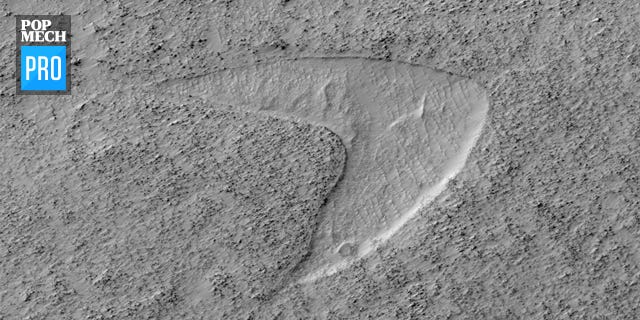
The answer was both delightful and disappointingly sensible: yes, the shape really looked like the famous Star Trek delta insignia, but no, it was not carved by aliens, Vulcans, bored astronauts, or a lost Federation intern with a laser shovel. The feature was a natural Martian landform in southeast Hellas Planitia, photographed by the High Resolution Imaging Science Experiment, better known as HiRISE, aboard NASA’s Mars Reconnaissance Orbiter.
The image, known as “Dune Footprints in Hellas,” showed several sharp, chevron-like shapes on the Martian surface. One of them strongly resembled the Starfleet emblem. The internet did what the internet does best: it turned a serious geology observation into a cosmic pop-culture celebration. For a brief, glorious moment, Mars looked as if it had signed up for a five-year mission to explore strange new worldsdespite already being a strange old world itself.
What Was Actually Found on Mars?
The so-called “Star Trek logo on Mars” was not a logo in the human-made sense. It was a dune cast, also called a dune footprint. These are geological records left behind when moving sand dunes interact with lava flows and wind over long periods of time.
The formation appeared in southeast Hellas Planitia, a region within the enormous Hellas impact basin in Mars’s southern hemisphere. Hellas is one of the largest impact basins on the planet, and its plains contain a wide variety of landforms shaped by ancient impacts, volcanic activity, dust movement, seasonal changes, and relentless Martian winds.
The specific HiRISE image was acquired on April 22, 2019, and later highlighted by the University of Arizona team that operates the camera. Its map-projected image scale was about 50 centimeters per pixel, meaning the camera could resolve surprisingly small details on the Martian surface. That is one reason HiRISE images often feel so intimate: they do not show Mars as a vague rusty ball, but as a place with ridges, dunes, slopes, pits, craters, and, apparently, accidental science-fiction branding.
How Did the “Star Trek Logo” Shape Form?
Step 1: Crescent-Shaped Dunes Moved Across the Plain
The story begins with barchan dunes. Barchan dunes are crescent-shaped sand dunes that form when wind tends to blow mainly from one direction and sand supply is limited. They are common on Earth and Mars, and their shape can reveal clues about local wind direction. If dunes were gossip columnists, barchans would be the ones pointing dramatically downwind and saying, “The wind went that way.”
Long ago, dunes like these migrated across the region in Hellas Planitia. They were not permanent monuments. Sand dunes are travelers. They shift, creep, and reshape as wind moves grains from one side to another. On Mars, where the atmosphere is thin but winds still matter, dune movement can be slow, strange, and scientifically valuable.
Step 2: Lava Flowed Around the Dunes
At some point, volcanic activity changed the landscape. Lava flowed across the plain and surrounded the dunes. Importantly, the lava did not completely bury them. Instead, it moved around the sandy shapes, leaving the dunes standing like temporary islands in a dark volcanic sea.
When the lava cooled and hardened, it preserved the outlines of the dunes. The sand itself was still loose, but the surrounding material became solid rock. That set the stage for the next act of Martian sculpting.
Step 3: Wind Removed the Sand
After the lava hardened, the Martian wind continued doing what wind does best: rearranging things without asking permission. Over time, the original sand piles migrated away or were eroded, leaving behind empty impressions in the lava plain. These impressions are the dune casts.
In other words, the famous “Star Trek logo” shape was not a raised sculpture but a preserved footprint of vanished dunes. It is the ghost of a dune, recorded in volcanic rock. That is much cooler than a prank, even if it does slightly reduce the chances of finding Captain Kirk’s vacation home nearby.
Why Does It Look Like the Starfleet Insignia?
The resemblance comes down to shape recognition. The Starfleet insignia is a sharp, arrowhead-like delta emblem. The Martian dune cast happened to produce a pointed chevron form with a familiar outline. The human brain, which is excellent at finding patterns, immediately connected the Martian shape to pop culture.
This is related to pareidolia, the tendency to see meaningful images in random or natural patterns. People see faces in clouds, animals in rocks, and occasionally a cosmic franchise logo in ancient Martian lava. Pareidolia is not foolishness; it is part of how human perception works. Our brains evolved to detect patterns quickly, sometimes so quickly that they detect a little too much. The result can be funny, misleading, or, in this case, a perfect opportunity for science outreach.
Mars has a long history of familiar-looking formations. The famous “Face on Mars,” first seen in a 1976 Viking image, became a cultural phenomenon before higher-resolution images showed it to be an ordinary mesa shaped by light, shadow, and low image quality. More recently, rovers and orbiters have photographed rocks that people compared to animals, tools, doors, bones, flowers, and other everyday objects. Most of these are natural features viewed from just the right angle. Mars is not trying to fool us; our brains are doing half the special effects.
The Role of NASA’s Mars Reconnaissance Orbiter
The Mars Reconnaissance Orbiter, or MRO, has been studying Mars from orbit since 2006. Its mission includes examining the planet’s atmosphere, surface, minerals, climate history, and potential landing sites. It also serves as a communications relay for missions on the Martian surface, helping rovers send data back to Earth.
HiRISE is one of MRO’s most famous instruments. Operated by the University of Arizona, the camera is powerful enough to capture extremely detailed images of Martian terrain. It has photographed craters, dunes, cliffs, ice deposits, rover tracks, landslides, recurring slope features, and landing sites. The “Star Trek logo” image is only one playful example from a vast scientific archive.
That is what makes the story important beyond the joke. The image is not merely a meme with a Mars filter. It demonstrates how high-resolution orbital photography helps scientists reconstruct the history of landscapes. A small dune cast can reveal a sequence of events: wind-built dunes, lava flow, cooling rock, erosion, and later sand movement. One funny-looking shape can tell a serious geological story.
Why Hellas Planitia Matters
Hellas Planitia is a major Martian region because it sits inside a huge ancient impact basin. The basin formed when a massive object struck Mars early in the planet’s history. Since then, the region has experienced volcanic resurfacing, sediment movement, frost activity, wind erosion, and other processes that continue to shape the landscape.
Because Hellas is deep and broad, it is also meteorologically interesting. Atmospheric pressure can be relatively higher there than in many other areas of Mars, although it is still extremely thin compared with Earth. Its geography makes it a natural laboratory for studying Martian geology and climate interactions.
The dune footprints in Hellas show that Mars is not a frozen museum where nothing changes. It is a world with an active surface history. Wind moves sand. Dust storms sweep across plains. Frost forms and disappears. Slopes collapse. Craters appear. Dunes migrate. Mars may not have cities or starships, but it has drama, and it has been performing without commercial breaks for billions of years.
The Pop-Culture Explosion
Once the image reached the public, the story practically launched itself into warp speed. Headlines described a Starfleet logo on Mars. Fans joked that the Federation had arrived early. Science writers explained the real geology while still enjoying the coincidence. Even casual readers who might normally skip a Mars terrain article suddenly cared about lava, dunes, and orbital imaging.
This is why the story worked so well. It blended three powerful ingredients: a recognizable symbol, a real NASA image, and an explanation that was stranger than it first appeared. The joke pulled people in; the science kept them there.
That is a valuable lesson for science communication. People often discover science through curiosity, humor, and surprise. A person might click because of Star Trek, then leave knowing what a barchan dune is. That is not a downgrade from serious education. That is excellent packaging. Sometimes the road to geology runs through a starship bridge.
Was It Really the Star Trek Logo?
Visually, the resemblance was real enough to be funny. Scientifically, however, it was not the Star Trek logo. A logo is designed with intention. This was produced by natural forces. The correct description is: a Martian dune cast that resembles the Starfleet insignia.
That distinction matters. Saying “the Star Trek logo was found on Mars” is a catchy headline, but the accurate explanation prevents the story from drifting into misinformation. There is no evidence of alien branding, ancient civilization, spacecraft parking lots, or a secret Federation embassy under the dust. The feature is a natural geological formation.
Still, the coincidence is wonderful. Science does not become less exciting when the answer is natural. In fact, the natural explanation is often better. A logo stamped by aliens would be one mystery. A dune footprint created by wind, lava, sand migration, and volcanic resurfacing tells us about planetary evolution. The universe does not need to fake being interesting. It is already showing off.
What This Mars Discovery Teaches Us
1. Mars Has a Dynamic Surface
The dune cast reminds us that Martian landscapes are shaped by multiple forces over time. Even in a cold, dry environment, wind and geology interact in complex ways. Sand dunes can migrate, disappear, and leave records behind.
2. High-Resolution Imaging Changes Everything
Earlier Mars images gave humanity broad views of the planet. HiRISE gives us detail. That detail allows scientists to interpret landforms, study changes, and plan safer routes and landing sites for future missions.
3. Humor Helps Science Travel
The Starfleet resemblance gave the story a cultural engine. People who may not follow planetary geology suddenly learned about dune casts. A little humor made the science more accessible.
4. Pattern Recognition Can Mislead and Inspire
Pareidolia can lead to wild claims, but it can also spark curiosity. The key is to enjoy the resemblance while still asking what caused it. Wonder and skepticism make a good crew.
Experiences and Reflections: Why This Story Still Feels So Fun
The best way to experience the “Star Trek logo on Mars” story is to start with the image before reading the explanation. Look at the sharp chevron form first. Let your brain do its little fan dance. It is almost impossible not to see the Starfleet connection once someone points it out. The shape has that unmistakable arrowhead energy, the kind that makes you half expect a tiny starship to rise from behind a dune and request permission to leave orbit.
Then comes the second experience: the shift from joke to science. At first, the story feels like a cosmic coincidence built for social media. But the explanation is genuinely fascinating. Learning that the shape is a dune cast changes the way you see the Martian surface. It is not just a weird mark. It is evidence of a sequence: dunes formed, lava flowed, rock hardened, wind removed sand, and time preserved the outline. Suddenly the “logo” becomes a geological timeline.
This is one of the most enjoyable parts of following Mars exploration. The Red Planet constantly offers images that sit on the border between familiar and alien. A rock looks like a book. A mesa looks like a face. A dune cast looks like a sci-fi emblem. Each moment invites a laugh, but each one also opens the door to real planetary science. Mars becomes less distant when it gives us shapes we recognize, even accidentally.
For teachers, writers, and science communicators, this story is a gift. It can introduce students to erosion, lava flows, barchan dunes, orbital imaging, and pareidolia without beginning with a dry definition. Ask a classroom, “Did NASA really find the Star Trek logo on Mars?” and attention levels rise immediately. Then explain the answer, and the room has learned geology before realizing it has been tricked into education. That is not cheating; that is strategy.
For fans, the story also feels like a friendly handshake between imagination and exploration. Star Trek has always represented curiosity, science, and the hope that humanity might become wiser as it travels farther. NASA’s Mars missions represent the real-world version of that spirit: slower, more expensive, less dramatic, and sadly lacking transporter rooms, but still deeply inspiring. Seeing a Starfleet-like shape on Mars feels poetic because the franchise trained generations to look upward and ask what might be out there.
There is also a personal lesson in the image: curiosity often begins with play. We do not have to choose between laughing at a Mars meme and respecting the science behind it. The playful reaction is the doorway; the careful explanation is the room inside. The best space stories let us enjoy both. In this case, Mars gave us a natural sculpture that looked like pop culture, and scientists gave us the patient explanation of how nature made it.
So, was the Star Trek logo found on Mars? In the fun headline sense, yes. In the scientific sense, no. What was found was better: a real Martian landform with a real geological history that happened to resemble one of science fiction’s most beloved symbols. That is the kind of coincidence the universe seems to enjoy dropping into our inbox every so often, just to make sure we are still paying attention.
Conclusion
The “Star Trek logo” on Mars is a perfect example of how science, culture, and human imagination can meet in a single image. NASA’s Mars Reconnaissance Orbiter did photograph a shape that looks strikingly like the Starfleet insignia, but the feature is a natural dune cast in southeast Hellas Planitia. It formed through a long process involving barchan dunes, lava flows, hardened volcanic material, and wind-driven sand movement.
The real story is not that aliens branded Mars. The real story is that Mars has an astonishing surface history, and modern spacecraft can capture that history in extraordinary detail. The resemblance gave the internet a laugh, but the geology gave the discovery lasting value. If that is not a fine balance of logic and wonder, Spock would probably raise one eyebrow in approval.