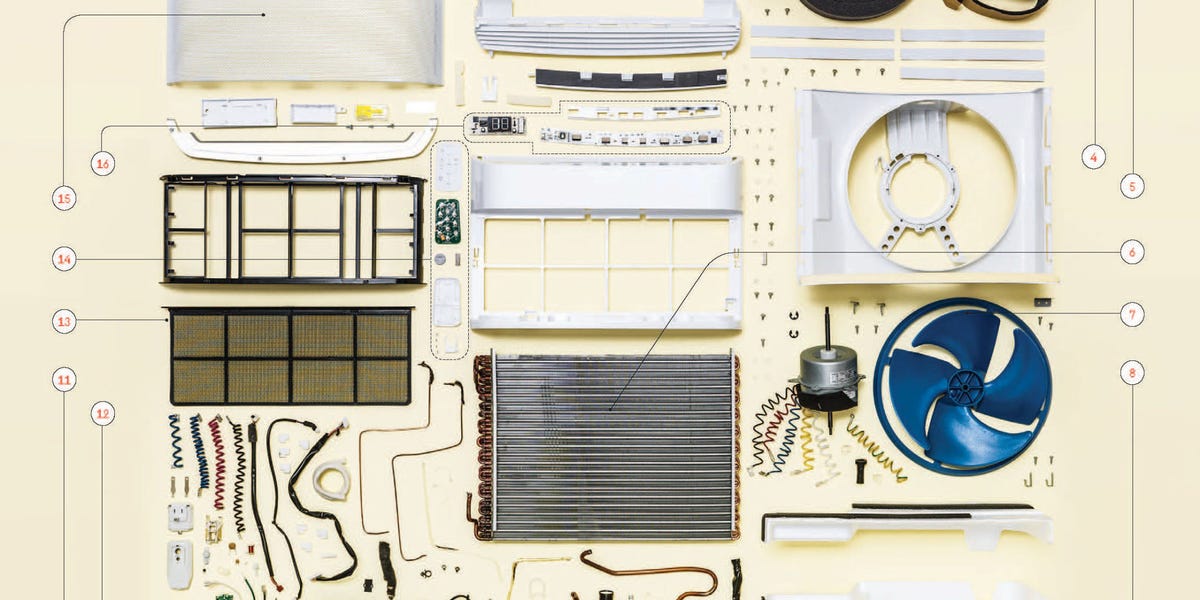
What happens when a familiar window unit becomes a neatly exploded map of metal, plastic, copper, airflow, refrigerant, and surprisingly good engineering?
Introduction: The Cool Box with a Secret Life
An air conditioner looks simple from across the room. It hums. It drips. It occasionally rattles like it has swallowed a handful of coins. You press a button, cold air arrives, and everyone stops melting into the couch. But inside that everyday machine is a carefully organized miniature weather factory.
The phrase Things Come Apart: Air Conditioner instantly suggests a teardown: a window AC unit opened up and arranged so every hidden part can finally introduce itself. The original Popular Mechanics feature spotlighted a Frigidaire Gallery 8,000 BTU window air conditioner, made in WuHu City, China, and disassembled in 2 hours, 27 minutes. That detail is oddly satisfying, like a cooking show for machinery: “Today, we’ll be reducing this appliance into one elegant pile of screws, coils, panels, and existential questions.”
This article does not encourage homeowners to take apart an air conditioner for sport. Refrigerant systems, capacitors, sharp fins, fan blades, and electrical components can be dangerous. Instead, we are going to do something safer and more useful: mentally take the air conditioner apart, understand what each piece does, and learn why maintenance, sizing, installation, and efficiency matter.
What “Things Come Apart” Reveals About an Air Conditioner
When an air conditioner is fully assembled, it hides its intelligence behind a plain grille. When it comes apart, the design becomes visible. You see the outer cabinet, screws, foam seals, fan blades, motors, copper tubing, aluminum fins, control board, thermostat sensor, compressor, evaporator coil, condenser coil, filter, drain pan, and wiring harnesses. Suddenly, the “cold box” becomes a mechanical orchestra.
The most interesting discovery is that an air conditioner does not really “make cold.” It moves heat. That sounds like a technical loophole invented by someone who enjoys correcting people at parties, but it is the heart of the machine. The indoor side absorbs heat from the room. The outdoor side rejects that heat outside. The refrigerant is the messenger running between them, changing pressure and temperature as it travels.
The Big Idea: Cooling Is Heat Transfer
Air conditioning is based on heat transfer. Heat naturally moves from warmer areas to cooler areas, but an AC system uses electricity, pressure changes, airflow, and refrigerant to push indoor heat outdoors. It is less like creating winter and more like hiring a tiny heat-moving delivery crew that never asks for lunch.
In a window air conditioner, the indoor and outdoor halves live in one compact cabinet. The front faces your room; the back hangs outside. In a central air conditioning system, those same jobs are split between the indoor air handler and the outdoor condenser unit. Different packaging, same basic mission: collect heat indoors, dump it outdoors, and keep humidity under control.
The Main Parts Inside a Window Air Conditioner
1. The Evaporator Coil: Where Indoor Heat Gets Captured
The evaporator coil sits on the indoor side of the unit. Warm room air passes across this cold coil, and heat moves from the air into the refrigerant inside the coil. Moisture in the air can also condense on the coil, which is why air conditioners help with humidity as well as temperature.
If the evaporator coil gets dirty, airflow drops and heat transfer suffers. The unit may run longer, cool poorly, or even develop ice. That is why filter maintenance matters. A neglected filter is not a personality quirk; it is a tiny sweater wrapped around your AC’s lungs.
2. The Compressor: The Hardworking Muscle
The compressor is one of the most important and expensive parts of the system. It pressurizes refrigerant vapor and helps move refrigerant through the cycle. In human terms, the compressor is the part of the air conditioner that wakes up, cracks its knuckles, and says, “Fine, I’ll do the heavy lifting.”
Because compressors work hard, they dislike bad airflow, incorrect refrigerant charge, dirty coils, overheating, and frequent short cycling. Many serious AC problems eventually end up bothering the compressor, which is why routine maintenance can save real money.
3. The Condenser Coil: Where Heat Gets Kicked Outside
The condenser coil lives on the outdoor side of a window AC or in the outdoor unit of a central system. After refrigerant absorbs indoor heat, it travels to the condenser, where the heat is released outside. The outdoor fan helps move air across the condenser coil so heat can escape efficiently.
Leaves, dust, lint, pollen, and debris can block the condenser coil. When that happens, the unit struggles to reject heat, and the compressor may run hotter. If your air conditioner sounds angry during summer, it may not be dramatic; it may simply be suffocating behind a blanket of grime.
4. The Expansion Device: The Tiny Pressure Gatekeeper
The expansion device controls refrigerant flow and drops refrigerant pressure before it enters the evaporator. Depending on the system, this may be a capillary tube, thermostatic expansion valve, or electronic expansion valve. It may look unimpressive, but its job is essential.
Think of it as the bouncer at the refrigerant nightclub. Too much flow, and the party gets messy. Too little flow, and nobody dances. Proper refrigerant metering helps the evaporator coil absorb heat efficiently.
5. Fans and Motors: The Air Movers
Without airflow, the refrigeration cycle cannot do much useful work. A window air conditioner usually contains fan components that move indoor air across the evaporator and outdoor air across the condenser. Central systems use blower motors and outdoor condenser fans for the same basic purpose.
Weak airflow may come from dirty filters, blocked grilles, bent coil fins, failing motors, clogged coils, or poor installation. Air conditioners are not shy about airflow problems; they show symptoms through weak cooling, strange noises, icing, longer run times, and higher energy bills.
6. Filter, Drain Pan, Seals, and Cabinet
The humble filter catches dust before it reaches the coil. The drain pan collects condensed moisture. The cabinet holds everything together. Window seals help prevent cool air from escaping and hot outdoor air from sneaking inside like it owns the place.
These “ordinary” parts matter more than many people realize. A poorly sealed window unit can waste energy. A clogged drain can cause water damage. A dirty filter can reduce efficiency and shorten equipment life. The small pieces are not accessories; they are part of the whole performance.
How the Air Conditioner Cooling Cycle Works
Here is the simplified version: indoor air gives up heat to the evaporator coil, refrigerant carries that heat to the compressor, the compressor raises the refrigerant’s pressure and temperature, the condenser rejects the heat outdoors, and the expansion device lowers the pressure so the refrigerant can absorb heat again.
This cycle repeats until the thermostat is satisfied. Then the unit pauses. Later, when the room warms up again, the system starts another round. It is basically a heat-moving loop with a thermostat acting as referee.
Why Humidity Matters
Air conditioners also remove moisture from indoor air. That matters because humid air feels warmer and heavier, even at the same temperature. A properly sized air conditioner runs long enough to pull moisture from the air. An oversized unit may cool the room quickly but shut off before it dehumidifies well, leaving the space chilly, damp, and weirdly cave-like.
This is one reason bigger is not always better. A massive AC in a small room can be like using a fire hose to water a houseplant. Technically powerful? Yes. Sensible? Not really.
Air Conditioner Sizing: BTU, Room Size, and Comfort
Cooling capacity is commonly measured in BTU per hour. A small bedroom may need a modest window unit, while a larger living room needs more capacity. Room size is the starting point, but it is not the whole story. Ceiling height, insulation, sun exposure, window area, kitchen heat, number of occupants, and local climate all affect the right size.
Many consumer guides recommend matching capacity carefully rather than buying the biggest unit available. Too small, and the air conditioner runs constantly while losing the battle. Too large, and it cycles quickly, wastes energy, and may not remove enough humidity.
Efficiency Ratings: EER, EER2, SEER2, and the Alphabet Soup
Room air conditioners are often compared using efficiency ratings such as EER or newer testing metrics. Central systems commonly use SEER2 and EER2 ratings. The general idea is simple: higher efficiency means more cooling for the electricity consumed.
ENERGY STAR certified room air conditioners often include better sealing instructions, improved insulation materials, smart features, and variable-speed technology. Variable-speed compressors can adjust output instead of simply turning fully on and fully off, which can improve comfort, reduce noise, and save energy.
Maintenance: Keeping the Cool Machine from Becoming a Dust Museum
If an air conditioner could talk, it would probably say, “Please clean my filter,” followed by, “No, seriously.” Filters are the easiest maintenance item to ignore and one of the most important. Dirty filters restrict airflow, reduce efficiency, and allow dirt to reach the evaporator coil.
During cooling season, filters should be checked regularly. Homes with pets, dust, heavy use, or allergy concerns may need more frequent attention. A washable filter should be cleaned and dried according to the manufacturer’s instructions. A disposable filter should be replaced with the correct size and type.
Coils, Fins, and Drain Channels
Evaporator and condenser coils need clean surfaces to transfer heat. Bent fins can block airflow. Drain channels must stay clear so condensed water can leave the unit properly. These issues sound small, but they can affect comfort, efficiency, noise, moisture control, and equipment life.
Homeowners can usually handle basic exterior cleaning and filter care, but sealed-system issues, refrigerant problems, electrical faults, damaged wiring, capacitor concerns, and deep internal service should be left to qualified HVAC technicians. Electricity and refrigerant are not the right ingredients for a weekend guessing game.
Installation Quality Matters
Proper installation is not just about making the unit fit. A window air conditioner must be supported, sealed, and positioned for safe drainage and airflow. A central air conditioner must be correctly sized, charged, ducted, and commissioned. Research from NIST has shown that poor HVAC installation can significantly reduce real-world efficiency. In plain English: even a great machine can perform badly if installed like a rushed school project.
Refrigerants and the Environmental Side of Cooling
Air conditioners rely on refrigerants to move heat, but refrigerants also matter environmentally. Older and higher-global-warming-potential refrigerants have been a major policy focus in the United States. The EPA’s HFC phasedown and technology transition rules are pushing the market toward lower-GWP alternatives in many cooling and heat pump applications.
For consumers, this means future air conditioners may use different refrigerants, and service practices may continue to evolve. It also means refrigerant handling should stay in professional hands. Releasing refrigerant is harmful, wasteful, and regulated. If your unit has a suspected leak, the answer is not “add mystery coolant and hope.” The answer is professional diagnosis.
What a Teardown Teaches About Product Design
The beauty of a “Things Come Apart” style teardown is that it turns an appliance into a lesson in design. Every screw, clip, bracket, gasket, wire, and coil has a purpose. Some parts are designed for strength. Some for airflow. Some for vibration control. Some for manufacturing speed. Some for service access. Some, apparently, are placed specifically to make future repair technicians sigh deeply.
A window AC is a compact compromise. It must fit in a window, withstand weather exposure, drain water, move air in two directions, keep indoor and outdoor airflow separated, reduce noise, support heavy components, meet electrical requirements, and still be affordable. That is a lot to ask from a box that many people buy in a hurry during the first brutal heat wave of summer.
Why Modern Units Look Different
Modern room air conditioners increasingly include smart controls, inverter or variable-speed technology, improved seals, quieter layouts, and U-shaped or saddle-style designs that place noisier components farther outside. These designs reflect a bigger trend: cooling is no longer just about brute-force cold air. It is about efficiency, sound, installation, comfort, connectivity, and energy management.
Common Air Conditioner Problems Seen Through the “Come Apart” Lens
Weak Cooling
Weak cooling may come from dirty filters, dirty coils, low airflow, poor sizing, refrigerant issues, thermostat placement, blocked vents, or a failing compressor. The teardown perspective helps because it reminds us that cooling is a system, not one magic part.
Water Leaks
Water around a window unit may point to drainage problems, improper tilt, clogged channels, or installation issues. Condensation is normal; indoor puddles are not. Your AC should not be creating a tiny indoor lake, no matter how committed it is to the summer theme.
Strange Noises
Rattling, buzzing, grinding, or squealing can indicate loose panels, worn fan parts, debris, motor issues, or electrical problems. Some noise is normal. A sound like a blender full of gravel deserves attention.
Short Cycling
Short cycling means the unit turns on and off too frequently. Causes can include oversizing, airflow restrictions, thermostat problems, electrical faults, or refrigerant issues. Short cycling wastes energy and stresses components.
Buying Tips Inspired by a Disassembled Air Conditioner
Before buying a room air conditioner, measure the space and choose an appropriate BTU capacity. Consider sunlight, ceiling height, insulation, room use, and whether the unit will cool a bedroom, office, living room, or kitchen. Check the electrical requirements before checkout, not after discovering the plug looks like it belongs to a spaceship.
Look for an accessible filter, clear installation instructions, quality sealing materials, good efficiency ratings, and a noise level that will not turn bedtime into an industrial documentary. Smart controls can be useful, but basic performance, proper sizing, and reliable installation matter more than an app you will forget after three weeks.
Window Unit, Portable Unit, or Central AC?
Window units are efficient for single rooms and relatively affordable. Portable units are flexible but often less efficient because they exhaust indoor air and need hose management. Central air conditioning cools the whole home but requires ducts, professional installation, and larger investment. Ductless mini-splits can be excellent for targeted zones, additions, and homes without ductwork.
The best choice depends on your home, budget, climate, and comfort goals. The wrong choice can still blow cold air, but it may do so loudly, expensively, or unevenly.
of Experience: Living with the Machine After the Teardown
The funny thing about air conditioners is that most people only think about them in two emotional states: gratitude and panic. Gratitude happens when you walk in from a blazing sidewalk and the room feels like a civilized planet again. Panic happens when the unit starts blowing warm air at 9:47 p.m. on the hottest night of the year, right when every HVAC company in town is already booked until the moon cools down.
My biggest experience-based lesson is that air conditioners reward boring habits. Cleaning the filter is boring. Checking the window seal is boring. Keeping furniture away from vents is boring. Making sure the outdoor side has airflow is boring. But these boring habits are exactly what keep the machine from becoming expensive, noisy, and dramatic. In home comfort, boring is beautiful.
A window air conditioner also teaches respect for installation. The first time you lift one, you realize “compact” does not mean “light.” A unit that looks manageable in a store can feel like a small refrigerator once you are balancing it near a window. Support brackets, secure placement, good sealing, and careful alignment matter. Cold air is great; a poorly supported air conditioner is not a design feature.
Another practical experience: noise changes how people judge cooling. A loud air conditioner may cool the room well, but if it roars through sleep, meetings, homework, or movie night, it becomes the villain. Many newer units focus on quieter operation, and that is not just a luxury. Comfort includes sound. A room can be 72 degrees and still feel unpleasant if the AC sounds like it is preparing for takeoff.
Humidity is another underrated part of the experience. People often chase lower thermostat settings when what they really want is drier air. A properly sized unit that runs steadily can feel better than an oversized unit that blasts cold air for a few minutes and quits. That clammy feeling is a clue. Temperature is only one piece of comfort; moisture is the sneaky second character.
There is also something satisfying about understanding what is inside the machine. Once you know the evaporator absorbs heat, the condenser rejects it, the compressor moves the refrigerant, and the filter protects airflow, the air conditioner stops being a mysterious box. You become better at noticing symptoms. Weak airflow suggests a filter or fan issue. Poor cooling with good airflow may point elsewhere. Water trouble makes you think about drainage. Rattles make you think about panels, mounting, or fan parts.
That does not mean you should become a kitchen-table HVAC surgeon. The best lesson from “Things Come Apart: Air Conditioner” is not that everything should be dismantled. It is that understanding the parts helps you respect the whole. Some maintenance is safe and simple. Some repairs require training, tools, and certification. Knowing the difference is part of being a smart homeowner.
In the end, an air conditioner is both ordinary and impressive. It sits in a window, gathers dust, hums through heat waves, and occasionally drips on the wrong side of the sill. But inside, it is performing a continuous heat-transfer trick that makes modern indoor life possible. When things come apart, the machine becomes less mysteriousand somehow more amazing.
Conclusion: A Cooler Appreciation for a Common Machine
Things Come Apart: Air Conditioner is more than a clever teardown title. It is an invitation to look at a familiar appliance with fresh curiosity. Behind the grille and cabinet is a compact system of coils, fans, refrigerant, controls, seals, drains, and electrical components working together to move heat out of your room.
Understanding those parts makes you a better buyer, a better maintainer, and a calmer person when the AC starts acting suspicious. Choose the right size. Keep airflow clean. Respect installation. Watch humidity. Do not ignore strange symptoms. And when the problem involves refrigerant, wiring, sealed components, or anything that feels beyond basic maintenance, call a qualified technician.
The air conditioner may look like a simple box, but once you mentally take it apart, you realize it is a compact lesson in physics, design, comfort, and summer survival. Not bad for a machine most of us only notice when it stops working.