The story of the USS Bonhomme Richard decommissioned is not just a headline about a Navy ship leaving service. It is a hard, smoky, expensive lesson in readiness, maintenance, leadership, fire safety, and the brutal math of modern naval power. One day, the amphibious assault ship was a major asset designed to move Marines, aircraft, vehicles, and supplies into crisis zones. After a catastrophic fire in July 2020, it became a case study in how quickly a billion-dollar warship can be lost while sitting at the pier.
Officially, the U.S. Navy decommissioned USS Bonhomme Richard (LHD 6) on April 15, 2021, after a ceremony at Naval Base San Diego on April 14. The ship had served nearly 23 years, carried Marines across the world, supported combat and humanitarian operations, and earned a place in modern Navy history. But its final chapter was shaped by a fire that burned for more than four days, damaged much of the ship, and left repair costs so high that scrapping became the Navy’s least painful option. In other words, the ship did not sail quietly into retirement. It left with smoke in the air, questions on the pier, and a very large bill on the table.
What Was the USS Bonhomme Richard?
The USS Bonhomme Richard was a Wasp-class amphibious assault ship, also known by its hull number, LHD 6. These ships are often described as small aircraft carriers, though that undersells their job. A Wasp-class ship is part floating airfield, part Marine Corps transport, part command center, part hospital, and part garage big enough to make any suburban homeowner deeply jealous.
Built by Ingalls Shipbuilding in Pascagoula, Mississippi, Bonhomme Richard was commissioned on August 15, 1998. It was the third U.S. Navy ship to carry the name, which traces back to John Paul Jones’ famous Revolutionary War frigate. The name honors Benjamin Franklin’s French pen name, “Bonhomme Richard,” often translated as “Good Man Richard.” The ship’s motto, inspired by Jones’ famous fighting spirit, fit its mission perfectly: go forward, carry Marines, and remain ready when the world gets messy.
As a Wasp-class amphibious assault ship, Bonhomme Richard could carry helicopters, MV-22 Osprey tiltrotor aircraft, AV-8B Harriers, landing craft, vehicles, supplies, and a large embarked Marine force. Its job was to help project American power from the sea, especially in places where a runway, port, or perfect invitation from world events could not be expected.
Why Was the USS Bonhomme Richard Important?
Bonhomme Richard was more than steel, wires, pipes, and flight deck markings. It was a key piece of the Navy-Marine Corps team. Amphibious assault ships are designed to put Marines ashore using aircraft and landing craft, support operations from offshore, and respond to crises without waiting for land bases to be available.
During its service life, Bonhomme Richard supported major missions, including operations connected to East Timor, Operation Enduring Freedom, Operation Iraqi Freedom, humanitarian relief after the 2004 Indian Ocean tsunami, and forward-deployed operations in the Indo-Pacific. In 2003, during Operation Iraqi Freedom, the ship helped move Marines and equipment into Kuwait and supported aviation operations into Iraq. Later, it served as a forward-deployed amphibious flagship in Sasebo, Japan, before returning to San Diego in 2018.
That résumé matters because the decommissioning of Bonhomme Richard did not remove an ordinary ship from the fleet. It removed a flexible, high-demand platform from a Navy already balancing global commitments, maintenance backlogs, and the growing strategic importance of the Indo-Pacific. Losing a ship like this is not like misplacing a wrench. It is more like losing the whole toolbox, the truck, and the guy who knows where the spare bolts are kept.
The July 2020 Fire That Changed Everything
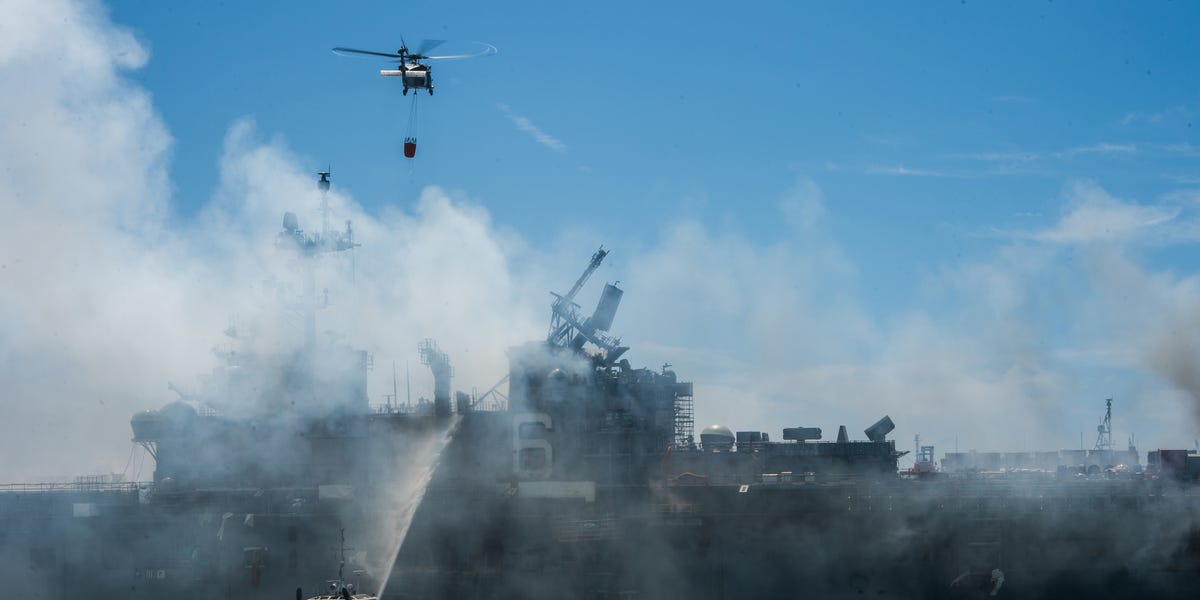
On July 12, 2020, USS Bonhomme Richard was moored at Naval Base San Diego while undergoing maintenance. A fire broke out in the lower vehicle storage area. At first, it appeared to be a shipboard casualty that could be attacked and contained. Instead, it spread rapidly and became one of the most serious non-combat warship fires in modern U.S. Navy memory.
The fire burned for more than four days. Sailors, federal firefighters, San Diego firefighters, nearby Navy crews, tugboats, and helicopters all joined the response. Helicopters dropped water over the ship. Firefighting teams battled intense heat, smoke, blocked access routes, and confusion inside a huge ship that was already torn apart by maintenance work. More than 60 sailors and civilians were treated for injuries such as smoke inhalation, heat exhaustion, and related conditions.
Maintenance status made the situation much worse. Ships in extended maintenance are uniquely vulnerable because systems may be tagged out, equipment may be removed, temporary services may run through passageways, and normal shipboard routines may be disrupted. Bonhomme Richard was in that dangerous in-between stage: not fully operational, not safely dormant, and filled with the kind of temporary conditions that make fire prevention and fast response much harder.
Why the Damage Was So Severe
The Navy’s later assessments found that the fire damaged critical areas, including the island, mast, flight deck, electrical systems, and internal spaces. Reports indicated that roughly 60 percent of the ship would have required replacement or major restoration. That is not a quick paint-and-polish job. That is the naval equivalent of saying, “The house is standing, but the kitchen, roof, wiring, plumbing, and half the walls are toast.”
One of the most painful details is that Bonhomme Richard had been undergoing a costly modernization period, including work related to operating newer aircraft such as the F-35B. Before the fire, the ship still had years of potential service ahead. After the fire, the Navy faced a difficult decision: spend billions and wait years to bring back a damaged 22-year-old ship, convert it for another mission, or decommission and salvage what could be saved.
In November 2020, the Navy announced its decision. Repairing the ship could have cost between about $2.5 billion and $3.2 billion and taken five to seven years. Converting the ship for another purpose, such as a hospital ship or command-and-control platform, could still have exceeded $1 billion. Decommissioning, while painful, was far cheaper and faster. The math was ugly, but clear.
USS Bonhomme Richard Decommissioned: The Official End
The Navy held a decommissioning ceremony for USS Bonhomme Richard at Naval Base San Diego on April 14, 2021. Attendance was limited because of COVID-19 precautions, which gave the ceremony a quieter tone than a ship with such a dramatic life might otherwise have received. The next day, April 15, 2021, the ship was officially decommissioned and stricken from the Naval Vessel Register.
After decommissioning, the hull was towed away from San Diego toward the Gulf Coast for dismantling. The former warship eventually went to Texas for scrapping. Useful systems and components were removed where possible, and some parts were saved for training purposes. Even in retirement, pieces of the ship continued to serve by helping Marines and sailors learn skills for real-world operations.
The phrase USS Bonhomme Richard decommissioned sounds tidy, almost administrative. In reality, it marked the end of a long operational career, the loss of a major amphibious asset, and the beginning of years of discussion about Navy fire safety, accountability, shipyard readiness, and risk management.
What Investigations Found After the Fire
The fire led to multiple investigations, including a command investigation and a major fires review. The findings were uncomfortable. Investigators identified problems in training, readiness, equipment status, communication, oversight, and coordination between shipboard crews and shore-based firefighting organizations.
One major conclusion was that the ship’s crew was not adequately prepared to respond to the fire during the maintenance period. The investigation pointed to degraded firefighting readiness, insufficient familiarity with procedures, poor oversight, and failures that accumulated over time. In simple terms, the fire was not just a single bad moment. It was a chain of missed opportunities, weak controls, and risk that had been allowed to pile up like laundry before inspection day.
A sailor, Ryan Sawyer Mays, was charged in connection with the fire, but in September 2022 he was acquitted at court-martial. The acquittal reinforced a key point for readers trying to understand the case: while the Navy investigation described the fire as intentionally set, the criminal case did not produce a conviction. The broader institutional lessons remained. Even if a spark starts a fire, readiness determines whether that fire becomes a casualty or a catastrophe.
The Cost of Losing Bonhomme Richard
The financial cost was enormous. A major amphibious assault ship represents billions of dollars in national investment when construction, upgrades, maintenance, crew training, aircraft integration, and operational value are considered. Repair estimates as high as $3.2 billion made restoration difficult to justify, especially because the work would have competed with other shipbuilding and maintenance priorities.
The operational cost was also significant. Amphibious assault ships are high-demand platforms. They support Marine Expeditionary Units, crisis response, aviation operations, humanitarian assistance, evacuation missions, and deterrence. Losing Bonhomme Richard meant the Navy had one fewer large-deck amphibious ship available at a time when U.S. strategy increasingly focused on the Indo-Pacific and distributed maritime operations.
Then there was the human cost. Sailors fought the fire for days. Many had served aboard the ship with pride. Some were injured. Many saw a command, workplace, and second home disappear in a way no crew wants to witness. A ship is not just inventory. For the people assigned to it, it is routine, identity, stress, laughter, duty, and a thousand small memories stacked between steel bulkheads.
Why Decommissioning Was the Navy’s Practical Choice
The Navy’s decision to decommission USS Bonhomme Richard came down to practicality. A repair project costing billions of dollars and lasting up to seven years would have tied up shipyard capacity that the Navy badly needed elsewhere. Modern naval maintenance is already a tight system. Adding a massive restoration job for a severely damaged ship would have created pressure across the fleet.
The ship was also more than two decades old. Although large Navy vessels can serve for many years, the return on investment had to be weighed against the cost of building or maintaining other ships. Spending billions to revive Bonhomme Richard might have looked heroic, but naval strategy is not a movie scene where the damaged champion gets rebuilt in a dramatic montage. It is budgets, schedules, shipyard labor, steel availability, and hard choices.
Decommissioning allowed the Navy to recover usable equipment, reduce further spending, and focus on preventing similar disasters. It was not a happy outcome, but it was the outcome Navy leaders judged most responsible.
Lessons From the USS Bonhomme Richard Fire
Fire Safety During Maintenance Must Be Treated as a Combat Skill
One major lesson is that shipboard fire safety cannot relax just because a ship is pier-side. In some ways, a ship in maintenance may be more vulnerable than a ship at sea. Systems may be offline, access routes may be blocked, and the crew may be smaller or less practiced. Fire drills, equipment checks, and watchstanding discipline cannot become paperwork theater.
Leadership and Oversight Matter Before the Emergency
When disaster strikes, everyone notices the response. But the real story often begins weeks or months earlier. Were inspections honest? Were hazards removed? Were drills realistic? Did leaders understand the risk? The Bonhomme Richard fire showed that oversight failures can create the conditions for disaster long before anyone smells smoke.
Big Ships Are Hard to Replace
The decommissioning also reminded defense planners that ships are not quickly replaced. A large amphibious assault ship takes years to build, crew, train, maintain, and integrate into fleet operations. Losing one unexpectedly creates a readiness gap that spreadsheets can describe but cannot magically fill.
How the Navy Responded Afterward
After the fire, the Navy took steps to improve fire safety across ships and shore installations. These actions included additional assessments, renewed focus on ships in maintenance availability, and stronger attention to compliance with fire-safety regulations. The goal was not merely to explain what happened to Bonhomme Richard, but to prevent the next shipboard fire from becoming another billion-dollar disaster.
Fire prevention is not glamorous. Nobody writes action movies about properly stored rags, inspected hoses, trained watch teams, and working alarms. But those details save ships. The Bonhomme Richard case showed that the small boring things are often the big heroic things before the emergency begins.
Why the Story Still Matters
The story of USS Bonhomme Richard decommissioned still matters because it sits at the crossroads of naval readiness, taxpayer cost, military accountability, and national security. It asks uncomfortable questions: How prepared are ships during maintenance? How well do crews and shore teams coordinate? How quickly can the Navy replace lost capacity? How much risk hides inside routine procedures?
For military readers, the story is a reminder that damage control is not a side duty. For taxpayers, it shows how fragile expensive national assets can be when systems fail. For defense planners, it highlights the strain on shipyards and the difficulty of balancing repair, modernization, and new construction. For everyone else, it is a dramatic example of how a disaster can unfold not in battle, but at home, tied to the pier.
Experiences and Practical Reflections Related to USS Bonhomme Richard Decommissioned
To understand the experience behind the USS Bonhomme Richard decommissioning, imagine the atmosphere around a naval base after a major shipboard fire. There is the visible damage: smoke-stained steel, warped structures, hoses across the pier, and exhausted responders. But there is also the invisible damage: uncertainty among the crew, frustration among leaders, and the strange grief that comes when a ship has survived war zones and deployments only to be lost during maintenance at home.
For sailors, a ship becomes a floating neighborhood. You learn its noises, its smells, its awkward ladders, its best quiet corners, and the places where coffee tastes slightly less tragic at 0300. When a ship is decommissioned after a disaster, the crew does not simply “move on” like someone changing office desks. They carry the experience to new commands. Some carry pride in how hard they fought. Some carry disappointment over what went wrong. Many carry both.
There is also a practical experience for anyone who works in safety, maintenance, logistics, construction, or emergency planning: disasters rarely arrive wearing a name tag. The Bonhomme Richard fire shows how risk builds quietly. A blocked passageway, an offline system, unclear communication, missing equipment, or a crew not fully drilled for a maintenance-period emergency may seem manageable in isolation. Together, they can become the difference between a contained incident and a total loss.
The ship’s decommissioning also offers a leadership lesson. Leaders cannot inspect everything personally, but they set the tone for what gets taken seriously. If fire safety becomes routine checklist behavior, people treat it as background noise. If leaders ask hard questions, walk spaces, demand realistic drills, and reward honest reporting, the culture changes. A ship does not become safe because a binder says it is safe. It becomes safer because people behave as if the next emergency could happen today.
For the public, the experience is a reminder that military readiness is not only about advanced jets, missiles, and dramatic deployments. It is also about maintenance discipline, industrial capacity, training time, spare parts, and people who know how to respond when alarms sound. The loss of Bonhomme Richard turned an amphibious assault ship into a national lesson: readiness is built in ordinary moments, long before crisis makes it famous.
There is even a human metaphor in the ship’s end. Bonhomme Richard carried a name associated with fighting against impossible odds. During the fire, sailors and firefighters did fight. They kept the hull afloat, protected nearby ships, and prevented an even worse disaster. The ship was still lost, but the effort was not meaningless. Sometimes the lesson is not that every battle can be won. Sometimes the lesson is that the next battle must be prepared for better.
Conclusion
The decommissioning of USS Bonhomme Richard was a sobering moment for the U.S. Navy. The ship had served across the globe, supported Marines, participated in combat and humanitarian missions, and represented nearly 23 years of naval capability. Yet a fire during maintenance led to damage so extensive that repair was judged too costly and time-consuming.
In the end, the Navy chose decommissioning over restoration. That decision closed the career of one ship but opened a larger conversation about fire safety, accountability, shipyard risk, and fleet readiness. The Bonhomme Richard story is dramatic, expensive, and painful, but it is also useful. It reminds us that military power depends not only on what a ship can do at sea, but on how carefully it is protected when tied to the pier.
Note: This article is based on publicly available official U.S. Navy information, defense reporting, government records, and reputable U.S. news analysis. Source links are not inserted per publishing requirements.