Note: This article is written in standard American English for web publication and is based on real, research-informed elementary math practices.
Why Number Sense Matters More Than “Getting the Answer”
Ask an elementary student what 8 + 7 equals, and you may get a fast “15.” Excellent. Applause. Tiny parade. But ask how they know, and the real story begins. A student with strong number sense might say, “I know 7 is 2 away from 5, so I moved 2 from 7 to make 10, then added 5.” Another might say, “Double 7 is 14, so 8 + 7 is one more.” A third may draw dots, use a ten-frame, or picture a number line. Same answer, different brain fireworks.
That is the heart of building students’ number sense in elementary math: helping children understand numbers as flexible, meaningful quantities instead of mysterious symbols marching across a worksheet. Number sense is not a single lesson, a cute poster, or a Friday activity squeezed between spelling tests and the class hamster’s dramatic escape attempt. It is a way of thinking that grows through daily routines, rich conversations, visual models, hands-on practice, and many chances to explain, compare, estimate, and revise.
In the elementary grades, number sense supports counting, place value, addition, subtraction, multiplication, division, fractions, mental math, estimation, and problem-solving. In other words, it is not the sprinkles on the math cupcake. It is the cupcake. Without it, students may memorize procedures for a while, but the moment numbers appear in a new format, everything gets wobbly. With it, students become more confident, more curious, and far less likely to treat math like a haunted house with pencils.
What Is Number Sense?
Number sense is a student’s ability to understand numbers, relationships, operations, and quantities in flexible ways. It includes knowing that 25 is more than 19, seeing 100 as ten tens, understanding that 6 × 4 can be thought of as 4 + 4 + 4 + 4 + 4 + 4, and recognizing that 1/2 is larger than 1/4 even though the digit 4 looks bigger than the digit 2. Sneaky fractions, always trying to start drama.
Students with strong number sense do not simply follow steps. They make sense of numbers. They notice patterns. They estimate before calculating. They can explain why an answer is reasonable or unreasonable. They understand that numbers can be composed and decomposed, which means they can be broken apart and put back together in useful ways.
Number Sense Looks Like This
In a first-grade classroom, number sense might look like students using counters to show that 8 can be made as 5 and 3, 4 and 4, or 6 and 2. In third grade, it might look like students solving 36 + 29 by thinking 36 + 30 – 1. In fifth grade, it might look like students placing 3/5 on a number line and explaining why it belongs between 1/2 and 1.
The goal is not to make every child use the same strategy. The goal is to help students choose strategies that make sense. When children understand numbers deeply, they stop asking, “What trick do I use?” and start asking, “What does this number mean?” That question is where real math learning begins.
The Building Blocks of Number Sense in Elementary Math
Number sense develops over time, but it grows faster when teachers intentionally build it through connected experiences. The most important foundations include counting, cardinality, subitizing, place value, number relationships, operations, estimation, and math language.
1. Counting With Meaning
Counting is more than reciting “one, two, three” like a tiny auctioneer. Students need to understand one-to-one correspondence, which means each object gets one number word. They also need cardinality, the idea that the last number counted tells how many objects are in the set. A child who counts five cubes and then says “five” understands something powerful: numbers represent quantity.
2. Subitizing
Subitizing is the ability to recognize small quantities without counting one by one. When students see five dots on a die and instantly know it is five, they are subitizing. This skill helps children see groups, patterns, and combinations. Dot cards, dominoes, dice, and ten-frames are excellent tools for developing this early number sense.
3. Place Value Understanding
Place value is where many students either build a strong foundation or start quietly packing their bags for Confusion City. Students need to understand that the digit 4 in 47 means four tens, not just “a 4 sitting next to a 7.” Base-ten blocks, place value charts, expanded form, number lines, and bundling activities help students connect digits to quantities.
4. Flexible Thinking With Operations
Students should learn that addition, subtraction, multiplication, and division are connected. Addition joins quantities. Subtraction compares or separates. Multiplication can represent equal groups, arrays, or scaling. Division can mean sharing or grouping. When students see these relationships, math facts become more than flashcard survival training.
5. Estimation and Reasonableness
Estimation teaches students to pause and think before calculating. If a student solves 48 + 51 and gets 811, number sense should gently tap them on the shoulder and say, “Friend, we need to talk.” Estimation helps students judge whether answers make sense, which is a key skill for both school math and real life.
Practical Strategies for Building Number Sense
Number sense improves when students interact with numbers in many forms: spoken, written, visual, physical, and contextual. The following classroom strategies are simple, powerful, and easy to adapt across grade levels.
Use Number Talks Daily
A number talk is a short classroom routine where students solve a problem mentally and explain their strategies. For example, the teacher might write 19 + 16 and ask, “How did you solve it?” One student may make 20 by moving 1 from 16 to 19, then add 15. Another may add 10, then 6. Another may use doubles by thinking 17 + 17 and adjusting.
The magic is not in the problem itself. The magic is in the discussion. Students learn that there are multiple valid ways to solve problems. They also learn to listen, compare, and refine their thinking. Number talks turn the classroom into a place where math is not just performed but understood.
Make Number Lines a Classroom Habit
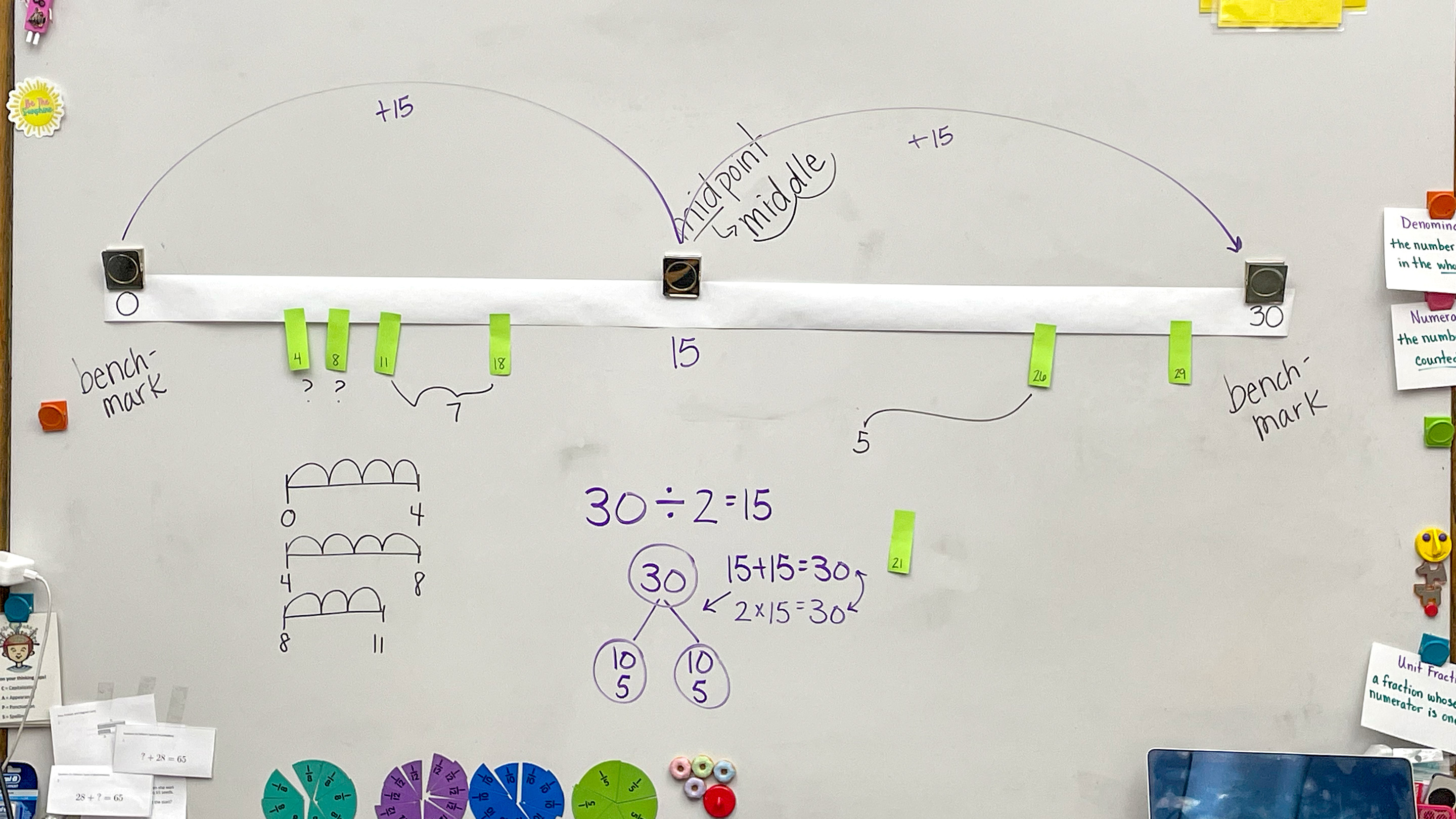
Number lines help students see magnitude, distance, order, and relationships. They are especially useful because they grow with students. In kindergarten, a number line may show whole numbers from 0 to 10. In second grade, it may support addition and subtraction jumps. In fourth and fifth grade, it may represent fractions, decimals, and negative numbers.
To build number sense, ask students to place numbers on an empty number line. Where would 48 go between 0 and 100? Where does 3/4 belong between 0 and 1? Why? This encourages reasoning instead of simply labeling tick marks like a math robot with excellent handwriting.
Use Visual Models Before Abstract Symbols
Students need to see and touch numbers before they are expected to manipulate them abstractly. Ten-frames, counters, cubes, rekenreks, arrays, fraction strips, base-ten blocks, and area models help students connect concrete experiences to written equations.
For example, before teaching 6 × 7 as a fact to memorize, show it as six groups of seven, seven groups of six, an array, and a decomposed problem such as 5 × 7 + 1 × 7. This helps students understand multiplication as structure, not just a chant.
Encourage Decomposing and Recomposing Numbers
Flexible number sense depends on the ability to break numbers apart and put them together. Students might learn that 14 can be 10 + 4, 7 + 7, 12 + 2, or 20 – 6. These relationships make mental math easier and help students understand operations more deeply.
Try asking questions like, “How many ways can we make 20?” or “What is a friendly way to break apart 37?” Friendly numbers, such as 10, 50, and 100, give students useful landmarks. Think of them as rest stops on the highway of calculation.
Teaching Math Facts Without Turning Math Into a Speed Contest
Math fact fluency matters, but fluency is not the same as speed alone. True fluency includes accuracy, efficiency, flexibility, and understanding. A student who can quickly answer 9 + 6 but has no idea why may perform well on a timed test but struggle when the problem appears in a word problem, a fraction task, or a multi-step situation.
Instead of relying only on timed drills, teachers can build fact fluency through patterns and relationships. For addition, students can use doubles, near doubles, making ten, and counting on. For multiplication, students can use arrays, skip counting, known facts, and the distributive property. If a student knows 5 × 8 = 40, then 6 × 8 is one more group of 8, or 48. Look at that: multiplication just used common sense and did not even need a cape.
Games That Build Fluency
Games are especially helpful because they provide repeated practice without making students feel like they are trapped in a worksheet factory. Try “Make 10” with cards, dice games for addition combinations, array-building challenges, or “closest estimate wins” activities. The best games require students to think, explain, and adjust strategiesnot just race.
How Teachers Can Support Struggling Math Learners
Some students need more time, more structure, and more explicit instruction to build number sense. That does not mean they are “bad at math.” It means they need clearer pathways into mathematical ideas. Elementary math instruction should include modeling, guided practice, visual supports, frequent review, and opportunities for students to explain their reasoning in low-pressure ways.
Use the Concrete-Representational-Abstract Sequence
One effective approach is moving from concrete materials to visual representations and then to abstract symbols. For example, students might first use base-ten blocks to model 23 + 18. Next, they draw tens and ones. Finally, they write the equation and explain the regrouping. This sequence helps students understand what the symbols mean instead of memorizing steps that feel like secret adult code.
Ask Better Questions
Questions shape thinking. Instead of asking only, “What is the answer?” try asking:
- “How did you know?”
- “Can you solve it another way?”
- “What number helped you?”
- “Is your answer reasonable?”
- “What pattern do you notice?”
These questions send an important message: math is about reasoning. They also give teachers valuable information about what students understand and where misconceptions are hiding.
Number Sense Across the Elementary Grades
Building number sense is not a one-year mission. It should develop across grade levels in a connected progression.
Kindergarten and Grade 1
Students focus on counting, comparing numbers, recognizing small groups, composing and decomposing numbers, and understanding addition and subtraction as real actions. They should use objects, drawings, fingers, songs, ten-frames, and classroom routines. Yes, fingers are allowed. Fingers are not cheating; they are built-in manipulatives with excellent portability.
Grades 2 and 3
Students deepen place value, develop addition and subtraction strategies, begin multiplication and division, and use arrays and equal groups. They should explore why strategies work and how operations connect. This is also a great stage for number talks, estimation routines, and open-ended tasks.
Grades 4 and 5
Students extend number sense to multi-digit operations, fractions, decimals, factors, multiples, and problem-solving. Number lines, area models, fraction strips, and real-world contexts become especially important. Students should compare fractions, estimate decimal sums, and reason about multiplication as scaling. This helps prepare them for middle school math without making algebra feel like it arrived from another planet.
Common Mistakes That Weaken Number Sense
Even well-meaning instruction can accidentally limit number sense. One common mistake is teaching procedures too early without enough conceptual exploration. When students learn “borrow from the neighbor” before understanding place value, they may follow steps but miss the meaning. Another mistake is praising speed more than reasoning. Fast answers are useful, but fast wrong answers are just wrong with confidence.
A third mistake is treating manipulatives as only for young students or struggling learners. Visual and hands-on models support all learners because they make mathematical structure visible. A fifth grader comparing fractions may benefit from fraction strips just as much as a first grader benefits from counters.
Finally, teachers should avoid making math feel like a guessing game where the teacher holds the one correct method. Students need to know that strategies can be compared, tested, and improved. A classroom rich in number sense sounds like thinking: “I noticed,” “I disagree because,” “I solved it another way,” and “That answer cannot be right because…” Music to a math teacher’s ears.
Family-Friendly Ways to Build Number Sense at Home
Families do not need fancy materials to support number sense. Everyday life is already full of math. Cooking, shopping, setting the table, sorting laundry, counting coins, reading clocks, comparing prices, and sharing snacks all create opportunities to talk about numbers.
Parents can ask simple questions: “We need six plates, and we already have four. How many more?” “This costs about $3 and that costs about $5. About how much altogether?” “You ate half of your sandwich. Is that more or less than one-fourth?” These conversations show children that numbers are useful tools, not just school decorations.
The most important home strategy is to keep the tone positive. Saying “I was never a math person” may sound harmless, but children hear it. A better message is, “Math takes practice, and we can figure it out together.” Confidence is not built by pretending math is always easy. It is built by showing that struggle is part of learning.
Classroom Experience: What Building Number Sense Looks Like in Real Life
One of the clearest signs that number sense is growing is the moment students stop waiting for permission to think. In many elementary classrooms, children begin the year believing math means choosing the right operation and getting the answer as quickly as possible. They look at the teacher after every step, hoping for the sacred nod. But when number sense routines become part of daily instruction, the classroom changes. Students begin to take ownership of numbers.
For example, during a second-grade number talk, a teacher writes 38 + 27 on the board. At first, several students may try to stack the numbers in their heads. Some may get lost. But after weeks of practice, hands begin to rise with different strategies. One student says, “I made 38 into 40 by taking 2 from 27, so it became 40 + 25.” Another says, “I added 30 + 20, then 8 + 7.” A third student notices that both methods arrive at 65. The important part is not only the answer. It is that students are listening to one another and realizing that numbers can move, stretch, split, and reconnect.
In a kindergarten classroom, the experience looks different but feels just as powerful. The teacher flashes a ten-frame for three seconds and asks, “How many did you see?” A student says, “Seven.” The teacher asks, “How did you see it?” The child replies, “Five on top and two more.” That short answer reveals a major shift. The student is not counting every dot. The student is seeing structure. That is number sense in its early superhero costume.
In upper elementary grades, the same idea appears with fractions. A fourth-grade teacher asks students to place 5/8 on an empty number line. Some students first want to count tick marks, but the teacher asks them to reason. Is 5/8 more or less than 1/2? How do you know? One student explains that 4/8 equals 1/2, so 5/8 is just a little more. Another student connects it to money: “It is like more than 50 cents if the whole dollar is divided into eight parts.” These connections make fractions less frightening and more logical.
Teachers often notice that number sense grows best when mistakes are welcomed as information. If a student says 3/4 is smaller than 2/4 because 3 is bigger and “bigger numbers mean smaller pieces,” the teacher has uncovered a misconception worth exploring. Instead of simply correcting the student, the class can model both fractions with strips, draw them on a number line, and discuss what the numerator and denominator mean. The mistake becomes a doorway.
Another real classroom experience is the power of repetition with variety. Students may use ten-frames in September, rekenreks in October, number lines in November, and mental math strings all year. The routine feels familiar, but the numbers change. This balance helps students feel safe enough to think deeply. They are not relearning directions every day; they are applying ideas in fresh ways.
The best part is watching students become braver. A child who once whispered answers may begin saying, “I solved it a different way.” A student who used to erase immediately may pause and check reasonableness. A class that once treated math as answer-hunting starts treating it as sense-making. That is the real reward of building number sense in elementary math: students do not just calculate better. They think better.
Conclusion: Number Sense Is the Foundation of Confident Math Learning
Building students’ number sense in elementary math is one of the most important investments teachers can make. It supports fact fluency, problem-solving, place value, fractions, estimation, and mathematical confidence. More importantly, it helps students see math as something that makes sense.
When classrooms make room for number talks, visual models, number lines, manipulatives, estimation, games, and student explanations, children learn that math is not a pile of rules dropped from the sky. It is a connected system of ideas they can explore, discuss, and understand. And when students understand numbers, they are better prepared for every math challenge aheadfrom multi-digit division to fractions to algebra and beyond.
Strong number sense does not happen overnight. It grows through small, consistent experiences. A dot card here. A number talk there. A good question. A useful model. A mistake turned into a conversation. Over time, those moments add up. And unlike the mystery of where all the classroom pencils disappear, this is one classroom transformation teachers can actually explain.