Propeller thrust is one of those numbers that looks wonderfully simple until you actually try to measure it. A motor spins, a propeller screams, the bench shakes, your dog leaves the room, and suddenly a neat little spec-sheet promise turns into a suspicious pile of watts, grams, RPM, and “why is this thing vibrating like a blender full of bolts?”
Whether you are building a drone, tuning an RC airplane, designing a small UAV, testing a boat prop, or simply trying to understand why one propeller feels heroic and another feels like an expensive fan, the real question is the same: how much thrust is your prop really making?
The answer is not just “whatever the manufacturer says.” Propeller thrust depends on air density, prop diameter, pitch, blade design, RPM, motor torque, battery voltage, ESC behavior, temperature, test setup, and whether the propeller is sitting still on a bench or moving through the air. In other words, your prop is not lying to you, but it does enjoy making the truth complicated.
What Propeller Thrust Actually Means
At its simplest, thrust is force. A propeller creates thrust by accelerating air in the opposite direction of travel. If the propeller pushes air backward, the aircraft, drone, or vehicle gets pushed forward. This is Newton’s third law wearing a spinning hat.
A useful way to think about propeller thrust is this: thrust depends on how much air the propeller moves and how much it changes that air’s velocity. A large propeller moving a big column of air slowly can make strong, efficient thrust. A small propeller moving a smaller column of air very quickly can also make thrust, but it may need more RPM and more power to do it.
This is why a big slow prop often works beautifully on an efficient aircraft, while a small high-speed prop may suit a racing quad or compact drone. Both can be correct. Both can also be hilariously wrong if matched with the wrong motor, battery, or airframe.
The Basic Propeller Thrust Formula
Engineers often describe static propeller thrust with a relationship like this:
In that formula, T is thrust, Ct is the thrust coefficient, ρ is air density, n is rotations per second, and D is propeller diameter. Do not worry if the equation looks like it escaped from a math textbook. The main lesson is surprisingly practical: diameter matters a lot, RPM matters a lot, and the propeller’s design matters more than a simple size label can tell you.
Notice the D⁴ term. Diameter is raised to the fourth power, which means a small change in prop diameter can create a very large change in potential thrust. Going from a 9-inch prop to a 10-inch prop is not just “one more inch of whoosh.” It can dramatically increase load on the motor and ESC. That extra whoosh may arrive with extra heat, extra current draw, and the exciting smell of electronics reconsidering their life choices.
Diameter, Pitch, and Why Prop Labels Can Mislead You
Most RC and drone propellers are labeled with diameter and pitch. A 10×4.5 prop is usually 10 inches in diameter with 4.5 inches of pitch. Pitch is the theoretical distance the propeller would move forward in one revolution if it were traveling through a solid material, like a screw through wood. Air, unfortunately, is not wood. Air slips, swirls, compresses slightly, and generally refuses to behave like a perfect spreadsheet.
Diameter
Diameter determines the size of the disk of air the propeller sweeps. Larger diameter usually means more thrust at lower RPM, assuming the motor can handle the load. This is why long-endurance aircraft often use larger props and lower motor speeds. They want efficient thrust, not a tiny propeller auditioning for a dentist drill.
Pitch
Pitch affects how aggressively the propeller tries to move air. Higher pitch can increase speed potential, but it also increases load. If the pitch is too high for the motor, RPM drops, current rises, and thrust may not improve. A higher-pitch prop can look powerful on paper and still perform poorly in a real setup.
Blade Count
More blades can increase disk loading and help when prop diameter is limited, which is why tri-blade props are popular on some drones. But extra blades also add drag and demand more torque. A three-blade prop is not automatically better than a two-blade prop; it is simply a different compromise wearing an extra blade.
Static Thrust vs. Real Flight Thrust
One of the biggest mistakes builders make is treating static thrust as the whole truth. Static thrust is measured when the propeller is not moving forward through the air. This is useful for drones, hover testing, takeoff estimates, and comparing motor-prop combinations. But it is not the same as thrust in forward flight.
When an airplane or fixed-wing UAV moves forward, air is already entering the propeller. This changes the propeller’s angle of attack, load, efficiency, and thrust output. Engineers describe this with the advance ratio, which compares forward speed with propeller rotational speed and diameter. At different advance ratios, the same propeller can behave very differently.
For multirotors, static thrust is more relevant because hover is close to a static condition. Even then, the real aircraft introduces complications: arms disturb airflow, one propeller may eat another propeller’s wake, the frame blocks air, and the ground can create cushion effects during low-altitude testing. Your bench number is useful, but it is not a magic prophecy.
How to Measure Propeller Thrust Properly
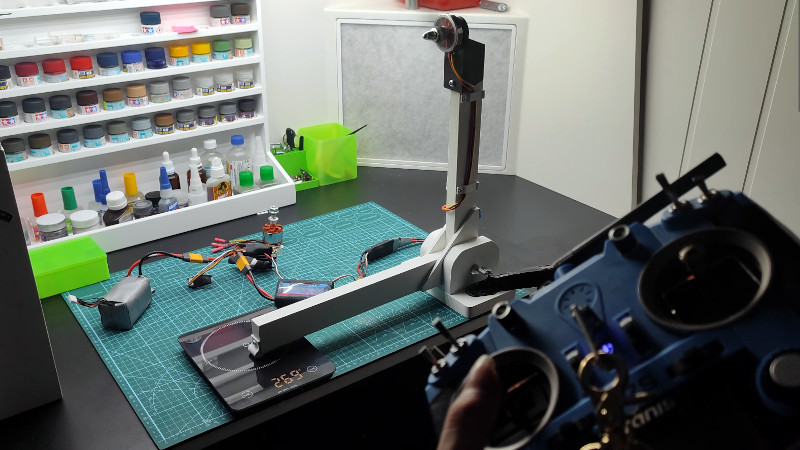
The most practical way to measure propeller thrust is with a thrust stand. A thrust stand holds the motor and propeller securely while a load cell measures force. Better test stands also record RPM, voltage, current, torque, temperature, and sometimes vibration. This gives you a real performance picture instead of one lonely thrust number waving from a spreadsheet.
What You Need
A solid propeller thrust test setup usually includes a rigid frame, a calibrated load cell, a motor mount, an ESC, a power source, an RPM sensor, a watt meter or power analyzer, and safe propeller clearance. For deeper testing, torque measurement is extremely useful because it allows you to calculate shaft power and propeller efficiency more accurately.
For hobby use, even a simple digital scale setup can reveal useful comparisons, but it must be built carefully. If the stand flexes, sticks, vibrates, or measures force at an angle, your results can become decorative fiction. A thrust stand should be stiff, repeatable, and calibrated with known weights before testing.
Test Procedure
Start by balancing the propeller. Mount it in the correct orientation. Confirm that the motor rotation direction is correct. Secure the entire stand so it cannot walk across the bench like a caffeinated crab. Then zero the load cell or scale before powering the system.
Increase throttle gradually and record thrust, RPM, voltage, current, and power at several throttle points. Do not only test full throttle. A propeller that looks mediocre at 100% may be efficient at 50% or 60%, which is where your aircraft spends most of its life. For drones, mid-throttle efficiency often matters more than heroic full-throttle thrust. For airplanes, cruise efficiency is usually more important than bench-racing numbers.
Understanding Thrust-to-Weight Ratio
For drones and VTOL aircraft, thrust-to-weight ratio is a key design number. If a quadcopter weighs 1,000 grams and the four motors together produce 2,000 grams of thrust, the aircraft has a 2:1 thrust-to-weight ratio. That means it has enough authority to hover comfortably, climb, recover from maneuvers, and handle some wind or payload variation.
A common rule of thumb is that a general-purpose multirotor should have at least a 2:1 thrust-to-weight ratio. Racing and freestyle drones often use much higher ratios. Heavy-lift or endurance platforms may be designed more conservatively, but they still need enough excess thrust for safe control. A drone that can barely hover at full throttle is not “efficient.” It is a flying stress test with propellers.
For fixed-wing aircraft, thrust-to-weight is still useful, but it does not tell the whole story. Wing lift, drag, propeller efficiency in forward flight, climb rate, and airspeed matter. A fixed-wing airplane does not need to hover unless you are building a 3D aerobatic machine or trying to impress people at the flying field.
Why Manufacturer Thrust Numbers May Not Match Yours
Manufacturers usually test under specific conditions: a particular motor, ESC, voltage, battery quality, prop orientation, air density, and test stand. Change any of those and the result changes. Sometimes the difference is small. Sometimes it is the kind of difference that makes you reread the product listing with narrowed eyes.
Battery Voltage Sag
A fully charged 4S LiPo may begin around 16.8 volts, but voltage drops under load. If your battery sags badly, RPM falls and thrust drops. Two batteries with the same cell count can produce different thrust because one maintains voltage better under high current.
ESC Timing and Firmware
Electronic speed controllers do not all drive motors the same way. Timing, PWM frequency, firmware, current limits, and thermal protection can affect RPM and power delivery. A motor-prop combination tested on one ESC may behave differently on another.
Air Density
Air density changes with altitude, temperature, humidity, and pressure. Hot, high-altitude air is thinner, which reduces thrust. This is why a drone that feels punchy on a cool morning may feel lazy on a hot afternoon. The propeller did not forget how to work; the air simply brought fewer molecules to the party.
Propeller Flex
Plastic propellers can deform at high RPM. Under load, the blade may twist, flatten, or flutter slightly. Carbon fiber props are usually stiffer, but they can introduce other issues such as sharper vibration transmission and higher damage risk. Blade stiffness affects real thrust, especially at high power.
Static Efficiency: Grams per Watt and Newtons per Watt
Hobby builders often compare static efficiency using grams of thrust per watt. For example, if a motor and propeller produce 800 grams of thrust while consuming 200 watts, the setup delivers 4 grams per watt. This is a handy comparison for drones and hover-focused aircraft.
However, static grams per watt is not the same as propulsive efficiency in forward flight. True propulsive efficiency relates useful power output to shaft power input. Since useful flight power is thrust multiplied by forward velocity, a static test at zero forward speed cannot fully describe cruise efficiency. That does not make static efficiency useless. It simply means you should use the right measurement for the right job.
A Practical Example: Choosing Between Two Props
Imagine you are testing a 2216-size brushless motor on a 4S battery. You try two propellers: a 10×4.5 and a 10×6. The 10×6 produces slightly more peak thrust, but it also pulls much more current and makes the motor hotter. The 10×4.5 produces a little less maximum thrust but gives better grams per watt at your hover throttle.
Which prop is better? For a camera drone, the 10×4.5 may be the smarter choice because it is cooler, quieter, and more efficient. For a fast fixed-wing aircraft, the 10×6 may perform better in forward flight because its higher pitch supports greater airspeed. The “best” prop depends on the mission. Propellers are not trophies. They are tools.
Common Testing Mistakes That Ruin Thrust Data
The first mistake is testing too close to a wall, table, floor, or large object. Propellers move a lot of air, and nearby surfaces can disturb airflow. The second mistake is using an uncalibrated scale or load cell. If your measuring device is wrong, your data is just wrong with confidence.
The third mistake is ignoring RPM. Thrust without RPM is incomplete. If two props make the same thrust but one does it at lower RPM and lower power, that matters. The fourth mistake is forgetting temperature. Motors and ESCs heat up during testing, and performance can change as resistance rises and protective limits appear.
The fifth mistake is testing only at full throttle. Full throttle is fun, loud, and emotionally satisfying, but aircraft rarely live there continuously. A proper thrust test includes multiple throttle points so you can see the efficiency curve, not just the “look what it did before the ESC got spicy” number.
Safety First: Propellers Are Not Toys
A spinning propeller is a cutting tool with ambition. Always remove loose clothing, keep hands clear, wear eye protection, and secure the motor mount. Never stand in the propeller plane. Never hold a motor by hand while testing. Never trust a setup just because it worked once. Vibration, loose screws, and cracked props can turn a harmless bench session into a high-speed lesson in regret.
Inspect props before testing. Small cracks near the hub can become big problems at high RPM. Tighten hardware properly. Use threadlocker where appropriate. Keep bystanders and pets away. If your test stand looks like it was assembled during an earthquake from leftover chair parts, improve it before spinning anything dangerous.
What Your Prop Is Really Telling You
When you test a propeller properly, the goal is not just to find the biggest thrust number. The goal is to understand the relationship between thrust, power, RPM, heat, vibration, and efficiency. A good motor-prop match produces the thrust you need without abusing the motor, draining the battery too quickly, or shaking the airframe apart.
For drones, look for stable hover efficiency, manageable current, and enough thrust reserve. For RC airplanes, consider static thrust but also think about pitch speed and in-flight loading. For long-endurance UAVs, prioritize efficiency and thermal stability. For racing setups, peak thrust and response may matter more, but even racers need reliability unless the plan is to convert batteries into smoke and applause.
Experience Notes: What Real Testing Teaches You
The first time you measure propeller thrust, you may expect a clean answer. You bolt the motor down, attach the prop, arm the ESC, advance the throttle, and wait for science to behave. It usually does not. The stand vibrates. The numbers jump. The battery voltage sags. The prop wash knocks papers off the bench. The RPM reading disappears exactly when the motor sounds most dramatic. This is normal. Propeller testing is part aerodynamics, part electronics, and part politely negotiating with chaos.
One useful lesson from hands-on testing is that repeatability matters more than one spectacular number. If your prop makes 1,250 grams of thrust once but 1,120 grams on the next run, do not celebrate the bigger number. Find out why the readings changed. Was the battery warmer? Was it freshly charged? Did the motor heat up? Did the stand shift? Did the load cell drift? Real testing rewards patience more than throttle bravery.
Another experience-based lesson is that efficiency curves are more valuable than peak thrust claims. Many builders choose props by looking for the highest full-throttle result, but the aircraft may spend most of its flight at partial throttle. A prop that is excellent at 55% throttle can deliver longer flight time and smoother control than one that only wins the bench-top shouting contest at 100% throttle.
Testing also teaches humility about propeller pitch. It is tempting to assume that more pitch means more performance. Sometimes it does. Other times, the higher-pitch prop loads the motor so heavily that RPM drops and total performance suffers. The motor gets hotter, the battery works harder, and the actual thrust gain may be tiny. In extreme cases, the lower-pitch prop can produce better usable thrust because the motor stays in a healthier operating range.
Frame effects are another surprise. A motor and prop tested alone can look wonderful, but once mounted on a drone arm or behind a fuselage, airflow changes. Carbon arms, landing gear, payload mounts, and even wiring can disturb prop wash. On multirotors, stacked airflow during maneuvers can reduce thrust or cause oscillations. Bench testing gives you a baseline, not a final flight certificate.
Noise and vibration are also meaningful data. A prop that makes good thrust but sounds harsh, buzzes at certain throttle points, or creates visible shaking may not be the best choice. Vibration can damage flight controllers, cameras, bearings, solder joints, and your patience. A slightly less powerful but smoother prop can make the whole aircraft more reliable.
Finally, good thrust testing changes how you read specifications. After a few sessions, you stop asking, “How much thrust does this prop make?” and start asking better questions: At what voltage? At what RPM? At what current? For how long? At what temperature? On which motor? In what air density? With what efficiency? That is when propeller testing becomes truly useful. You are no longer chasing one number. You are understanding a system.
Conclusion: The Real Answer Is a Curve, Not a Claim
So, how much thrust is your prop really making? The honest answer is: it depends, and you should measure it. Propeller thrust is shaped by physics, hardware, environment, and setup quality. Static thrust numbers are useful, but they are only one slice of the performance picture.
If you want reliable data, use a proper thrust stand, record RPM and power, test multiple throttle points, watch temperature, and compare efficiency as well as peak thrust. A propeller is not just a spinning accessory. It is the final translator between electrical power and useful motion. Choose it carefully, test it safely, and your aircraft will reward you with better performance, longer flights, and fewer mysterious crashes into shrubbery.